SourceFlix has just released a new video short, “Follow Me,” with some great footage of sheep and shepherds.

Hezekiah’s Pool (aka Patriarch’s Pool) in the Christian Quarter of Jerusalem has long been a swampy dump. The area was cleared last year and recently it held what Tom Powers believes is the first public gathering in its history.

Wayne Stiles: Beersheba epitomizes the faith God required to live in the Holy Land….God used this unassuming, barren place to shape some of the most significant lives in the Bible.

Heavy rains in the Eilat mountains and southern Aravah led to flooding of the Hai-Bar Yotvata Nature Reserve. Workers safely evacuated animals in danger of drowning.

Peter James answers some difficult questions about the Step Pyramid of Saqqara and the Bent
Pyramid of Dashur based on his years of repairing damaged structures in Egypt.

The Penn Museum is opening to visitors its conservation process of ancient Egyptian mummies.

Back issues of Christian History magazine are available as free pdf files.

Here is what looks to be like an interesting lecture this evening (in Hebrew): “The Tomb of David on
Mount Zion? Pierotti’s Cave?”

Amit Reem, IAA. At the Bible Lands Museum Jerusalem, 7:30pm. Free with museum admission.

HT: Jack Sasson

Dashur Bent Pyramid northeast corner, tbs102049811
The Bent Pyramid of Dashur
Share:

The Jerusalem Post suggests six tourist attractions you might have missed:

1. Camel Riders—Mamshit

2. Alpaca Farm—Negev Highlands

3. Deer Farm—Gush Etzion

4. Robotic Cowshed—Kfar Yehezkel

5. Hai Park—Kiryat Motzkin

6. Ma’ayan Zvi Fishing Park—Sharon Plain

The full article is here.

Gazelle in Nahal Paran, tb042107595
Gazelle in Nahal Paran.
Photo from
Cultural Images of the Holy Land.
Share:

About half a dozen new excavation reports were published yesterday at the IAA’s Hadashot Arkheologiyot, including three from Jerusalem: Mishkenot Sha’ananim – a section of the Low-Level Aqueduct from the Roman-Byzantine period and an earlier unknown period. This aqueduct brought water from Solomon’s Pools to Jerusalem. St. Claire’s Monastery, Talpiot – a section of the High-Level Aqueduct from the 1st-2nd centuries AD. Zedekiah’s Cave – co-sponsored by the [Ron] Wyatt Museum of Tennessee, this 2011 excavation focused on two areas in the lower level of the cave. Remains were found from the Arab and Crusader periods, but the ark of the covenant was not located. All reports include maps, plans, and photographs. Several other discoveries have been mentioned in recent days: Byzantine-era remains of Jewish town found 9 miles (15 km) north of Beersheba will require the re-routing of Israel’s new north-south toolway. Imported pottery from Cyprus discovered at Tel Burna in the Shephelah has been photographed. A figurine was discovered on the surface of Tell es-Safi/Gath by a student. 5386-6 Water channel excavated at St. Claire’s Monastery. Photo by IAA.

Share:

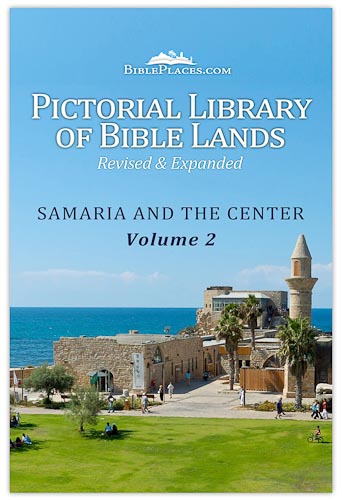
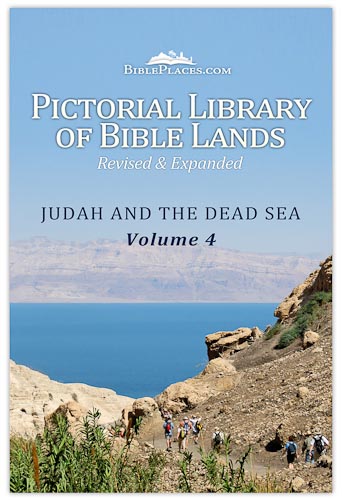
This week we are going to give away two copies of the Israel Collection (volumes 1-5) of the Pictorial Library of Bible Lands. Just as any father likes all of his children, I like all 18 volumes. But since these are not children, I can say without hesitation or fear of repercussion that the first five volumes are my favorite ones.

Israel is not only the center of God’s redemptive plan for the world, but it was my home for a long time. These photos reflect that, not only in terms of comprehensive coverage, but also in quality of photos because of repeated visits in various seasons and at different times of the day.

If you asked a father to describe a few characteristics of his children, he would beam with joy and respond immediately. I’m not going to tell you about my five children, but I will offer a few words about these five volumes.

Galilee and the North – my favorite place in Israel is on the shore of a lake where Jesus walked, talked, and gave us a tiny taste of the kingdom to come.

Samaria and the Center – this volume easily wins the “most improved” award because so many of the sites had restricted access during the years I was making the previous editions (Shiloh, Shechem, Samaria, Jericho, etc.).

Jerusalem – the “city of the Great King” is my favorite city in the whole world. I could teach a whole course on it. But I enjoy even more a quiet stroll along the walls in the early morning.

Judah and the Dead Sea – this really is a 3-in-1 volume, with about 700 photos of the Judean Wilderness and the Dead Sea area, another 300 photos of the Hill Country, and another 500 of the Shephelah and Coastal Plain.

Negev and the Wilderness – I added a lot to sites previously included (Beersheba, Arad, tabernacle model, etc.), but a LandRover and some great friends got me to beautiful places you’ll probably never see. Indeed, the wilderness is “vast and dreadful,” but it also is majestic and inspiring.

This week you can sign up to win one of two free copies. One will be given away to entrants who use the email form. The other will go to those who enter with PunchTab. You can enter either or both. If you don’t win, you can purchase the Israel Collection with all of its 6,000 photographs for $149.99. If you do win and you already own the collection, we’ll refund your purchase or surprise you with something else. The drawing ends this Friday at 10 am Pacific Time.

(We need your email address to notify you if you win. We will not use it for anything else.)

Share:

The Friends of the Israel Antiquities Authority has announced the establishment of the Brandt-Lewis Center for Ancient Jewelry and Artifacts, to be part of the Schottenstein National Campus for the Archaeology of Israel in Jerusalem.

The BBC reports on a dispute over oil pipelines that run under the ruins of Babylon.

The Jerusalem Post reviews the 30th volume of Eretz Israel.

The Freeman Institute has produced a 14-minute film on the Rosetta Stone and how they create full-size replicas.

James Tabor explains why he believes that finding Jesus’ remains in the Talpiot tomb does not contradict Christian belief in Jesus’ resurrection. Michael Heiser writes an excellent response.

Joe Yudin describes the wonders of the Small Machtesh.

Don’t forget about Eisenbrauns 30/30/300 sale. It ends on the 30th.

I’ll be traveling the next couple of weeks, but I have some posts prepared and may have a little time along the way. When I return I’ll have the most important announcement in the history of this blog.

HT: Joseph Lauer, Jack Sasson

Machtesh Qatan panorama, tb042207334

Machtesh Qatan panorama
Share:

News:

Plans are being made for a renovation of the Church of the Nativity in Bethlehem, beginning with a long-delayed replacement of the roof.

Paleobabble gives a summary of Randall Price’s recent presentation on the 2011 search for Noah’s Ark.

The Israeli government is planning to relocate 30,000 Bedouin in the Negev.

The seed of the date palm discovered at Masada has now grown to a 8-foot (2.5 m) tall tree after more than five years. The tree was planted last week at Kibbutz Ketura in the Arabah. Previous updates were posted in 2006 and 2008.

A new study of textiles has determined that the Qumran inhabitants differentiated themselves from their contemporaries by what they wore.

“Moammar Gadhafi’s forces tried to flee Tripoli with a sack of ancient Roman artifacts in hopes of selling them abroad to help fund their doomed fight, Libya’s new leaders said Saturday as they displayed the recovered objects for the first time.”

The Jerusalem Post has added a two-minute video on the dating of the southwestern corner of the
Temple Mount, including sound bites from Ronny Reich and Eli Shukron.

Joseph Naveh passed away this week. His life and publications are remembered by Christopher Rollston.

HT: Biblical Flora, Joseph Lauer, Jack Sasson

Share: