“A nearly completely intact clay oil lamp from 2,300 years ago was found near a stone bath during recent conservation work at the Mount Gerizim National Park.”

Plans to construct a zip line near Haas Promenade south of Jerusalem’s Old City is facing criticism. There are also plans to build a pedestrian suspension bridge over the Hinnom Valley.

Zvi Koenigsberg argues that the discovery of the curse inscription supports his theory that the original “place that He will choose” was a temple on Mount Ebal.

Aren Maeir is interviewed in the History Channel of Israel’s “Whatever Happened to the Philistines?”

Zoom lecture on May 11: “Beer in Israel and the Ancient Near East: New Insights from Archaeology,” by Jennie Ebeling ($7).

Albright Institute hybrid workshop on May 12: “A Comparison of the Monastery at Tel Masos and Byzantine Monasteries in the Negev Desert,” by Rachel Bernstein. Register here.

Hybrid conference at Tel Aviv University on June 13: “Local and Regional Perspectives on Nomads in the Biblical World” (pdf schedule; Zoom link).

The early bird discount for the Infusion Bible Conference ends on June 3.

The latest free maps from Bible Mapper:

HT: Agade, Joseph Lauer, Arne Halbakken, Charles Savelle
Share:

Haaretz has an extended summary of an article by Shimon Gibson about the attraction of stone vessels to Jerusalemites in the Second Temple period.

Archaeologists found a rare bronze fork at Chorazin (Korazim).

“An expedition of scientists and artists, adventurers all, embarked on a four-day desert journey. Their goal: to retrace an ancient trade route that connected the Kingdom of Judah to the Kingdom of Edom” (Haaretz premium).

Joel Kramer is interviewed on Digging for Truth about his book, Where God Came Down: The Archaeological Evidence.

The Biblical Language Center, founded by Randall Buth, is offering live video classes this summer in biblical Hebrew and Koiné Greek.

Zoom lecture on April 27: “Tell es-Sultan, Ancient Jericho: Urban Diversity in Palestine,” by Prof. Lorenzo Nigro. Advance registration required.

Hybrid lecture at the Museum of the Bible on May 26: “Tel Shimron: New Research into a Biblical City,” by Daniel Master.

Now online: “Iconography on Hebrew Seals and Bullae Identifying Biblical Persons and the Apparent Paradox of Egyptian Solar Symbols,” by Benjamin Stanhope.

The Volunteer Guide for the Tel Burna Archaeological Project is now online, and they are still accepting applications.

Morris Proctor explains how to find all the relevant maps for a site using the Atlas feature in Logos Bible Software.

Bryan Windle gives a good survey of the possible locations of where Pilate sentenced Jesus to death and concludes with a very reasonable suggestion.

HT: Agade, Joseph Lauer, Charles Savelle, Arne Halbakken, Paleojudaica

Share:

Renovations at the Church of the Holy Sepulcher have revealed a medieval high altar that once stood in the center of the church.

A Byzantine-era mosaic floor from a Christian basilica in Nahariya has been restored and will be opened to the public. The 500-square meter mosaic includes 87 surviving medallions, with illustrations of flora, fauna, and scenes from everyday life. A video in Hebrew is here. BibleWalks has more photos of the church and the surrounding area.

A family hiking in the Harovit forest in central Israel discovered a beautiful mosaic from the Byzantine period.

The recently vandalized tomb of Joseph in Nablus has been restored.

Two girls were rescued when they accidentally entered a minefield in Nahal Tamar south of the Dead Sea.

Jodi Magness takes Amanda Borschel-Dan on a walking tour of the Church of the Holy Sepulcher.

The Museum of the Bible and DIVE (Digital Interactive Virtual Experiences) will be conducting a virtual tour of the Via Dolorosa on April 20 ($20).

The lead tablet found on Mount Ebal is the subject of discussion in the latest episode of the Biblical World podcast.

“After decades of laying beside the sacred lake at Luxor’s Karnak Temple, a team of Egyptian restorers and archaeologists succeeded in re-erecting the restored Hatshepsut’s obelisk.”

“German researchers have tracked down and documented hundreds of antiquities located in Berlin museums that were looted from the island of Samos, Greece.”

“Scientists have debated the reason why Bronze Age wall paintings at the ancient settlement of Akrotiri on the Greek island of Santorini depict monkeys that existed thousands of miles away in Asia.”

The Jerusalem Post has a short interview with a curator of the Museum of the Bible on the role of biblical archaeology.

Expedition Bible has launched a new YouTube channel. In the first video, Joel Kramer goes to Tell Deir Alla to discuss the Balaam inscription.

Roy Albag has created a number of reconstructions of sites in Israel, including the Church of the Holy Sepulcher, the Herodian Quarter’s palatial mansion, Solomon’s temple, and Herod’s palace in Jerusalem.

New release: Jerusalem and the Coastal Plain in the Iron Age and Persian Periods: New Studies on Jerusalem’s Relations with the Southern Coastal Plain of Israel/Palestine (c. 1200–300 BCE). Research on Israel and Aram in Biblical Times IV. Edited by Felix Hagemeyer (Mohr Siebeck, 119 €).

A number of Eilat Mazar’s publications are for sale, including her excavation reports of various sites in Jerusalem.

HT: Agade, Joseph Lauer, Arne Halbakken, A.D. Riddle, Alexander Schick

Share:

Erez Ben-Yosef’s re-evaluation of the copper mines at Timna has significant consequences for the archaeological evidence for David and Solomon’s era, and David Spoede provides a useful introduction to his discoveries.

Ruth Schuster writes about the history of the date palm tree in the land of Israel.

Bible Archaeology Report: “This month’s news items include three finds related to names that were considered divine in the ancient world: Baal, Horus, and YHWH.”

Ferrell Jenkins shares a recent photo of Mount Hermon after a snowfall.

New release from Eisenbrauns: Megiddo VI: The 2010–2014 Seasons. 1,924 pages, 867 illustrations, $210 (with discount code NR22).

Jerusalem University College is offering three courses in its Online Summer Institute:

  • Egypt and the Old Testament, with Mark Janzen
  • Geographical Lenses on Ezekiel, with Elaine and Perry Phillips
  • The Jewish Context of Jesus and the New Testament, with Oliver Hersey and Joel Willitts

Logos has the Lexham Geographic Commentary digital set on sale for 55% off (2 volumes released; 4 forthcoming).

A tiny Hebrew curse inscription on a folded lead tablet was discovered in 2019 during the wet-sifting of material in the excavation dump on Mount Ebal. The text is written in paleo-Hebrew script, allegedly dating to the 12th century BC or earlier. The hour-long press conference can be watched here. Earlier reports of this discovery are noted here. A journal article is being written and will be published later this year. I will be curious to see how they argue that this was not a Hellenistic-era amulet written in old script; its discovery alongside Late Bronze and Iron Age pottery in a dump is not conclusive, especially at a site likely frequented by pilgrims. I continue to believe that the most sensational announcements require the most rigorous scrutiny, and the public is not well-served by claims not supported by scholarly publication.

HT: Agade, Joseph Lauer, Arne Halbakken, G. M. Grena, Explorator

Share:

Construction work in the Gaza Strip has uncovered a Roman cemetery. There have been reports of looting.

Ongoing work at a quarry near Bethlehem has destroyed about 100 meters of a 1st-century aqueduct that brought water to Solomon’s Pools. There are calls on the government to stop the destruction.

Haaretz (premium) runs a short story about the Gal On Citadel, a Canaanite fortress in the Shephelah between Gath and Lachish. But, as Moshe Gilad writes, “it is advisable not to have too high expectations.”

Schoolchildren hiking in Nahal Besor discovered a coin with the head of Roman Emperor Valentinian I.

The latest episode of This Week in the Ancient Near East podcast questions whether there were really two synagogues in Magdala.

Peter Feinman surveys what prominent Egyptologists in the last century have thought about Israel’s exodus from Egypt.

Pharaoh Hophra ruled Egypt when Jerusalem fell to the Babylonians, and he is the subject of the latest archaeological biography on the Bible Archaeology Report.

A series of videos featuring Alexander Schick discussing the history of the Bible, Tischendorf, and the Dead Sea Scrolls is being released this month as the “focus series” by the Historical Faith Society (membership required).

On The Book and the Spade, John DeLancey discusses what’s new for tourists in Israel after returning from his first tour following Covid shutdowns.

HT: Agade, Joseph Lauer, Arne Halbakken, Explorator

Share:

A new study suggests that the mining operations in the Timna Valley and Faynan thrived in the 10th century because of good management. The underlying journal article is here.

Moshe Gilad wonders whether the Bible can be used as an archaeological travel guide to Israel, and his article in Haaretz is based on the responses of Israel Finkelstein, Aren Maeir, and Yoram Bilu.

Saul Jay Singer writes about the life of Yigael Yadin and his father Eliezer Sukenik.

A couple of scholars are suggesting that Mary Magdalene was not from Magdala. (Now seems to be the perfect time for such a proposal, with all the great finds coming out of 1st-century Magdala…) The underlying journal article is here.

Questions have been raised about artifacts in the Israel Museum that were donated by Michael Steinhardt.

John DeLancey and Kyle Keimer complete their four-part tour of the archaeological wing of the Israel Museum.

The Museum of the Bible and Digital Interactive Virtual Experiences are offering virtual tours of Caesarea on January 20 and Qumran on January 27.

The materials in the Israel Film Archive are now online for public viewing. The Times of Israel identifies some highlights.

Andrew Lawler is on The Times of Israel podcast talking about his recent book, Under Jerusalem. (I enjoyed the book, and I hope to say more later.)

The Jerusalem Post reviews Adventure Girl: Dabi Digs in Israel, an illustrated book for children.

Israel’s Good Name reports on his trek around Horvat Hanut and Salvatio Abbey.

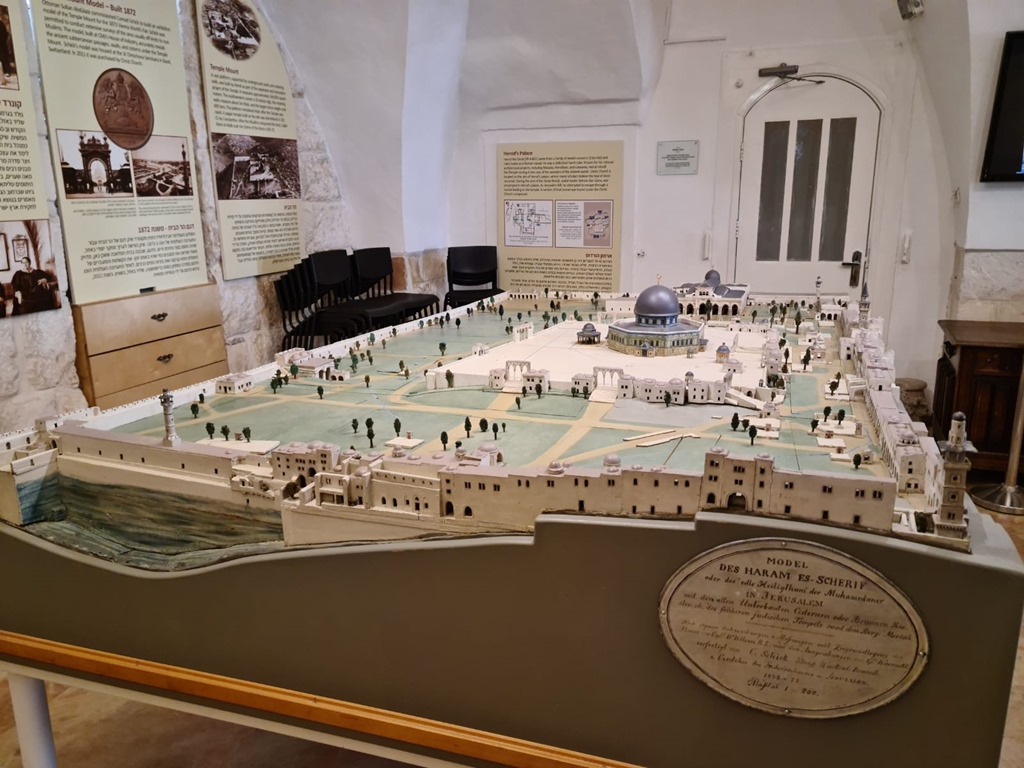
The 200th anniversary of the birth of Conrad Schick is on January 27, and Christ Church in Jerusalem will be having a special event to celebrate on the 28th (10:00-13:00). Their museum includes some of Schick’s models, including the one pictured below.

HT: Agade, Joseph Lauer, Arne Halbakken, Wayne Stiles, Alexander Schick

2

Model of Conrad Schick on display at Christ Church, Jerusalem. Photo by Michael Schneider.

Share: