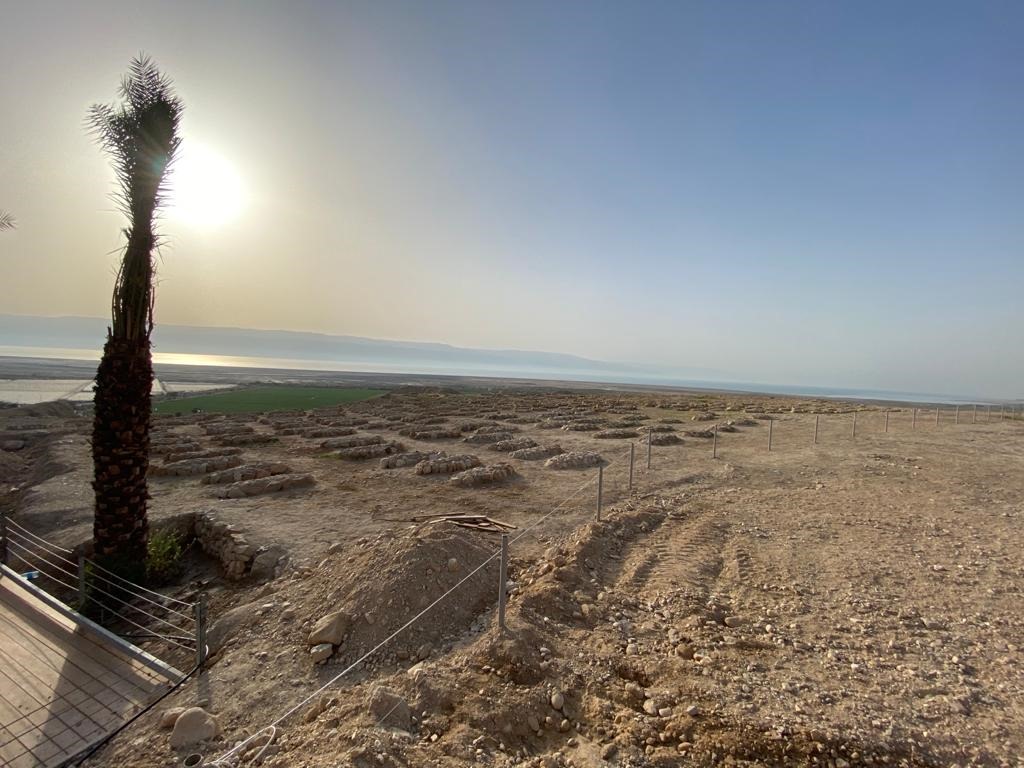
The enclosure wall around the Mount Ebal altar has been restored. And Israel’s defense minister is not allowing a visit by the Foreign Affairs and Defense Committee.

Two stone sarcophagi from the 2nd or 3rd centuries AD were discovered at the Ramat Gan Safari Park.

I share a bit about my work with photo collections, both past and future, in the latest Scholar’s Chair interview at Bible Archaeology Report.

Chris McKinny talks about learning historical geography and archaeology in Israel on a new video produced by John DeLancey.

Erez Ben Yosef is interviewed by the Jerusalem Post about his years of excavating at Timna.

Zoom lecture tomorrow: “Archaeology and the Hidden Religious Culture of Israelite Women,” by Carol Meyers.

The NY Times has posted an obituary for Norman Golb, the unorthodox Dead Sea Scrolls scholar who died last month.

Assyrians used the policy of deportation in the Levant not to bolster its labor supply but in order to intimidate the population and put down revolts.

The Hazor team is accepting applications for its 31st season of excavations at this important Canaanite and Israelite site.

The Times of Israel reports on the 2018 re-discovery in Cairo of a Hebrew Bible written in the year 1028.

Snow fell in Jerusalem this week for the first time in six years, and some photos are posted by The Jerusalem Post, Al Jazeera, Haaretz, and The Times of Israel. Shmuel Browns took some beautiful photos of the snow in the Judean hills. Daily Sabah has photos from around the Middle East.

HT: Agade, Ted Weis, Arne Halbakken, Keith Keyser, Explorator

Share:

A worker clearing a nature path at Nitzana (Nessana) in the Negev discovered a stone with a Greek inscription reading “Blessed Maria.”

A forthcoming article by David Ussishkin argues that there was no gate shrine at Lachish desecrated in the reign of Hezekiah.

Bill Barrick’s latest research trip post focuses on Tel Dan and includes a variety of images and a list of recommended resources.

The Crusader-era siege ramp around Ashkelon served another purpose: protecting the city from being overtaken by sand.

After an extended investigation, the Israel Antiquities Authority recovered thousands of looted artifacts in three raids in central Israel.

Evie Gassner looks at a lot of evidence in order to determine just how Jewish King Herod was.

Bruce Routledge will be lecturing on Jan 11, 11am CET, on “Iron Age Jordan: The Levant from a very different angle.” To register and receive a Zoom link, email [email protected].

Conversations in the Archaeology and History of Ancient Israel with Israel Finkelstein. This video series with a controversial archaeologist will be rolling out over the coming year. The initial videos (20-30 min. each) are available now.

Claus-Hunno Hunzinger died this week. He was the last living member of the original Dead Sea Scrolls team.

An obituary has been posted for Shlomo Bunimovitz who died last month.

Peter Goeman gives a good roundup of articles in the blogosphere in the latest biblical studies carnival.

HT: Agade, Andy Cook

Share:

“A first ever First Temple-era gold granule bead was discovered during wet sifting of earth from the Temple Mount by a nine-year-old.”

Jamie Fraser and Caroline Cartwright give a very interesting account of the discovery and excavation of an olive oil factory in Gilead.

Israel’s Good Name shares his adventures at various sites in the western Jezreel Valley.

Leen Ritmeyer uses archaeological and textual sources to locate the Music Chamber in Herod’s temple.

Though most don’t believe that it is Mount Sinai, Har Karkom is home to 40,000 rock engravings.

According to Jeffrey Chadwick, the width of a gate at Gath is the same dimensions as the height of giant Goliath.

The release of Ken Dark’s new book has put in the news again the author’s theory that he has identified the house believed by the Byzantines to have been the house of Jesus.

“Visiting Sepphoris” is the latest video tour hosted by John DeLancey.

COVID restrictions have helped researchers excavating an underwater site off Israel to develop methods that will make future undersea excavation more precise and efficient.

A doctoral dissertation proposes that a silver shortage in Israel in the early Iron Age led to the creation of an alloy composed mainly of copper.

The next ASOR Zoom webinar: Eric Meyers, “Early Synagogues, Jesus, and Galilee—A Jewish Perspective,” on Dec 13, 7:30 EST.

Yesterday we released the Photo Companion to 1-2 Corinthians. These two volumes include 2,500 images.

HT: Agade, Joseph Lauer, Keith Keyser, Ted Weis, Ferrell Jenkins, Alexander Schick, Arne Halbakken

Share:

The Tel Burna team has begun a survey of Khirbet ʿAter, a likely candidate for biblical Ether.

Bruno Soltic created a video on “Tel Burna – Week on a Dig,” featuring interviews with Itzick Shai, Steven Ortiz, Chris McKinny, and others.

Registration has now opened for next summer’s excavations at Tel Burna and Gath.

Sepphoris was an important city near Nazareth, and Wayne Stiles looks at its possible place in Jesus’s youth.

Bill Barrick posts about his visit to Sepphoris on a recent research trip, and he includes many photos.

Archaeology magazine has a feature on the dye industry at Tel Shikmona near Haifa.

Israel21c has identified “Israel’s best ancient toilets.”

Three individuals were arrested on suspicion of stealing antiquities from ancient Megiddo.

“In the hills of Timna in the Arava Desert, just north of Eilat, lies a secret lake that has become a magnet for some adventurous Israelis unable to travel abroad due to the coronavirus pandemic.”

Hebrew University has just released the first three volumes in the Tel Rehov final report series (scroll to the bottom).

Shalom Paul died earlier this week.

Israel’s Good Name made a number of outings this year to the Yavne dunes, finding it an ideal place for spotting birds, snakes, and other wildlife.

I am excited about this book forthcoming from Barry Beitzel: Where Was the Biblical Red Sea? Examining the Ancient Evidence. Beitzel defends the traditional location and shows why the Gulf of Aqaba hypothesis is impossible.

The Infusion Bible Conference (formerly the Institute of Biblical Context Conference) has just announced that the 2021 conference will be held in Franklin, Tennessee. This year’s topic is “Paul and His Roman World.”

HT: Agade, Joseph Lauer, G. M. Grena, Charles Savelle, Explorator

Share:

Archaeologists have discovered a fortified building in the Golan Heights that dates roughly to the time of David and may have belonged to the kingdom of Geshur.

A cache of gold coins dating to the early Islamic period have been unearthed near the Western Wall plaza in Jerusalem.

Expansion of Beit El threatens to destroy remains of an ancient village.

Excavations at Caesarea Philippi (Banias) revealed a 2nd or 3rd century AD altar with a Greek inscription written by a pilgrim to the god Pan.

Bryan Windle has found a number of photos to illustrate the brief reign of King Jehoiachin, in his most recent archaeological biography.

A new film (in Hebrew) claims that the united kingdom was based in Israel, not Judah, and began in the 8th century, not 10th, based on Israel Finkelstein’s excavations of Kiriath Jearim.

Wayne Stiles looks to Ziklag for the secret of David’s spiritual success.

John Delancey’s latest video visits the City of David.

New from Eisenbrauns:

HT: Agade, Joseph Lauer, Ted Weis

Share:

Excavations at Khirbet Kafr Mer near Beit El have revealed dozens of jars and intact ceramic objects inside a repurposed underground reservoir.

“A new paper published last week in the PLOS ONE journal explains how trash mounds found in villages and agricultural settlements in the Negev from the Byzantine and Early Islamic periods show that there was a turning point in the management of herbivore livestock dung, a vital resource in the Negev.”

Egyptian artifacts in several Berlin museums have been damaged by vandals.

Pat McCarthy has written an article about reputed relics of Jesus that have undergone scientific scrutiny.

New: Go Now to Shiloh: A Biblical Theology of Sacred Space, by N. Blake Hearson

Albright Virtual Workshop: Discussions in response to:
The Archaeology of the Bronze Age Levant:
From Urban Origins to the Demise of City-States, 3700-1000 BCE,
Cambridge University Press, 2019, by Raphael Greenberg. Registration required.

The Badè Museum is hosting a series of lectures entitled “New Perspectives on Ancient Nubia.”

The Cyprus American Archaeological Research Institute has posted their online program for the coming months.

UCF has compiled a list of open educational resources for the ancient Near East.

This week on the GTI Tours podcast I talk with Rich Ferreira about the value of photographs in understanding and teaching the Bible.

HT: Agade, Ted Weis, G. M. Grena, Charles Savelle

Share: