The Islamic State beheaded the retired chief archaeologist of Palmyra. The Oriental Institute condemns this “brutal and senseless act.” Ian Tuttle suggests that he be added to the ranks of martyrs.

Does Syria’s Director-General of Antiquities and Museums have the saddest job in the world?

Recently his job has been to hide antiquities from ISIS.

The forthcoming Museum of the Bible in Washington DC has made a multi-year deal with the Israeli
Antiquities Authorities to display numerous artifacts.

Opening October 12: The New York Metropolitan Museum of Art will have an exhibition entitled,

Ancient Egypt Transformed: The Middle Kingdom,” featuring a range of artifacts from monumental stones to fine jewelry.

Greece’s financial woes have halted work on the great tomb which last year generated huge publicity.

The J. Paul Getty Museum in Los Angeles is hosting an exhibit on bronze sculptures in the Hellenistic era. The link includes some fantastic pictures.

Here’s more on the claim that the tomb of Egyptian queen Nefertiti may have been found. And a 15-minute video that explains the technology behind the claim.

The former director of the Walters Art Museum tries to make the case for buying antiquities in order to save them (WSJ; subscription required).

Ancient inscriptions in the Cave of the Elijah the Prophet are in danger.

The Lost Sheep is a new video short from Source Flix that will serve as a great intro or illustration in teaching.

Can you guess the location of these photos from the ASOR Archives? (We scored a 10.)

Rose Eveleth: Is Archaeology Better Off without Religion?

If you’ve been looking for an original, but affordable, copy of Edward Robinson’s Biblical Researches in Palestine, there’s one available now from a bookseller in California ($69 for three volumes). It looks like the Logos version is quite close to production, needing only a few more bids.

HT: Jared Clark, Charles Savelle, Agade, Joseph Lauer, and especially Ted Weis

Share:

The largest treasure of gold coins ever found in Israel was recently discovered in the harbor of Caesarea. Most of the coins date to the Fatimid period (ca. AD 1000). There’s a close-up of a well-preserved coin here. Seven high-res images are available here.

The Jerusalem Post has photos and a video of the recent snowfall in Israel. Record snowfall was recorded in Istanbul, and the snow was heavy in Lebanon and Jordan. Yahoo has more photos of Jerusalem here. And Shmuel Browns has some photos from his neighborhood in the German Colony.
Leen Ritmeyer suggests that some paving stones on the Temple Mount pre-date the Roman destruction.

The next stop for the Passages exhibit is the happy town of Santa Clarita, California.

Some of the Dead Sea Scrolls are coming to the California Science Center next month, along with the Jerusalem IMAX movie.

Ever wanted to volunteer in Israel? Wayne Stiles suggests 15 volunteering opportunities.

James Pritchard’s HarperCollins Atlas of Bible History is not the best atlas out there, but it’s currently only $3.99 for Kindle. As one reviewer notes, the text may be more useful on the screen than the maps.

This week on the Book and the Spade: Herod’s palaces and ancient olive oil, with Clyde Billington.

Ferrell Jenkins explains how Pilate used coins to promote the emperor cult.

Codex Vaticanus is now online.

Aren Maeir’s recent lecture at GVSU is now posted on Youtube.

Eric Cline will be lecturing at the Oriental Institute in Chicago next week.

Gabriel Barkay, Zachi Dvira, and others involved in the Temple Mount Sifting Operation are coming on a fundraising tour in April and May. Check out their blog to learn how you can arrange talks or dinners with them.

The Islamic State is reportedly looting ancient sites “on an industrial scale.” Some people are trying to stop it.

HT: Ted Weis, Joseph Lauer, Charles Savelle, Jock Stender

Gold coins discovered in Caesarea harbor
Photo copyright: Clara Amit, courtesy of the Israel Antiquities Authority
Share:

From the Associated Press:

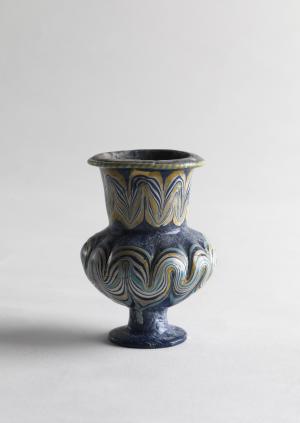
Two New York philanthropists are donating a major collection of more than 300 ancient Greco-Roman and Near-Eastern glass vessels to The Israel Museum in Jerusalem.

The gift from Robert and Renee Belfer was announced by the museum Wednesday. It comes as the institution celebrates its 50th anniversary this year. An exhibition titled “A Roman Villa — The
Belfer Collection” showcasing approximately 100 of the objects will be on view at The Israel Museum from June 5 through Nov. 21.

The collection is “one of the most important private holdings of antiquities anywhere,” museum Director James Snyder said in a telephone interview from Jerusalem.

He called it a “transformative gift” of “pristine” and “superlative” examples that will strengthen and enhance the museum’s current collection of Greco-Roman artifacts.

“For us it’s like the exquisite icing on the cake,” he said.

They include cast vessels and blown and mosaic glass pieces, ranging from the 14th century B.C., the Late Bronze Age, through the 14th century, the Islamic period.

The collection also includes about 50 important works of Greco-Roman sculpture and relief work, including bronze and marble sculptures, mosaics, frescoes and pottery.

The full story is here.

In this Feb. 12, 2015 photo provided by the Israel …
Egyptian 18th Dynasty glass jar
AP Photo/Israel Museum, Elie Posner
Share:

The Big Picture has 13 great photos of the declining level of the Dead Sea.

Why visit the Bible Lands Museum Jerusalem? Bible History Daily points out 10 great biblical artifacts.

That same museum is hosting a new exhibit “By the Rivers of Babylon” that is profiled in Haaretz.

The Tower of David Museum in Jerusalem is using iPads and phones to improve the visitor’s experience (NYTimes).

The Melbourne Museum has produced a recreation of the eruption of Mount Vesuvius that destroyed Pompeii.

Illegal excavations in Alexandria have revealed a Graeco-Roman necropolis.

An update on the Nineveh destruction from Agade: “Reliable reports from the Mosul that for good reason cannot be attributed are that the fortifications of Nineveh have not been damaged in any way.

Unfortunately, Nabi Younis, however, is now completely destroyed.”

HT: Agade

Share:

Archaeologists working at Bethsaida have discovered a possible escape tunnel from the time of the Israelite monarchy.

Leen Ritmeyer explains the recent construction work on the Temple Mount and its potential significance for archaeology.

“The Egyptian Antiquities Ministry recently announced the excavation of a 3,000-year-old fortress at the site of Tell el-Habua (also known as Tel Habuwa and Tell Huba) near the Suez Canal in Egypt.”

Egypt’s Prime Minister recently visited the Grand Egyptian Museum to check on its progress for a slated August 2015 opening.

The works of the famous glass maker Ennion are now on display at the Met.

The Museum of Biblical Art in Dallas is hosting a temporary exhibition of old maps of the Holy Land. Wayne Stiles shows a few photos from his visit and explains the value of using maps in your
Bible study.

Monday lecture at the British Museum: Rupert Chapman, Ahab’s Ivory House: When Was It Destroyed?

Plans are underway to allow visitors inside the Erechtheion of the Acropolis.

The most visited museum in 2014 was the Louvre, with 9.3 million visitors.

HT: Explorator, Agade

Ennion's blue glass jug, 1st c AD, tb031114560
Blue glass jug made by Ennion, first century AD
From the Eretz Israel Museum
Share:

The Bible Lands Museum Jerusalem is hosting a special exhibition entitled By the Rivers of Babylon beginning next month. An international conference on Jerusalem in Babylonia will be held on February 2-3.

Now online: the Fall 2014 issue of DigSight, published by Southern Adventist University’s Institute of Archaeology.

See the Holy Land has published new articles on Kathisma and the Church of St Alexander Nevsky (the Russian excavations), and an updated article on Magdala.

Free video lecture online: Doctors, Diseases and Deities: Epidemic Crises and Medicine in Ancient Rome, by Sarah Yeomans of the Biblical Archaeology Society.

Matthew Karsten hiked portions of the Israel National Trail and has some spectacular photos to show for it.

Aren Maeir will be giving a lecture on the latest work at Gath at the Albright Institute on January 15.

Registration for MEMRA’s ancient language courses ends soon.

G. M. Grena shares some personal thoughts and more from his time at the ASOR 2014 conference.

The British Museum explains why it was so pleased to be involved in the latest Night at the Museum movie.

The new Exodus movie is “an unimaginative, mind-numbing bore,” according to Michael Heiser.

Egypt has banned the movie “Exodus: Gods and Kings” for being historically inaccurate.

ISIS is threatening to blow up the walls of ancient Nineveh.

Vassilios Tzaferis has died in Athens. Among Tzaferis’s excavations was the tomb of the crucified
man.

HT: Agade, Exploring Bible Lands

Share: