This summer I was out scouting around trying to locate some sites on the Coastal Plain, including Ono, Eltekeh, and Bene-berak.  Bene-berak is mentioned in Josh 19:45; 21:45; 1 Chr 9:14; Neh 11:15.  The most likely location is el-Kheriyah, located about 3 miles south of the modern Israeli city of Bene-berak.  I wasn’t quite sure if I had found the right spot or not.  It wasn’t for lack of remains that I lacked certainty, but for an overabundance.  Today it was announced that the government is going to transform the Hiriya landfill into the “Ariel Sharon Park.”  While I’m not sure if I’d feel honored if a trash dump was named aft er me, I am hopeful that the $250 million project will make the ancient Israelite site accessible to tourists.

The Hiriya Landfill, located between Ramat Gan and Tel Aviv is a mountain of garbage that was used from 1952 until 1998. The government is now planning on transforming the site and the area around it into one of the largest parks in the country.The Hiriya site stretches out along 112 acres and the garbage mountain itself is elevated around 200 feet.
“The restoration project will transform Hiriya from a waste landfill into a flourishing, green park which will attract thousands of visitors each year, providing leisure and recreational opportunities as well as pleasant walks along its paths,” organizers say.
“Today is the opening shot in the building of this incredible park,” said Danny Shternberg of the Ayalon Park Government Company. “We are proud to name it for former Prime Minister Ariel Sharon, who was an enthusiastic backer of the idea, advancing the park himself.” Shternberg declined to comment on the unorthodox nature of deciding to name a park after someone who is still living.
The park will contain within it sheltered areas (such as the Menachem Begin Park), open areas, forested regions, agricultural tracts and man-made lakes and streams.
Archeological sites will also be refurbished and put on display. The ancient city of B’nei Brak, spoken of in the Passover Haggadah, lay at the site and an Arab village named Hiriya was built atop its ruins until its residents fled in 1948. Emergency plans when Israel feared an Arab victory in the 1967 Six Day War called for mass graves to be dug in the area for the expected Jewish casualties.

For more, see the Arutz-7 report.
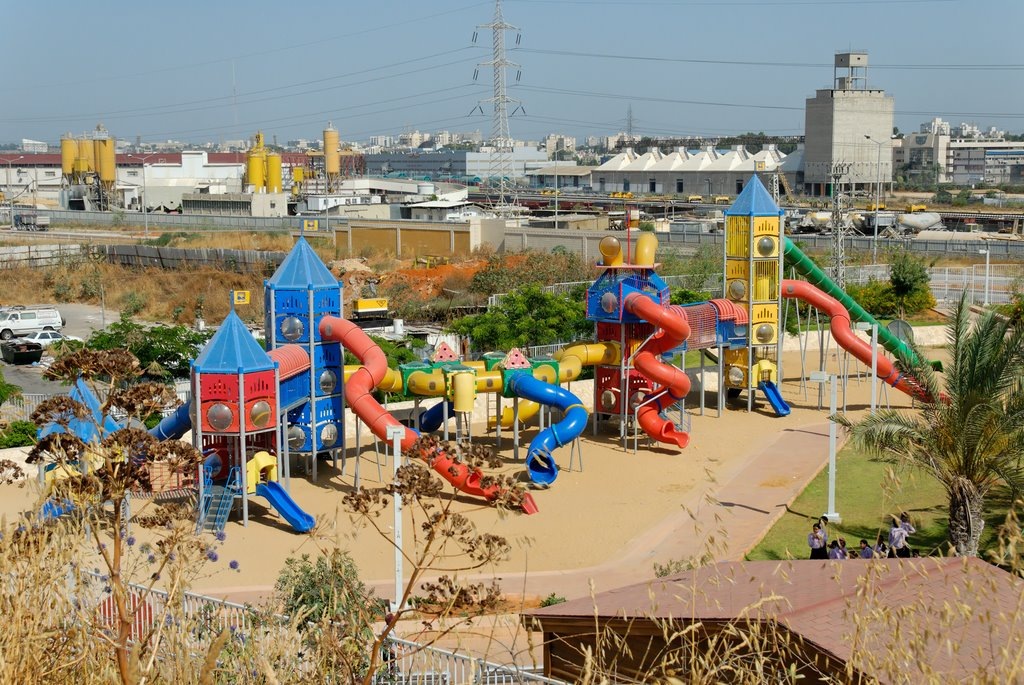
Playground in Bene Berak, tb062807402sr
Playground in modern Bene-Berak.  It’s pretty nice for a neighborhood park.  It doesn’t have any relation to the landfill, but it is certainly more picturesque than the subject of the story.  Apologies if it makes your kids jealous.
Share:

I read this story yesterday in the Washington Times and ignored it, because I thought it was in error. 

I’ve since seen it mentioned in blogs online as if the story was credible.  Jay Bushinsky of the Washington Times begins his report:

An ancient inscription memorializing Jerusalem’s salvation from Assyrian invaders 2,700 years ago is to be returned to the Holy Land from Turkey for study and public display.  Israel has been trying for about 20 years to recover the artifact, which marks one of the most important turning points in Hebrew history.

I think this story is bogus for the following reasons:

1. No one else is reporting this.  I hardly think that the Washington Times knows something that no one else does.  You can check online news sources easily by searching for “Siloam Inscription” at Google News (here is that link).

2. A story like this would be broken by the Israel Museum or a major government agency, and not only are they not mentioning it, the WT story does not cite them.  The story is long, but the length is deceptive as only the first sentence mentions the return.

3. About a month ago, various news outlets reported some discussion of the matter.  The essence of the story was that a Turkish official agreed to consider some sort of loan.  In the Middle East, such “consideration” is a far cry from a decision.  And a decision is very different than action.  In other words, this isn’t “news” until the inscription is sitting in Jerusalem.

What I think happened is that this reporter read some of those stories too quickly and wrote an article based on a misunderstanding.

By the way, if you want to take a picture of the inscription, don’t wait until it comes to Jerusalem. 

The Israeli authorities won’t allow it, I’m certain.  You’ll do better to go visit it in Istanbul, where you can take pictures.  Which is far better anyway, because there are so many great artifacts on display that won’t be coming to Jerusalem on loan.  There would be a certain irony as well if the Siloam Inscription came to Jerusalem the next couple of years, as hundreds of the best archaeological finds in Israel are locked up out of sight of visitors.

Share:

Several months ago a new museum opened at the foot of Masada. I won’t repeat the details about the museum that you can read in the Haaretz, JPost, and goisrael articles, but I’ll just add a personal comment from my recent visit: I found the displays to be beautifully presented, mentally stimulating, and historically accurate. Entrance requires a handheld audio guide, which costs about 20 NIS ($5), and no photos are allowed. The audio guide is more of a gimmick, as the text of the audio (and much more) is written on the displays. Overall, I recommend a visit to the museum, especially to those who are making a second visit to the site.
UPDATE (8/10): The Jerusalem Post has just posted a lengthy article about the museum.

Share: