For only the 4th time, a Bar Kochba coin has been found in Jerusalem, possibly brought there by a Roman soldier. This article has nice photos, and this article has a short video.

The Jerusalem Post surveys how archaeology in Israel has been affected by governmental actions in response to COVID-19.

El-Araj, a good candidate for Bethsaida, has been flooded by this winter’s rains and the rise of the Sea of Galilee.

Critics are claiming that construction by the Palestinian Authority is destroying remains at Tel Aroma, the northernmost Hasmonean fortress in Samaria.

“Exploratory drilling has started just outside the Old City for a project to extend the Tel Aviv-Jerusalem fast rail to the Old City’s Dung Gate — the main entrance to the Western Wall.”

The Greek Orthodox Church of Jerusalem has filed a lawsuit demanding closure of Ein Yael outdoor museum.

Four fragments of Dead Sea Scroll fragments that were thought to be blank are not.

A new excavation at Petra will focus on the lower part of the Treasury as well as nearby tombs and facades.

A new burial chamber has been discovered at the mummification workshop complex of the 26th Dynasty at Saqqara.”

“A stone chest excavated by archaeologists near Deir el-Bahari and the temple of Hatshepsut could lead archaeologists . . . to a royal tomb.”

Egypt’s decision to move ancient objects from their original setting in Luxor to Cairo’s Tahrir Square is stirring controversy.

“The excavation team working on the site of the ancient city of Patara, near the Mediterranean resort city of Antalya, has unearthed a new inscription in the ancient theater.”

“A small sinkhole that appeared next to the Pantheon in Rome has enabled archaeologists to examine the original Roman paving that was laid when the Pantheon was built by Marcus Agrippa around 27-25 BC.”

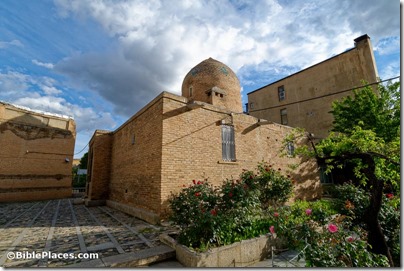
The traditional tomb of Esther and Mordechai in Hamadan, Iran, was set afire yesterday.

David Moster has created a new video on “Biblical Pandemics.”

The Temple Mount Sifting Project Symposium on May 24 features eight lectures via Zoom on the archaeology of Jerusalem and the Temple Mount. Registration is required.

Francis I. Andersen died recently. His breadth of publications is remarkable.

Thomas O. Lambdin died on May 8.

HT: Agade, Ted Weis, Joseph Lauer, Explorator, BibleX

Ecbatana tomb of Esther and Mordecai, tb0510183126

Traditional tomb of Esther and Mordecai in Hamadan (biblical Ecbatana) before attack

Share:

Israel is moving forward on plans to extend the high-speed train line to a station near the Western Wall in the Old City of Jerusalem.

Restoration work has begun on the floor of the Church of the Holy Sepulcher.

Two ritual baths south of Jerusalem are overflowing with water following the winter rains.

$1.3 million has been given to support marine archaeological research off Israel’s coast.

Volunteer applications are being accepted for excavations at Tell Keisan this coming September.

A BBC documentary describes the discovery of a hoard of silver decadrachm coins in Gaza, and what happened to them next.

Egypt has sentenced the brother of an ex-minister to 30 years in jail for smuggling antiquities.

Iran’s Basij Resistance Force is apparently threatening to destroy the historic tomb site of Esther and Mordecai, located in Hamedan.

Wayne Stiles was at Colossae last week and he reflects on the significance of the site and Paul’s letter to the church.

An archaeology park featuring a Roman theater is being developed in Ankara.

Debate continues over whether a skull unearthed 120 years ago near Pompeii belonged to Pliny the Elder.

Italian archaeologists have found underneath the Roman Forum an ancient shrine and sarcophagus that was likely dedicated to Romulus.

A conference on “Sheshonq (Shishak) in Palestine” will be held in Vienna on March 6-7.

Ferrell Jenkins answers questions about the six water jugs at the wedding of Cana.

Herod Antipas, ruler of Galilee during Jesus’s ministry, is the subject of the latest archaeological biography by Bryan Windle.

To listen to the latest episodes on The Book and the Spade, see this page.

HT: Agade, Ted Weis, Keith Keyser, Explorator

Gezer Solomonic gate from northeast, mjb1902200736

This week on our Facebook/Twitter/Instagram streams we featured sites related to Israel’s kings, including this one of the gate at Gezer that was built by King Solomon’s administration.

Share:

Aaron’s tomb in Jordan will re-open to Israeli tourists after the site was closed following a group that allegedly prayed there.

A researcher claims that the world’s oldest chess piece was discovered in Jordan.

Sara Toth Stub explains what happened to Petra after it was abandoned by the Nabateans.

It’s not clear where Egyptians came up with five million African sacred ibises, but a DNA study shows that they were not raised in breeding farms.

Archaeologists have discovered five lion mummies in excavations in Saqqara.

3-D scans of the bust of Nefertiti are now available online.

The Ilisu dam will soon flood Hasankeyf, one of the oldest known and continuously inhabited settlements in the world.

The Central Baths at Pompeii have now been opened to tourists.

A reconstruction of the god Moloch is part of an exhibit on Carthage in Rome.

Cyrus, king of Persia, is the latest subject in Bryan Windle’s series of bioarchaeographies.

Save the date: the annual conference of the Institute of Biblical Context, now redubbed the Infusion Bible Conference, will be held on June 8 to 10, 2020 in west Michigan. The topic is “Paul and His Roman World.”

Gift subscriptions are now available for Walking the Bible Lands.

HT: Agade, Joseph Lauer, Explorator, Keith Keyser

Share:

“The rare ancient tomb of a wealthy Minoan woman has been discovered at a monumental archaeological complex on the Greek island of Crete.”

“Archaeologists have revealed the face of an Egyptian princess who lived almost 4,000 years ago by painstakingly piecing together the wooden shards of her sarcophagus.”

A study of legal texts from Susa reveals how elderly parents ensured that their children took care of them.

“A replica Phoenician vessel made in Syria is sailing the Atlantic to prove the ancient civilisation did it 2,000 years before Columbus.”

The Biblical Archaeology Society has announced their 2019 Publication Awards Winners.

A review of a new work from Oxford: Peter Mitchell, The Donkey in Human History: An Archaeological Perspective.

“Persepolis, Then & Now” is the title of a conference at NYU on November 21.

The latest issue of Biblical Archaeology Review includes articles on the Assyrian relief at Sela, the search for portraits of Herod, and hiking in Paul’s footsteps.

Bible Land Passages has just released a new video, “Go Now to Shiloh.” Here’s what you’ll see:

This full-length documentary complete with on-site interviews, a behind the scenes look at the process of archaeology, analysis of the newest and most exciting discoveries to date, reenactments, computer generated graphics and illustrations, and numerous biblical connections and faith building lessons.

Appian Media has launched its ‘inRoads’ podcast, and they have made it available via Apple Podcasts, Google Podcasts, Spotify, Stitcher, as well as video versions on Facebook and YouTube. If you sign up to be a supporter this month, you get a beautiful free coffee mug.

The Biblical Archaeology Society is having an inventory clearance sale on Carta and IES books, with the best prices on some items I’ve seen. Some examples, all of which I recommend:

  • Leen Ritmeyer, The Quest ($30)
  • Carta’s Illustrated Josephus ($30)
  • The Carta Bible Atlas ($25)
  • Jerusalem: Biblical Archaeology Map ($9)
  • New Encyclopedia of Archaeological Excavations in the Holy Land, 4 vols. ($100)

There’s still time to catch the second of the two-day Oriental Institute Indiana Jones Film Festival.

Carl Rasmussen has begun a series on hippodromes/circuses, with part 1 and part 2 of what happened there, featuring some beautiful photos of a splendid ancient mosaic in France.

Ferrell’s Favorite Foto this week is of the Siq and Treasury at Petra.

What do we know about Pontius Pilate from archaeology? Bryan Windle pulls it all together in the latest entry in his Archaeological Biography series.

HT: Agade, Keith Keyser

Share:

Tourism:
National Geographic has a beautifully illustrated article on the history of Jerash (ancient Gerasa).

Saudi Arabia is now giving visas to foreign tourists.

A $6 million, 9-year project has made much of Jerusalem’s Old City accessible to wheelchairs. And now you can rent a golf cart at Jaffa Gate (for $100/hour).

The entry fee for Rome’s Colosseum is jumping to €16.

Ferrell Jenkins shares a number of photos from his visit to the Brook Besor.

The first photograph of the Acropolis of Athens was taken in 1842.

I enjoyed talking about my visit to Susa on The Book and the Spade. Part 2 is now posted.


Lectures:
Peter Machinist will be lecturing on “Assyria and the Hebrew Bible: A Reassessment” at NYU on Nov 14. Registration required.

Felix Höflmayer, Katharina Streit, & Lyndelle Webster will be lecturing at the Albright Institute on Oct 31 at 4:00. Their topic:  The Austrian-Israeli Expedition to Lachish After Three Years of Excavation.


Videos:
New series on YouTube: “The Holy Land: Connecting the Land with Its Stories is a nine-episode series hosted by Dr. John (Jack) Beck that takes you to regions throughout Israel to experience the land, the culture, and the customs that surround the sacred stories of the Bible.” The first two episodes have been released, and you can see a 2-minute special feature about Jerusalem here.

The latest video from Biblical Israel Ministries and Tours: “It Happened Here” – Life Lessons from Israel: Beth Shemesh (6 min).

Appian Media is posting regularly to their YouTube channel, including some behind-the-scenes videos.

We’ll have more in part 3 tomorrow.

HT: Agade, Joseph Lauer, Ted Weis, Keith Keyser, Explorator

Share:

A resident of the northern Israeli village of Araba discovered a Bronze Age settlement on his way to work.

This week Bryan Windle looks at el-Araj, the other candidate for Bethsaida. He provides the evidence both for and against this identification.

The Kingdom of Copper: Copper Production and Social Complexity in Iron Age Faynan, Jordan, is a good story that has been very creatively produced. (The subdomain “storymaps” is suggestive.)

In the last few years, Zedekiah’s Cave (aka Solomon’s Quarries) has become “a major venue for concerts and cultural events.”

Jerusalem looks as it has for the thousands of years, but that’s all about to change, writes Michael Kimmelman in the NY Times, because they are building a cable car to the Western Wall. (I think a case is considerably weakened when it is grossly overstated. And the cable car does not go to the Western Wall.)

Tourism to the West Bank is growing.

A high-tech analysis of the Temple Scroll helps to explain why this very thin parchment was so bright and possibly why it was so well preserved.

The excavations at Gath made it on Jeopardy this week. And you can now register for the penultimate season there.

Leon Mauldin shares several photos from Shepherds’ Field in Bethlehem.

If you enjoy virtually touring Israel, you can join John DeLancey as it posts daily about his current trip.

Tomorrow Duke is celebrating the conclusion of its years of excavating at Sepphoris.

Ahmed Shams describes the Library of Congress’s collections of photos related to the Sinai Peninsula Research project.

Archaeology in Jordan (AIJ) is a new, biannual open access (OA) newsletter published online by ACOR aimed at raising scholarly awareness of archaeological and cultural resource management projects being carried out in Jordan and to make this information accessible to a wider audience.”

I am on The Book and the Spade this week, talking with Gordon Govier about my visit to Susa, the Persian capital where Esther lived.

There will be no roundups for several weeks.

HT: Agade, Joseph Lauer, Charles Savelle

Share: