Ruins of Nero’s theater have been discovered in Rome.

“An iconic bronze statue of the Roman emperor Hadrian, which is one of three found worldwide and dates back some 2,000 years, was turned into an active honeycomb as 50,000 bees produced their wax onto 3D-printed grid replicas of the original.”

“Archaeologists have recovered thousands of pieces of glassware—many of them ‘perfectly preserved’—from a 2,000-year-old shipwreck in the waters between Italy and France.”

Impressed by costly Persian metal vessels, Athenian craftsmen created imitations in clay.

Local women are helping to renovate the mosaic floor of the ancient synagogue of Sardis.

Kim Lawton recently visited important, but less-visited, sites in Turkey related to Paul’s ministry, including Pisidian Antioch, Lystra, and Tarsus. The well-illustrated article includes a couple of quotes from an interview with me.

Leon McCarron spent ten weeks traveling the length of the Tigris, from its source in Turkey to its mouth at the Persian Gulf.

“Gems have unique elemental compositions that can be used to identify their location of origin.”

Mark Hoffman writes of his discovery of the Gardens of the Roman Empire website.

Steven Anderson’s book on Darius the Mede has been translated into Persian Farsi and published by Qoqnoos Press in Iran (ISBN: 9786220404651). It can be purchased from Agah Bookshop.

Howard Golden is donating his collection of hundreds of European maps dating to the 15th to 18th centuries to the National Library of Israel.

Don’t delay: “The permanent galleries in the Pergamon Museum will close on October 22, 2023 and will remain closed for renovations until 2037 (estimated).” Photos of many of their artifacts are available online.

The James Ossuary will go on display in Dallas beginning on August 25. This is the first time it has been displayed in the US. The price should keep the crowds down.

HT: Agade, Arne Halbakken, Explorator

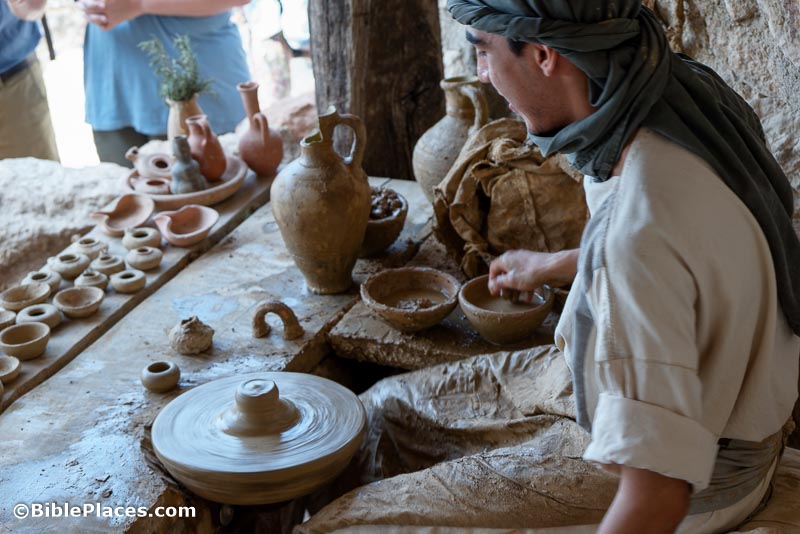
The experience at Nazareth Village, with the increased number of exhibits and actors, has never been better. One caveat: it doesn’t work so well with large groups.

Share:

Archaeologists have discovered the oldest pearling town on an island in the Persian Gulf.

Writing for Christianity Today, Mark Wilson recounts the history of Antioch on the Orontes, including its significant place in the early church and the numerous earthquakes it has suffered.

Jason Borges provides some essential information for visiting Antalya, a beautiful city on the southern coast of Turkey. I would add a day-trip recommendation for Termessos.

This 10-minute video explains the ancient craft of parchment-making, in the city which gave its name to parchment (Pergamum).

“The coveted metal copper and a sheltered location turned the Cypriot village of Hala Sultan Tekke into one of the most important trade hubs of the Late Bronze Age.”

“The exhibition ‘The colours of the Romans. Mosaics from the Capitoline Collections,’ on show in Rome’s Montemartini Museum, has been expanded to include a new section presenting 16 newly restored works dating from the late Roman period and never before shown in public.”

Entrance to the Pantheon in Rome will no longer be free.

The most expensive coin ever sold at auction was sold using false provenance and the owner of the auction house has been arrested.

“Governments, law enforcement officials and researchers have linked a mounting number of the Met’s relics to looters and traffickers.”

New release: The Public Lives of Ancient Women (500 BCE-650 CE), edited by Lucinda Dirven, Martijn Icks, and Sofie Remijsen (Brill, $143).

HT: Agade, Arne Halbakken, Explorator

Share:

Researchers have launched a global contest with $250,000 in prizes for teams to use AI for decoding unrolled scrolls from Herculaneum.

The Moabite king Mesha is the latest subject of Bryan Windle’s archaeological biography series.

Nathan Steinmeyer explains the significance of the Cyrus Cylinder and its relevance to the Bible.

Jason Borges tracked down the Istanbul Airport Museum and explains how to find it.

“In a new study, genetics and archaeology combine to reveal the ancient origins of humanity’s first beast of burden,” the donkey.

The Codex Sassoon, to be auctioned off on May 16, will be displayed in Tel Aviv, Dallas, Los Angeles, and New York over the next two months.

Chris McKinny, Amy Balogh, and Kyle Keimer discuss “Biblical Geography—The Missing Ingredient” on the Biblical World podcast.

On This Week in the Ancient Near East podcast, “The Archaeology of Ancient Fingerprints, or Profiling Potters for Fun and Profit.”

HT: Agade

Share:

A scan of the north side of the Great Pyramid of Giza detected a corridor measuring 30 feet by 6 feet.

“The Egyptian Ministry of Tourism and Antiquities announced on Friday the discovery of a group of tombs from the Persian, Roman and Coptic eras in the Al-Bhansa [Oxyrhychus] region.”

“Archaeologists excavating at the ruins of Old Dongola in Sudan have discovered ancient Egyptian hieroglyphics inscribed on sandstone blocks.”

Iran and China are collaborating to conduct underwater archaeological surveys in the Persian Gulf.

A curator at Manchester Museum describes the significance of the touring exhibition, “Golden Mummies of Egypt.”

The Art Newspaper reports on the full scale of earthquake damage to heritage sites in Turkey and Syria.

Hybrid lecture on March 9: “Iron in the Sky: Meteorites in Ancient Egypt,” by Victoria Almansa-Villatoro. Register here.

“Daniel—The Top Ten Archaeological Discoveries” is the latest episode on Digging for Truth.

Expedition Bible’s latest video is on the “Search for the Tower of Babel.”

New release: Esarhaddon, King of Assyria, by Josette Elayi

Bryan Windle highlights the top three reports in biblical archaeology in the month of February.

HT: Agade, Arne Halbakken, Gordon Dickson, Ted Weis, Explorator

Share:

A bronze shield thought to belong to a king of Urartu has an inscription mentioning a previously unknown nation.

Archaeologists discovered a tavern dating to 2700 BC in the ancient city of Lagash.

“Two ancient clay tablets discovered in Iraq and covered from top to bottom in cuneiform writing contain details of a ‘lost’ Canaanite language that has remarkable similarities with ancient Hebrew.”

“The ancient Egyptians employed a host of exotic ingredients – some apparently imported from as far away as Southeast Asia – to mummify their dead.”

“A battleground fought over by ancient Egyptians and the Ptolemaic Kingdom and mentioned on the Rosetta Stone has been discovered.”

Papyrus conservator Helen Sharp explains how ancient Egyptian papyri have survived for so long.

Julien Cooper writes about the travels of Khety in the Sinai Peninsula during the 11th Dynasty.

On the Tikvah Podcast, Israeli rabbi and biblical scholar Joshua Berman talks about leading tours to Egypt. (“Things that you see from there you don’t see from here.”)

Life and the Afterlife: Ancient Egyptian Art from the Senusret Collection, on view at the Michael C. Carlos Museum from February 4 to August 6, 2023, is an exhibition about the power of ancient Egyptian objects to engage and inspire.”

Jason Colavito argues against displaying mummies in museums.

Webinar on Feb 8: “Secrets of Egypt’s Middle Kingdom Capital: el-Lisht,” by Sarah Parcak

“The 20th edition of the Annual Symposium on the Iranian Archaeology will take place in the National Museum of Iran,” with presentations of the latest archaeological research.

Zoom lecture on Feb 8: “Mercenary Soldiers in the Achaemenid World,” by John W. I. Lee

New release from RevelationMedia: Polycarp. Free to view if you enter your email address. (I don’t see another viewing option.)

Nominations are invited for the 2023 Biblical Archaeology Society Publication Awards, for books published in 2021 and 2022.”

ASOR is offering 40+ scholarships of $2,000 each for participation on ASOR-affiliated projects during the summer of 2023. The deadline to apply is February 15.

HT: Agade, Arne Halbakken, Explorator

Share:

Two 3,800-year-old cuneiform tablets found in Iraq give first glimpse of Hebrew precursor.”

Asshur, the ancient religious capital of Assyria, will be flooded once construction is completed on a dam on the Tigris River.

Arab News looks at evidence of early Christianity in the Arabian Peninsula.

Mohy-Eldin Elnady Abo-Eleaz looks at how kings of the Late Bronze Age dealt with various kinds of “fake news.”

A Greek blacksmith is creating replicas of ancient armor for display in museums. I saw about a dozen of these last week in the Museum of Ancient Greek Technology in Athens.

Mark I. Pinsky reviews Eric M. Meyers’s autobiography, An Accidental Archaeologist: A Personal Memoir. Only $9.99 on Kindle.

Eric Meyers is interviewed by Eve Harow on the Rejuvenation podcast.

Alex Joffe grew the readership of ANE Today from zero to 42,000 over the last decade, and now he is stepping down. This provides him with the occasion to reflect on the challenge of getting archaeologists to write for normal people.

The Met has closed its galleries for Ancient Near Eastern and Cypriot Art for a two-year, $40 million renovation project.

The H.A.P.S. summer scholarship is possibly the first crowd-funded grant aimed at helping humanities Ph.D. students – specifically, those studying the Ancient Near East.”

New release: City of Caesar, City of God: Constantinople and Jerusalem in Late Antiquity, edited by Konstantin M. Klein and Johannes Wienand (De Gruyter, 2022; $127; free download).

New release: Naming and Mapping the Gods in the Ancient Mediterranean, edited by: Thomas Galoppin, Elodie Guillon, Max Luaces, Asuman Lätzer-Lasar, Sylvain Lebreton, Fabio Porzia, Jörg Rüpke, Emiliano Rubens Urciuoli, and Corinne Bonnet (De Gruyter, $196; free download)

New release: The Scribe in the Biblical World: A Bridge Between Scripts, Languages and Cultures, edited by Esther Eshel and Michael Langlois (De Gruyter, $100)

New release: The Solid Rock Hebrew Bible – “this edition prints the entire Hebrew text (in a traditional two-column layout and an easy-to-read 13-point font, with vowel points included for readers’ convenience) and includes adjustments made to the base text (the Leningrad Codex) in over 2,500 places.” $35 per printed volume, and free download.

ASOR webinar on Jan 26: “Antiquities Trafficking in the Age of Social Media: How Big Tech Facilitates and Profits from the Digital Black Market,” featuring Katie A. Paul and moderated by Eric Cline ($12).

Video recordings from the “Yahwism under the Achaemenid Empire” conference are now available (also on YouTube).

Speakers at the online Spring Bible & Archaeology Fest 2023 include Erez Ben-Yosef, Shimon Gibson, James Hoffmeier, Chris McKinny, Gary Rendsburg, Sarah Parcak, and others.

Amélie Kuhrt died on January 2.

HT: Agade, Joseph Lauer, Arne Halbakken, Gordon Dickson, Ted Weis, Wayne Stiles, Mondo Gonzales, Alexander Schick, Charles Savelle, Keith Keyser, Explorator

Share: