The following is a “roundup of roundups.” Surveying more than 100 roundup posts written over the year, I have created a series of lists for what I consider to be most significant, beginning with the Top 10 Discoveries related to biblical archaeology. Our survey also recalls the most controversial stories of the year and other noteworthy reports from Jerusalem, Israel, and the broader biblical world. We have a section of top stories related to tourism, and for the first time, I am including a section of stories related to the antiquities trade and vandalism. As usual, we round up the best print and digital resources noted here over the year, as well as the deaths of influential figures. At the end, you can find links to other top 10 lists.
Top 10 Discoveries of 2023
1. A deep rock-hewn moat on the northern side of Jerusalem’s City of David dates to approximately the reign of King Joash (ca. 800 BC) and includes two sets of large channels, the purpose of which is yet unknown. Archaeologists also discovered a handprint carved into the stone.
2. Archaeologists excavating Tel Shimron in Galilee discovered a massive Middle Bronze monument that was 15 feet tall and covered the entire acropolis. Soon after its construction, it was filled in with gravel, thus preserving it for nearly 4,000 years.
3. Four Roman swords were discovered in a cave near En Gedi. Three are spatha swords, and all were likely stolen from Roman soldiers by Jewish rebels during the Bar Kochba revolt. The swords were discovered incidentally while doing multispectral imaging on a 7th-century BC inscription in the cave. The new reading of the inscription may include the word “salt.”
4. Archaeologists working on Mount Zion discovered, for the first time ever, destruction levels from the Romans and the Babylonians in the same space.
5. Excavations in front of the edicule in the Church of the Holy Sepulcher revealed the 4th century arrangement of the rotunda.
6. The 11th and final season at the Huqoq synagogue in Galilee wrapped up with the discovery of additional sections of the Samson mosaic panels along with a new mosaic section two inscriptions. The site will be developed into a tourist attraction.
7. Scientists identified, for the first time ever, ancient DNA from the bodies of Israelites who lived during the Old Testament period.
8. The oldest gate ever found in Israel was accidentally discovered near Kiryat Gat. The gate dates to about 2500 BC and has been reburied.
9. About 1,000 feet of the Upper Aqueduct bringing water to Jerusalem was discovered in a neighborhood south of the Old City. This is the longest section of this aqueduct ever discovered.
10. A recreational swimmer discovered a shipwreck that included a cargo of 44 tons of marble blocks headed to the Roman port of Ashkelon or Gaza for an elite building project.
Most Controversial Stories of 2023
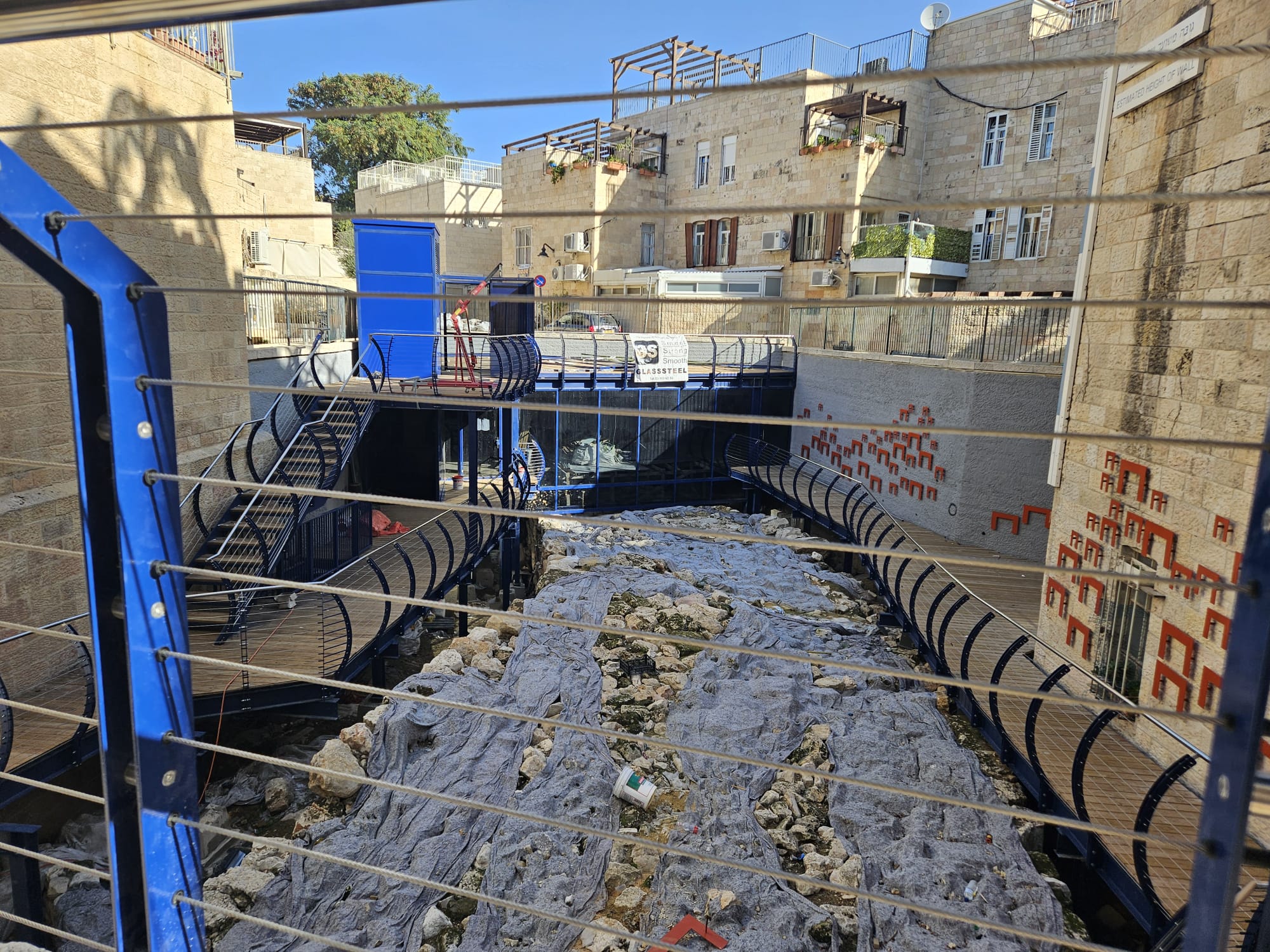
Following the controversial purchase of a garden where the Pool of Siloam was located, archaeologists began work to expose the entire pool in order to open it to tourists. They found almost nothing.
Israeli archaeologists upset with ridiculous claims by Gershon Galil published an open letter.
An inscribed potsherd was discovered on the surface at Lachish, and after careful investigation and three scans, they announced it to be an authentic inscription read “Year 24 of Darius,” a reference to the Persian king who ruled over the land of Israel from 522 to 486 BC. The next day a professor reading the news report told the IAA that she had inscribed the potsherd in a demonstration to students.
The “curse tablet” from Mt. Ebal was published, but scholars are challenging its identification, date, and whether it is even inscribed at all.
Jericho was named a World Heritage Site “in Palestine.”
Noteworthy Stories from Jerusalem
A new study suggested that a 10th-century BC inscription discovered near the Temple Mount in Jerusalem may provide a link with the Queen of Sheba’s visit to Solomon. Or not.
The oldest ceramic rooftiles discovered in Israel date to the 2nd century BC and were found in the Givati Parking Lot excavations in the City of David.
A rare gold bead was discovered by a teenage volunteer in excavations on the “Pilgrimage Road” leading from the City of David to the Temple Mount.
A 1st-century receipt was discovered in a 19th century excavation tunnel in Jerusalem.
Archaeologists discovered a Second Temple period stonemason’s workshop near Jerusalem.
Israeli scientists were mapping the movement of subatomic particles in order to map underground Jerusalem.
Noteworthy Stories from Israel
An excavation in Ashkelon revealed a 6,000-year-old copper fishing hook that may have been used for catching sharks.
Israeli archaeologists discovered the oldest hoards of silver, attesting to its use as currency some centuries earlier than previously thought.
Archaeologists discovered evidence of brain surgery in two brothers buried under a Late Bronze building in Megiddo.
A study claims that five sites in Judah demonstrate that Judah was expanding into the Shephelah already in the 10th century.
A large Israelite purple dye factory was discovered at Tel Shikmona near Haifa. This supplied the prestigious color to Solomon’s temple in Jerusalem from about 850 to 750 BC.
Israeli archaeologists excavated a large tomb with dozens of skeletons in a remote area in the Negev desert.
A Hellenistic burial cave in Jerusalem contained the remains of a young female courtesan along with a well-preserved bronze mirror.
Archaeologists working at Megiddo identified a small amphitheater that was used for “brutal combat training exercises.”
More than 120 tombs, including two rare lead sarcophagi, were discovered in the northern Gaza Strip.
New excavations at Hyrcania in the Judean wilderness revealed an inscription in Greek adapted from Psalm 86.
Excavations at el-Araj, possibly biblical Bethsaida, uncovered a 5th-century Byzantine basilica that was built over a “venerated wall” that did not belong to Peter’s house.
A 6th-century Byzantine church with beautiful mosaics was uncovered in Jericho.
Researchers created an AI program to translate cuneiform tablets written in Akkadian into English instantaneously.
Other Noteworthy Stories
The earthquake in southeast Turkey and northern Syria caused massive loss of life and devastation to property and antiquities. Antakya, ancient Antioch on the Orontes, was largely destroyed. The Gaziantep Castle and the citadel of Aleppo also sustained significant damage. Gobekli Tepe and Arslantepe Mound suffered little or no damage in the recent earthquake in southern Turkey.
An Iron Age temple in Khirbet Al Mudayna, possibly biblical Jahaz, was discovered with altars, bones, and animal figurines.
Two tablets written at least partially in the Amorite language prove that the language existed.
Part of an ancient gateway believed to have been constructed by Cyrus the Great was discovered near Persepolis.
Hundreds of 5,000-year old wine jars were discovered in the tomb of an influential woman in the royal court during the First Dynasty.
New rooms were discovered in the Sahura Pyramid.
Ruins of Nero’s theater were discovered in Rome.
The discoveries in Pompeii just kept coming, including a servant’s quarters in the house of a rich person, political graffiti, a fresco that looks like a pizza, a bakery that housed slaves, and more.
The oldest nearly complete Hebrew Bible, dating to approximately AD 900, was sold by Sotheby’s for $38.1 million. The Codex Sassoon is now on display at the ANU Museum in Tel Aviv. It has previously been digitized, is in the public domain, and is available online.
Top Stories Related to Tourism in Israel
The Israeli government approved spending more than $100 million in the next five years on various projects in Jerusalem, including on excavations in the Western Wall Tunnels and the City of David National Park.
A pedestrian suspension bridge crossing the Hinnom Valley was built (YouTube).
A seven-mile stretch of the Jordan River south of the Sea of Galilee was cleaned and developed for tourism.
An area in Caesarea underneath Herod’s palace is being billed as the prison of Paul.
Sussita National Park was opened to the public. The site, also known as Hippos, overlooks the Sea of Galilee on its eastern side.
The Israeli government approved an $8 million budget to restore and protect the ancient capital city of Samaria.
Among the sites opened this year after a period of renovation:
Top Stories Related to Tourism Outside Israel
Crowds at the Acropolis of Athens led to crowd control measures for the first time ever.
Italian authorities are working to reduce congestion at Pompeii. They are also installing solar panels at the site that look like terracotta tiles.
Several smaller museums were replaced by a new Izmir Museum in biblical Smyrna.
The James Ossuary went on display in the US for the first time ever.
Among the sites re-opened this year after renovation:
Top Stories Related to the Antiquities Trade and Vandalism
The Israel Antiquities Authority announced a two-week amnesty campaign, and thousands of people turned in antiquities.
The most expensive coin ever sold at auction was sold using false provenance and the owner of the auction house has been arrested.
A former director of the Citadel Museum in Amman, Jordan, was convicted of stealing 6,000 ancient coins and replacing them with forgeries.
The US returned to Lebanon a dozen looted artifacts valued at $9 million, including three from the New York Metropolitan Museum of Art.
An American attacked several ancient Roman statues in the Israel Museum that he considered to be “blasphemous” and “in violation of the Torah.” He was acquitted of a crime, but sent to involuntary hospitalization.
The Protestant Cemetery on Mount Zion was vandalized, damaging several grave markers including that of Bishop Gobat.
Roman sarcophagi at Tel Kedesh were vandalized. Criminals apparently believed that Deborah the prophetess’s tomb is located there.
Notable Resources of 2023: Books
14 Fresh Ways to Enjoy the Bible, by James F. Coakley(Moody, 208 pages; $15)
Ancient Persia and the Book of Esther: Achaemenid Court Culture in the Hebrew Bible, by Lloyd Llewellyn-Jones (Bloomsbury, 280 pages, $31; Amazon)
Ancient Synagogues Revealed 1981-2022, edited by Lee I. Levine, Zeev Weiss, and Uzi Leibner (Israel Exploration Society, 300₪)
Assyria: The Rise and Fall of the World’s First Empire, by Eckart Frahm (Basic Books, 528 pages, $35; Amazon).
Discovering the Bible inside your Bible: The Gospel of John, by Andy Cook (Experience Israel Now, 208 pages, $20)
Excavating the Land of Jesus, by James Riley Strange (Eerdmans, $30)
Hazor: Canaanite Metropolis, Israelite City, by Amnon Ben-Tor, expanded edition (Israel Exploration Society, 180₪)
The Oxford History of the Ancient Near East: Volume IV: The Age of Assyria, edited by Karen Radner, Nadine Moeller, and D. T. Potts (Oxford, 1288 pages, $150; Amazon)
The Seven Wonders of the Ancient World: Science, Engineering and Technology, by Michael Denis Higgins (Oxford Academic, 360 pages, $35; Amazon)
A set of three Gateways from Biblical Backgrounds: Bible in its Land: The Land Between Concept; Bible in its Time: An Overview of 4000 Years; Bible in its Time: 500 Years of Israelite Kings
Notable Resources of 2023: Digital Resources
The New York Public Library made available Charles W. Wilson’s Ordnance Survey of Jerusalem (1865).
“Lessons from the Land: The Kings” is the latest series produced by Appian Media. The 13 episodes are about 5 minutes each.
An impressive video of a 3D model of Herod’s Temple was released by Bible Scenes. A second video tours 50 different areas of the virtual 3D model of Herod’s Temple Mount.
Reading the Bible Lands is a new Bible-reading program developed by Wayne Stiles and enriched by his excellent videos, photos, devotionals, and community.
Our team here at BiblePlaces.com created and released two new volumes in the Photo Companion to the Bible series: Ezra and Nehemiah.
Losses This Year
Yehoshua Ben-Arieh, professor of geography at The Hebrew University
Amnon Ben-Tor, professor of archaeology at The Hebrew University and director of excavations at Hazor
Weston Fields, managing director of the Dead Sea Scrolls Foundation
Rafael Frankel, retired archaeologist from the University of Haifa
Dennis E. Groh, professor of humanities and archaeology at Illinois Wesleyan University
Heinz-Wolfgang Kuhn, one of the first to engage with the archaeological research of el-Araj
Amélie Kuhrt, professor of ancient Near Eastern history at University College London
Jaromir Malek, Egyptologist and creator of the Tutankhamun Archive
Robert D. Miller, professor of Old Testament at The Catholic University of America
Ilan Sharon, co-director of the excavations at Tel Dor
Jonathan Tubb, archaeologist and curator at the British Museum
Other Top 10 Lists
Gordon Govier writes about the top 10 stories in biblical archaeology for Christianity Today (subscription required).
Bryan Windle has compiled his top 10 discoveries in biblical archaeology of 2023.
Haaretz identifies top archaeology stories in 2023, with no attempt to rank them. They also link to top stories in world archaeology this year.
National Geographic listed “seven of the most exciting archaeological discoveries in 2023,” placing the Judean desert swords in the top spot. (The Times of Israel has an article about the story, if the paywall prevents access.)
Previous Years
You can revisit the top stories of previous years with these links: