The Tower of David Museum in Jerusalem reopened on June 1 after a $50 million renovation. The Times of Israel explains what’s new.

The Israeli government has approved spending more than $100 million in the next five years on various projects in Jerusalem, including on excavations in the Western Wall Tunnels and the City of David National Park.

To judge from this recent promo video, Israel’s Ministry of Tourism is seeking a different kind of tourist. This video also seems to embody the adage that advertising is another form of lying.

The IAA discovered three ossuaries in a Roman-period burial cave near Kafr Kanna (Cana) that had recently been looted.

A traffic stop near Ramallah led to the discovery of dozens of 10th Roman Legion floor tiles that had recently been illegally excavated.

Israeli police arrested a suspect in possession of dozens of coins illegally excavated in Jerusalem, including a rare coin from the reign of Antigonus Mattathias II.

A three-week operation led to the capture of thieves illegally excavating a Roman-Byzantine site near Nazareth.

The latest volume of the Journal of the Ancient Near Eastern Society includes articles on 1 Samuel 5, the Gezer Calendar, the altar at Tel Dothan, and the story of Dinah. Articles are open-access.

Preprints for a festschrift for Tallay Ornan are available on Academia.

New release: Pushing Sacred Boundaries in Early Judaism and the Ancient Mediterranean: Essays in Honor of Jodi Magness (Brill, $211)

New release: History of Ancient Israel, by Christian Frevel (SBL, $75)

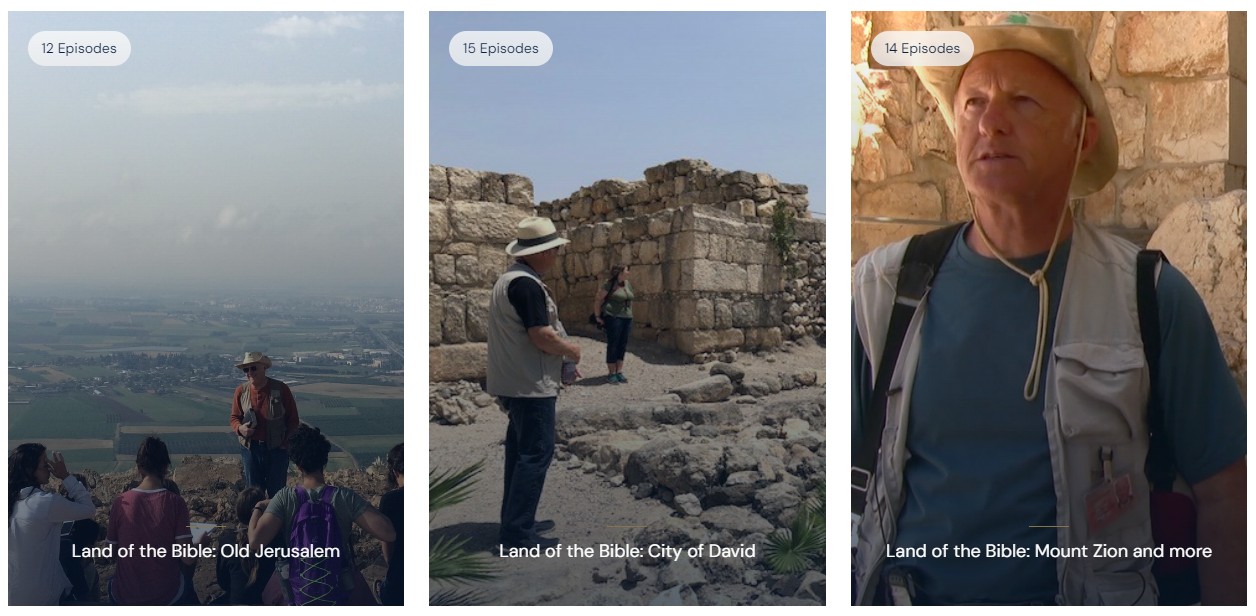
On pre-order sale at Logos: “A Virtual Walk Through the Land of the Bible,” by Charlie Trimm

Logos has just released The New Encyclopedia Of Archaeological Excavations In The Holy Land.

Logos has a sale on The New Moody Atlas of the Bible this month ($10).

Rafael Frankel, retired archaeologist from the University of Haifa, died last week. Some of his publications can be seen here.

Weston Fields, longtime managing director of the Dead Sea Scrolls Foundation, died on May 25. A list of his publications can be seen here.

HT: Agade, Joseph Lauer, Arne Halbakken, Ted Weis, Alexander Schick, Explorator

The viewing area for the Broad Wall in Jerusalem will be transformed once they complete construction of these new walkways. Amazing that it took 50 years to get around to this.

Share:

If you asked me for a list of historical fiction related to the biblical world that needed to be written, I’m not sure that the Maccabean Revolt would have been in the top 5. What I discovered, however, in reading David A. deSilva’s Day of Atonement: A Novel of the Maccabean Revolt, is that it really should be near the top. The book came out in 2015 but I only learned of it recently, and I wanted to mention it here in case you missed it as well.

To be sure, this is not really a book about the “revolt” per se. That is, it’s not a war story set in the midst of the battles between the Jews and the Seleucids. Instead, the book is about the people and events that led up to the great conflict. And this is perfect for what I needed.

Names that I knew on paper became living and breathing people, and you really feel like you make acquaintance with the high priests Honiah (Onias III), Jason, and Menelaus. Antiochus Epiphanes, one of the little horns of Daniel’s prophecies, is more human than I had considered. Most interesting are the characters whom deSilva has created who agonize over, or embrace, the increasing Hellenization of Jerusalem.

I loved being transported into Jerusalem in the year 171 BC and watching the construction of the gymnasium while overhearing the Jewish residents debate how far was too far. The uprising didn’t occur in a vacuum, and deSilva reveals various political, social, and religious threads that led a bunch of farmers and craftsmen to take up arms to preserve the worship of the true God.

deSilva is eminently qualified to write this book, given his lifetime of scholarship in the world of the Second Temple and his works on the New Testament and the Apocrypha. He recently wrote A Week in the Life of Ephesus (two thumbs up!), and I hope that he will continue writing historical fiction.

There was an interpretation or two that I would have written differently, but that doesn’t diminish my enthusiasm for the book and my appreciation for the author’s diligent labors. I am happy to give Day of Atonement my highest recommendation, and I commend it to all who love to learn history through excellent fiction written by a careful scholar of the era.

You can see some endorsements at Amazon, and Mark Strauss has reviewed the book for Themelios (but he gives a lot away, so you might skip it if you prefer surprise).

I would include this book in my top 5 works of historical fiction related to the biblical world, along with:

Share:

[Due to some website issues, part 2 of the last Weekend Roundup was not sent out. You can read it here.]

A cave near ancient Shechem served refugees for at least eight different historical periods, from the Chalcolithic to the Mamluk periods.

El-Unuk, one of Adam Zertal’s six “Gilgal” sites, is under threat of destruction from construction work.

The Israeli government has approved an $8 million budget to restore and protect the ancient capital city of Samaria. The funding “will go toward establishing a tourism center at the site, building new access roads, mapping untouched areas, and increasing law enforcement to prevent illegal activity.”

Scott Stripling discusses the Mount Ebal Curse Tablet on the latest episode of Digging for Truth.

John DeLancey’s latest video was filmed in the 1st-century synagogue of Magdala.

What are the Lachish Letters and why are they of importance to the Bible? Nathan Steinmeyer explains.

JNS has a story on the Inscriptions of Israel/Palestine project being run by Brown University.

In connection with a new exhibit at the Corning Museum of Glass, Ruth Schuster investigates the history and method of Roman glassmaking in the land of Israel.

Hybrid lecture at the Albright Institute on May 11: “Before the Nabataeans: Arabian Traders in the Negev Highlands,” by Tali Erickson-Gini and Martin David Pasternak

Zoom lecture on May 11: “Jesus Reading Scripture: Exploring the Archaeology of Worship in First-Century Synagogues,” by Paul Flesher ($6/$12).

The online lecture with Ken Dark on “Exploring the Archaeology of Jesus’ Nazareth” has been rescheduled to Friday, 12 May 2023 at 11:00am-12:30 pm ET.

Preserving Bible Times has released Session 5 of The Bible: Its Land & Culture! This session explores Two Different Worlds: Jewish or Hebrew and Roman or Gentile; Peter vs Paul; Deciphering the Roman World; and Roman Exceptionalism. Individual sessions are available here, and all 5 sessions are now available for purchase as a set ($40).

Paleojudaica links to articles that explore connections of King Charles III’s coronation with the Bible and the ancient Near East.

HT: Ted Weis, Explorator

Share:

According to Haaretz, the recent excavations have found no traces of the Pool of Siloam.

Chandler Collins investigates “artificial platforms of massive proportions [that] altered Jerusalem’s landscape while also destroying or concealing remains of former times.”

Google Arts & Culture’s collections include a story on the Holy Places of Jerusalem, with many large, beautiful photographs.

Bible History Daily summarizes a recent study that argues that it is very unlikely that a ring bears the name of Pontius Pilate.

Daily Mail tells the story of the Shellal Mosaic, discovered by ANZAC soldiers near Tell el-Farah (South) during World War I.

Haaretz profiles the research of Guy Bar-Oz in his efforts to study the cultural history of trees in Israel.

As Adolfo Roitman nears retirement as curator of the Dead Sea Scrolls at the Shrine of the Book, Israel21c reports on how he ended up in the position, with no museum experience or expertise in the Dead Sea Scrolls.

New episode on This Week in the Ancient Near East: “New Jerusalem Inscription Points to (Previously Known) Iron Age Spice Trade, Or, Solomon and Sheba Get Spicy?”

Hybrid conference on May 21-23: “Epigraphy in Judah: The Second International conference of the Roger and Susan Hertog Center for the Archaeological Study of Jerusalem and Judah”

The Oxford Centre for Hebrew & Jewish Studies is offering free Modern Hebrew Ulpanim courses on Zoom.

Bible Mapper continues to produce and release free maps of the biblical narrative and world:

If you have not entered the drawing for more than 30 prizes of the Photo Companion to the Bible, you have until tomorrow to do so. Everyone who enters receives the new “Top 50 Sites from Dan to Beersheba” PowerPoint.

HT: Agade, Arne Halbakken, Mark Hoffman, Explorator

Share:

“Archaeologists in Southern Italy uncovered a trove of historical treasures in a temple in the ancient city of Paestum. The treasures include a statue of the Greek god of love Eros, Terracotta bull heads and dolphin statues.”

Art & Object reports on excavation work around the Colosseum.

“A team of marine archaeologists working off the coast of Italy has identified a submerged Nabatean temple dating to the early first century CE.”

“Ancient Babylonian treasures, painstakingly unearthed, are slowly disappearing again under wind-blown sand in a land parched by rising heat and prolonged droughts.”

Eckart Frahm is guest on The Ancients podcast to discuss the “Rise of the Assyrians.”

David Moster found a Babylonian Kudurru at Goodwill and made a video about it.

Tom Davis discusses Pauline archaeology on the latest episode of Biblical World.

New release: Ramesses II, Egypt’s Ultimate Pharaoh, by Peter Brand (Lockwood Press, 575 pages, $40)

New from Eisenbrauns: The Royal Inscriptions of Ashurbanipal (668–631 BC), Aššur-etel-ilāni (630–627 BC), and Sîn-šarra-iškun (626–612 BC), Kings of Assyria, Part 2, by Joshua Jeffers and Jamie Novotny. Price reduced to $91 with code NR23.

The latest BAS OnSite video tours Petra, with BAR editor Glenn Corbett as guide.

HT: Agade, Arne Halbakken, Keith Keyser, Alexander Schick, Explorator

Share:

“Thousands of animal bones, ceramic animal figurines, wall stones and limestone altars have been found at an Iron Age temple in Khirbet Al Mudayna,” possibly biblical Jahaz.

Lawrence Schiffman explains why he believes that Gershon Galil’s discovery of new inscriptions from the time of Hezekiah is the product of scholarly imagination.

The Inscriptions project seeks to collect and make freely accessible all of the previously published inscriptions (and their English translations) of Israel/Palestine from the Persian period through the Islamic conquest (ca. 500 BCE – 640 CE).”

The New York Public Library has available for viewing online Charles W. Wilson’s Ordnance Survey of Jerusalem (1865).

Grunge’s list of “female archaeologists who changed history forever” includes Kathleen Kenyon.

Jonathan Moore is a guest on Digging for Truth to discuss the archaeological evidence for the destruction of Jericho.

Zoom lecture on May 2: “The Antiquities Trade in Israel and Palestine: Same as It Ever Was?,” by Morag Kersel and Michael Press, sponsored by PEF and AIAR.

Zoom lecture on May 4: “Exploring the Archaeology of Jesus’ Nazareth,” by Professor Ken Dark, sponsored by Jerusalem University College

Bryan Windle begins a new series entitled “Weighing the Evidence.” In the first post, he evaluates the evidence both for and against the authenticity of the James Ossuary and its inscription.

HT: Agade, Arne Halbakken, Keith Keyser, Alexander Schick, Explorator

Share: