A beautiful seal with a Hebrew inscription from the time of Hezekiah was discovered in the Mount Carmel range. The seal is believed to have belonged to an official from Judah, and LMLK seal impressions were also found at the site.
The Caesarea aqueduct will be restored in a project that will take 40 months and cost 40 million shekels ($13 million). “The work will include planning, conservation, the constructive stabilization of each of the aqueduct’s 85 arches, engineering treatment of the upper aqueduct (the water channel itself), and of course, arranging a safe pedestrian crossing under the arches.”
The Humble Skeptic visited the Hecht Museum and asks whether an ossuary discovered in 1983 that mentions Joanna the granddaughter of Theophilus might be related to the two individuals mentioned in the Gospel of Luke (18 min).
Bryan Windle shares the results of his research into the excavations of Jericho in a two-part episode of Digging for Truth.
BibleMapper has posted an audio-visual reading of very interesting Genesis 14.
Aren Maeir announces that the 8th Annual “Jerusalem Days” conference will be held on July 7-10 at Yad Yitzah Ben-Zvi in Jerusalem on the topic of “Jerusalem: Between East and West.”
John James Davis, professor and president of Grace Theological Seminary, died this week.
Gabriel Barkay was honored this week in an event attended by many friends, colleagues, and students. The report of the evening includes recorded tributes by Paul Wright and Andy Vaughn.
HT: Agade, Arne Halbakken, Ted Weis, Keith Keyser, Explorator
“More than 17,000 archaeological artefacts have disappeared from museums and heritage sites in the Gaza Strip, according to Gaza’s cultural authorities and international human rights organisations.”
A new study reveals that the earliest bathhouses in Pompeii were not very hygienic.
“A gang of four antiquities robbers was caught red-handed on Sunday afternoon while digging inside an ancient Roman-period burial cave near Hittin, on the edge of the Arbel Valley.”
The latest video from Expedition Bible traces the route of Abraham from Iraq through Syria, Turkey, Jordan, and Israel.
Marta Lorenzon writes about the social meaning and functionality of mudbrick architecture. “By tracing the full chaîne opératoire — from soil selection to mixing, molding, drying, and construction — we can approach mudbrick not only as a building technology but also as a reflection of cultural practice, community identity, and human engagement with the environment.”
The NY Times posted an obituary for Gabriel Barkay (gift link).
The first guest on The Book and the Spade radio program was Gabriel Barkay, and that recording from 1984 is now online.
“Bible Mapper is pleased to announce the launch of Bible Mapper, Jr.! The new site hosts a growing collection of resources specifically designed to help kids understand where the stories of the Bible happened and why it matters. Each map lesson includes a kid-friendly map, a Bible reading, a Life Lesson, and an article that unpacks what happened in the story and how it can help us follow God more closely.”
“The Huqoq Excavation Consortium will benefit from a $1.6 million grant from the U.S. Department of State to the W.F. Albright Institute of Archaeological Research.”
Aren Maeir attended the Jerusalem and Samaria conference which included visits to Samaria and Mount Ebal. His beautiful photos fit with my observation that January is the best month for taking photos in Israel.
The Great Isaiah Scroll: A Voice from the Desert, edited by Marcell Fidanzio, was written to accompany the special Israel Museum exhibit on the scroll, which I’m told will go on display in late February.
There was no syllabus. It was probably the third week when a student mustered up the courage to ask what was required for the class. I don’t remember his exact answer, but it was very much in the vein of “know everything.” The library had books; read them. The city had ruins; learn them. He clearly knew it all, and he wanted us to know it all as well.
Most remembrances of Gabriel Barkay will likely focus on his archaeological contributions, but for me he was one of the most influential teachers of my life. He didn’t just demand that I know it all, he made me want to know it all. When students of mine complain about the lack of a (useful) exam study guide, I tell them about Dr. Barkay’s exam. There was one, on the last day of the semester, and your entire course grade depended on that one test. It was not multiple-choice or true/false. We had eight essay questions and two hours to write as fast as we possibly could everything we knew. Preparing for those exams taught me how to study, and I’ve never been the same.
Gabi taught Jerusalem Archaeology I and II and Biblical Archaeology I and II. My parents had just given me a laptop computer as a college graduation gift—still a rarity for students in 1992—and I sat in the back row of the classroom at the Institute of the Holy Land Studies, typing as fast as I possibly could while an information dump truck was unloaded on us, all delivered from memory and without notes. I memorized what he said, and I remember that better today than what I read last month.
Gabi was best known for his excavations of Ketef Hinnom and the discovery of the silver amulets with the priestly benediction. He loved to tell the story on location, with students gathered around, about the pesky kid whom he put out of sight by sending to the tomb repository, and the seemingly miraculous discovery that, unlike every other repository, this one had not been robbed in antiquity.
Gabriel Barkay standing next to the Ketef Hinnom tomb and its famous intact repository where the silver amulets were discovered.
Gabi didn’t stop being my teacher after I passed his classes because I would invite him to guide tours for my archaeology classes at IBEX. But I was very intentional about asking him to take us to places I had never been with him. There was no more eager student in the group than me. Generally averse to writing longhand, I probably handwrote more on a one-day tour with him than I did the rest of the year combined.
Dr. Barkay teaching on the southern steps of the Temple Mount
He gave us a full-day tour of Gezer, and my “love” for Robert Alexander Stewart Macalister is his fault. Once the IBEX faculty hired him to give us a full-day tour of two sites in the Shephelah. When the day was over, we were still at Lachish and I no longer remember what other site we had planned to visit. For another faculty tour, we hired him to guide us through the Archaeology Wing of the Israel Museum. We figured we had better skip the Early and Middle Bronze Ages and start in the Late Bronze section lest we not make it to the Iron Age. We never made it to the Iron Age.
Most of the tours he gave my classes were in his beloved city of Jerusalem. No one is more responsible for my own love for that city than Dr. Barkay. He took us through the City of David, along the Old City walls, and to the western tumuli. His special expertise was in tombs, and we visited Jason’s Tomb, the Sanhedrin tombs, and the Hinnom Valley tombs. For reasons of safety, we could not go to the Silwan tombs, but he told us stories of his adventures after the Six-Day War surveying the 50 (“exactly 50”) tombs.
I kept a file with questions for the next time we were together, and he never had a moment’s rest while we were on the bus going to the next site. One of those conversations came to mind a few days ago when I was editing a forthcoming book and recalled his observation that there was no individual alive capable of all the skills necessary to forge the Jehoash Inscription. And if the artifact was a team effort, someone would spill the beans. Twenty years later, no one has confessed, and I will suggest in the book that the Tablet is likely authentic, based on my trust in Dr. Barkay.
His legacy for me is not the excavations he directed at Ketef Hinnom or supervised at Lachish. His legacy is the way he mastered his subject and presented it so clearly. He was an LLM before LLMs, with such a vast knowledge of archaeology not only in Jerusalem and in Israel but elsewhere that he could connect the dots, make the associations, and explain what no one else had explained.
Dr. Barkay explaining discoveries made at the Temple Mount Sifting Project
From Dr. Barkay I gained a deeper love for books and especially for books about Jerusalem. For some of his courses, he would devote an entire two-hour lecture to the history of research, and it was mostly a tour of the significant literature in the field. It wasn’t just the texts that were important but their authors. You had to know the author to understand what they wrote and how to read their works. After his teaching, we felt like we knew Ermete Pierotti, James Turner Barclay, Charles Wilson, Charles Warren, Frederick Jones Bliss, John Duncan, Montagu Parker, Raymond Weill, John Garstang, James Leslie Starkey, Kathleen Kenyon, and Yigael Yadin. He held in highest regard Conrad Schick, Father Vincent, Jan Simons, and Nahman Avigad.
A younger Gabriel Barkay touring the Temple Mount with Michael Avi-Yonah in June 1968. Photograph by David Bivin.
Like many brilliant men, he had a keen sense of humor. After unleashing the firehose on us at a site for 30-60 minutes, he would then ask if there were any “questions or corrections.” Ha! If I were to make a list of “best days of my life,” some of his tours would surely be on it. I am very thankful to the Lord for the gift of Dr. Barkay to me and to many others. He served us well, and his memory will surely be for a blessing.
You can read more about Dr. Barkay at Wikipedia, the Temple Mount Sifting Project (which he co-founded), and Aren Maeir’s blog. A festschrift published in 2024 honored him on his 80th birthday, with articles written by James Charlesworth, Aaron Demsky, Baruch Halpern, Yigal Levin, Steven Ortiz, Ronny Reich, Yuval Baruch, Robert Deutsch, André Lemaire, Alan Millard, Lawrence Mykytiuk, Nadav Na’aman, Dennis Pardee, Ziony Zevit, David Ussishkin, and others. An essay by Zachi Dvira describes his early life, his path to archaeology, his teaching, his excavations, and his publications. Dvira’s conclusion is worth repeating here:
To sum up, Gabriel Barkay can certainly be ranked among the “giants” of archaeology in Jerusalem and Israel. His place in this esteemed group is not only due to his extensive knowledge, numerous publications, and discoveries but also because of his tireless efforts to bring this heritage to the public through teaching, lecturing, and media appearances. Barkay believes that archaeology serves as a vital link between the past and the present, and he embodies this principle through his actions. Even today, despite his severe illness, he does not refuse an invitation to speak, whether it be via an online video broadcast or in person, despite his difficulties in traveling. On his 80th birthday, we wish Professor Gabriel Barkay good health, strength, and happiness in all aspects of his life. We express our deep gratitude for his significant contributions to the heritage of Jerusalem and the Land of Israel.
“An impressive section of Jerusalem’s fortification wall from the second century BCE has been uncovered on the grounds of the Tower of David complex in the Old City.” About 130 feet of the “First Wall” has been uncovered in the Kishle.
Archaeologists have found evidence for the famous battle at Bet Zecharia described in 1 Maccabees. “It is the first time we have possible archaeological evidence from one of Judah Maccabee’s battlefields.”
A scholar believes that he has cracked Cryptic B, a rare alphabet known only from two uses in the Dead Sea Scrolls.
Jerusalem University College will be presenting its 6th annual online seminar on January 10. The “Geography and the Bible” seminar is free and will include four sessions:
“Road Systems from Egypt through Sinai,” by James Hoffmeier
“Trekking from the Desert to the Land of Milk and Honey,” by Hélène Dallaire
“What Does it Mean that Jerusalem was ‘Built as a City which is Compact Together?’ A Geographical and Archaeological Reading of Psalm 122:3,” by Chandler Collins
“The Early Church’s Encounter with the Roman Imperial Cult,” by Carl Rasmussen
There is no hat tip (HT) below to Gordon Franz, because Gordon died on November 22. I met Gordon when studying at IHLS in the early 90s, and we stayed in touch over the years, including a tour he gave my family of NYC. Gordon taught for various schools over the years, including the Israel and Turkey/Greece/Rome programs for the Talbot School of Theology. Most recently Gordon sent me stories for these roundups, and in the last email he wrote me, he said he was on his way to buy Rabbi Landy’s latest book. He was quite the book connoisseur. And he had much yet he planned to accomplish. Some of Gordon’s writings are still available on his website. A recording of his celebration of life service is online. He will be missed.
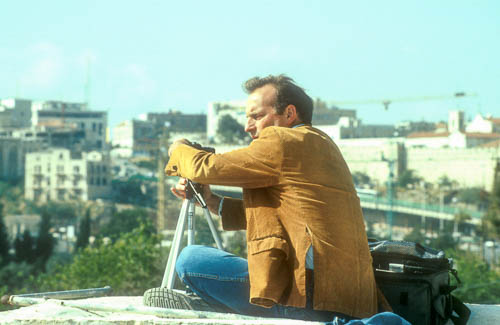
Gordon Franz taking photos from the rooftop of the Institute of Holy Land Studies in Jerusalem, 1993
HT: Agade, Ted Weis, Keith Keyser, Arne Halbakken, Alexander Schick, Explorator
The BiblePlaces Blog provides updates and analysis of the latest in biblical archaeology, history, and geography. Unless otherwise noted, the posts are written by Todd Bolen, PhD, Professor of Biblical Studies at The Master’s University.