Several magnificent 4th-century AD Roman sarcophagi will soon be on display in Ashkelon.

The site of ancient Samaria (Sebastia) has been damaged by arson and looters. The article discusses more broadly the destruction of archaeological sites in Judea and Samaria.

Artifacts discovered in a salvage excavation next to the Machpelah in Hebron may be buried to provide a path for disabled visitors.

Plans have been shelved that would have transformed the ruins of Lifta on the outskirts of Jerusalem into a residential and commercial area.

The arrest of three antiquities thieves in the West Bank resulted in the recovery of Roman and Byzantine coins, jewelry, doors, and a stone olive press.

Israel’s tourism industry is on it way to record highs.

“The Experience of Resurrection” is a new multimedia exhibition at the Franciscans’ Christian Information Center (CIC) located inside the Old City’s Jaffa Gate. The same Jerusalem Post article reports on several other new tours, including one which explores Wilson’s Arch.

After going on an international tour, the Magdala stone has returned home.

James McGrath reports on his tour of the region of Samaria, led by the grandson of the Samaritan high priest. This is part of a series entitled “In the Footsteps of John the Baptist.”

John DeLancey shares a video of the 1st-century pilgrimage road that runs from the Pool of Siloam to the Temple Mount.

The Temple Mount Sifting Project is seeking more financial support.

Ilan Ben Zion summarizes two views on the origins of the Philistines. Aren Maeir believes that Philistines came to the land of Canaan in a series of mass migrations, arriving from many locations in the eastern Mediterranean over many decades, whereas Daniel Master argues that they came from Crete around 1175 BC.

Joseph Aviram, long-time director of the Israel Exploration Society, died at the age of 106 (Haaretz premium).

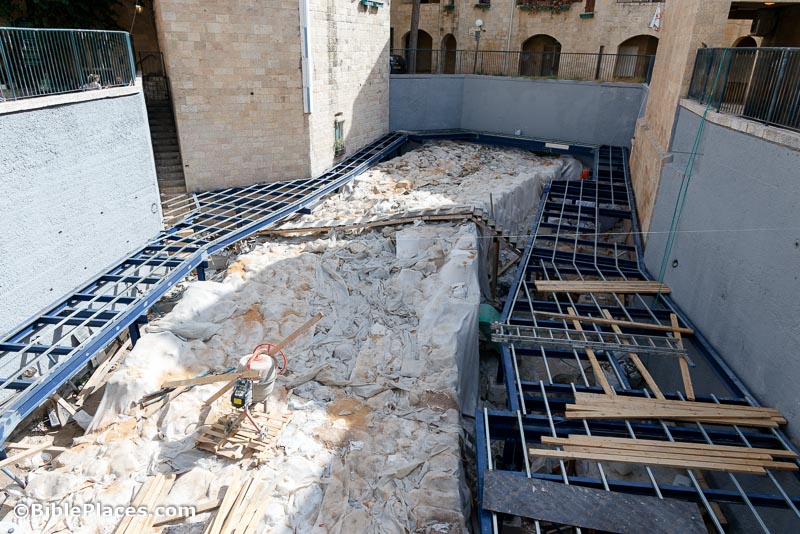
Chandler Collins reports on the transformation of a mound of dirt in the Armenian Quarter of Jerusalem’s Old City into a paved parking lot. He has done a great job with before-and-after photos. (You can support his work and gain some nice benefits by becoming a patron.)

HT: Agade, Arne Halbakken, Joseph Lauer, Explorator, Paleojudaica

Share:

A lot happened while I was away, and it’s going to take five or six days (!) to catch up. Let’s get to it.

Archaeologists excavating el-Araj discovered a mosaic in the Byzantine church that mentions the “chief and commander of the heavenly apostles,” further strengthening the site’s claim to be Bethsaida, the hometown of Peter. They are hoping to find an inscription mentioning Andrew in the October excavation.

“Archaeologists working at Tel Shiloh earlier this summer discovered piers that they believe formed a door into a gate complex at the northern edge of the biblical city.” Scott Stripling thinks this is the gate where Eli died.

Also at Shiloh, archaeologists discovered five intact storage jars from the Late Roman or Byzantine eras.

Excavations have begun at Kh. Tibnah, possibly Joshua’s city of Timnath-heres. Early discoveries include a Roman spearhead. Also, there is a dispute over ownership of the site (subscription).

The first Roman military amphitheater ever found in Israel was recently uncovered at Megiddo.

Matthew Adams talks about the excavations this summer at Megiddo on The Book and the Spade.

A Byzantine convent dedicated to Hannah was recently re-discovered at Horbat Hani in central Israel. There are some nice photos here.

A collection of 530 astragali (animal knucklebone gaming dice) from the Hellenistic period were discovered at Maresha-Bet Guvrin with names inscribed of Aphrodite, Eros, Hermes, Hera, and Nike.

A volunteer at the Temple Mount Sifting Project discovered what may have been a cheater’s die, with the number 5 where the number 4 should have been.

“A bronze Roman coin dating back 1,877 years with the symbol of the Cancer zodiac sign and a Moon goddess was discovered at Carmel Beach in Haifa.”

Computer calculations of 70 CE Roman arsenal uncovered in excavations in Jerusalem demonstrate veracity of Jewish historian Josephus’s report of intense fighting near Third Wall.”

Lior Schwimer has reviewed nearly 15,000 panels of Negev rock art with more than 50,000 carvings.

Steven Ortiz is a guest on the Biblical World podcast, talking with Chris McKinny about the Lanier Archaeological Center at Lipscomb University, the Gezer Archaeological Project, and the Tel Burna Archaeological Project (28 min).

Bryan Windle identifies the top 3 reports in biblical archaeology for the month of July.

Registration for Jerusalem University College’s fall online courses ends on Monday.

HT: Agade, Arne Halbakken, Joseph Lauer

Share:

Excavations at the Church of the Holy Sepulcher have revealed rock layers of a stone quarry used for the construction of Constantine’s church. A press release from the Franciscan Custody of the Holy Land gives more details about all of the excavation works in progress.

“An Israel Antiquities Authority bust in the northern Israeli city of Afula late last week yielded thousands of ancient coins and arrowheads.”

The Druze military fortress on Mount Arbel will open after being closed for a year and a half for conservation work.

The Museum of the Bible and DIVE are offering a virtual tour of Shiloh on August 10 ($20).

John DeLancey just returned from volunteering at the Tel Dan excavation, and he shares his experiences on The Book and the Spade.

Bryan Windle has created a well-illustrated archaeological biography of King Menahem. (If you don’t remember who that is, you’ll be reminded in the first paragraph.)

Cynthia Shafer Elliott writes about the first post in a series on the geographical context of ancient Israel, looking at Israel’s place in the ANE.

Leen Ritmeyer notes the publication of JewishQuarter Excavations, Volume VIII, focused on the Palatial Mansion. Leen has created a beautiful new reconstruction drawing of the mansion, available in his image library for only $6.

Glamping is increasingly popular in Israel, including rooftop options in Jerusalem.

I watched Gesher Media’s “The Philistines: Warriors to the West” and was very impressed with the high-quality production, featuring top archaeologists, an interesting storyline, and (my favorite!) stunning aerial footage. For $7.99, you can stream it anytime.

HT: Agade, Joseph Lauer, Arne Halbakken

Share:

The Shelby White & Leon Levy Lod Mosaic Archaeological Center has been dedicated, and the featured mosaic has returned after a world tour. “This is the Rolls Royce . . . the most visually impressive mosaic we have found.”

Scott Stripling is on The Book and the Spade with an excavation report from this year’s dig at Shiloh.

John DeLancey shares photos from his week of excavating Tel Dan.

Five marble statues from the Roman period have been put on display at the Tel Ashkelon National Park nearly 100 years after they were first excavated.

Australian Catholic University is partnering with the Israel Museum to create an interactive virtual showcase that will make the museum’s collection accessible worldwide.

The Times of Israel looks at challenges to archaeological discovery in the Gaza Strip.

The 2002 issue of ‘Atiqot includes excavation reports on Nain, Akko, Avdat, and more.

The Sea of Galilee will be the first natural lake in the world to be filled with desalinated water. This article has a good bit of information about the lake’s water levels.

“Numerous goddess figurines, ritual objects, as well as rich iconography, demonstrate that goddess worship was extremely important in the life of Israelite faith.”

BAS Quarterly Virtual Lecture on Sept 15: “The Archaeology of Qumran 75 Years after the Discovery of the Dead Sea Scrolls,” by Jodi Magness ($10).

Jerusalem University College has released its slate of fall online courses, including:

  • Biblical Archaeology I, with Chris McKinny and Kyle Keimer
  • Contexts of the Holy City, with Chandler Collins
  • Cultural Backgrounds of the Bible, with Oliver Hersey

Writing for Bible History Daily, Steve Notley celebrates the life of Emanuel Hausman, founder of Carta Jerusalem.

I was a guest this week on the TheologyMom video podcast with Krista Bontrager, talking about “5 times geography shapes our view of the Bible.” I don’t think I had ever made a “top 5” list like this before, and I enjoyed pulling it together.

HT: Agade, Joseph Lauer, Arne Halbakken, Explorator

Share:

There’s a brand new excavation opportunity this summer at a site usually identified with Joshua’s hometown of Timnath Heres. The site of Kh. Tibna/Tel Timna has never before been excavated, and this July Dvir Raviv and Avraham Tendler of Bar Ilan University are launching an excavation and survey project in the western hill country of Ephraim.

I’m not sure if I can explain it, but I’ve long had a special attraction toward this site. Perhaps it is related to its beautiful location in the hills that enjoy the afternoon breezes from the Mediterranean. Perhaps it is owing to its remoteness—I have only visited once, and I don’t remember any of my friends or colleagues telling me that they had traveled there. Perhaps it is the fact that of all the places that Joshua could have chosen as his inheritance as one of the two faithful spies, he chose this site to spend his remaining years after the conquest (Josh 19:49-50).

Timnath-serah, Khirbet Tibnah, from east, tb071304492

Kh. Tibna, possibly biblical Timnath Heres

In any case, this summer is the first time that an archaeological spade will begin revealing the secrets of the site. Initial surveys indicate that the city was particularly important during the Iron Age II and the Early Roman periods. There is evidence of a Hellenistic-Hasmonean fortress, and the site may have been a regional capital in the time of Jesus.

The excavation runs from July 24 to August 19, and university credit is available for those interested. The cost of participating ($240/week) is much lower than at many other excavations ($500-$1000/week). They are also offering weekly lectures and fieldtrips. This might be the opportunity you’ve been looking for.

The expedition’s Facebook page is mostly in Hebrew, but you can see some photos there. See the graphic below for contact addresses.

Tel Timna 1

Tel Timna 2

Share:

A nearly completely intact clay oil lamp from 2,300 years ago was found near a stone bath during recent conservation work at the Mount Gerizim National Park.”

Plans to construct a zip line near Haas Promenade south of Jerusalem’s Old City is facing criticism. There are also plans to build a pedestrian suspension bridge over the Hinnom Valley.

Zvi Koenigsberg argues that the discovery of the curse inscription supports his theory that the original “place that He will choose” was a temple on Mount Ebal.

Aren Maeir is interviewed in the History Channel of Israel’s “Whatever Happened to the Philistines?”

Zoom lecture on May 11: “Beer in Israel and the Ancient Near East: New Insights from Archaeology,” by Jennie Ebeling ($7).

Albright Institute hybrid workshop on May 12: “A Comparison of the Monastery at Tel Masos and Byzantine Monasteries in the Negev Desert,” by Rachel Bernstein. Register here.

Hybrid conference at Tel Aviv University on June 13: “Local and Regional Perspectives on Nomads in the Biblical World” (pdf schedule; Zoom link).

The early bird discount for the Infusion Bible Conference ends on June 3.

The latest free maps from Bible Mapper:

HT: Agade, Joseph Lauer, Arne Halbakken, Charles Savelle

Share: