A winepress from the Byzantine period was discovered at Chorazin by a team doing conservation work.

The recent discovery of a depiction of the Egyptian god Bes in the City of David Givati parking lot excavation is the first of its kind ever found in Jerusalem.

The Times of Israel features a well-illustrated story on the Beth Shemesh excavations including the controversy and the museum exhibit.

A new sound-and-light show, used advanced technologies, has been unveiled at Masada.

A shipwreck discovered in Heracleion matches the description of a Nile River boat described by Herodotus.

Excavation work at Macherus is complete after 11 years, but conservation work will continue.

Over a million people are expected between March-September to attend the Louvre exhibition of the  Egyptian pharaoh Tutankhamun. The show features the largest number of Tut items ever displayed together. As construction nears completion for the new Grand Egyptian Museum in Giza, the Egyptian Ministry for Antiquities states that after the six city world tour is completed, key pieces related to Tut will never again leave Egypt.

The Basrah Museum in southern Iraq has added three new galleries, totaling 2,000 pieces, focused on Sumer, Assyrian, and Babylonian objects.

Erin Darby will be lecturing on “The Archaeology of Women in Ancient Israel” in Oak Ridge, Tennessee, on April 2.

The History Channel has a photo essay of ten biblical sites.

Wayne Stiles recently visited the Royal Mummies Hall in the Cairo Museum.

Bible History Daily features a profile on Julia Berenice, the companion of King Agrippa II in Acts 26.

New from the Oriental Institute of the University of Chicago: The Great Hypostyle Hall in the Temple of Amun at Karnak, by Peter J. Brand, Rosa Erika Feleg, and William J. Murnane. For purchase in hardback or a free download.

“The Setting of the Assassination of King Joash of Judah: Biblical and Archaeological Evidence for Identifying the House of Millo,” by Chris McKinny, Aharon Tavger, Nahshon Szanton, and Joe Uziel, is a paper read and illustrated by Chris McKinny.

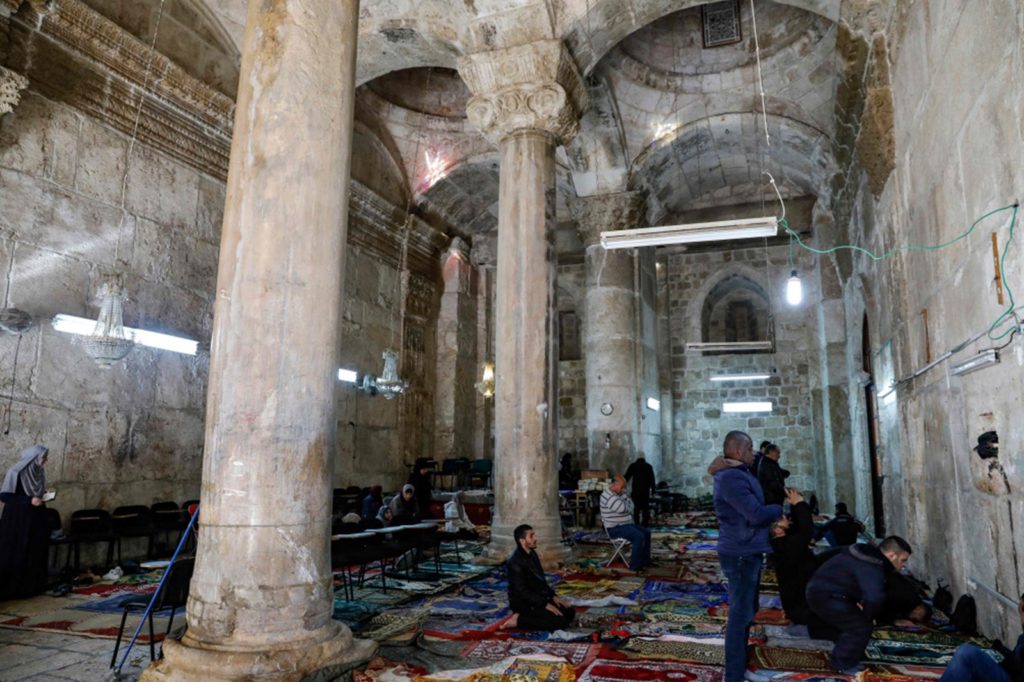
The photo below, from DerStandard, shows the interior of the Golden Gate in recent times.

HT: Ted Weis, Agade, Charles Savelle, Alexander Schick, Paleojudaica

Interior of the Golden Gate
Photo from DerStandard

An attempt to smuggle into Britain an ancient Babylonian kudurru as a “carved stone for home decoration” with a value of “300” failed.

“Music was ubiquitous in Ancient Greece. Now we can hear how it actually sounded.”

Israel has become the first country to list all cemetery tombstones online.

The February 2019 issue of the Newsletter of the Egyptian Ministry of Antiquities includes the latest discoveries, repatriations, and news.

A Greek archaeologist has been working in Alexandria for 15 years in an effort to find the tomb of Alexander the Great.

A 3-minute video shows an animation of what the hanging gardens of Babylon may have looked like.

The Museum of the Bible is hosting a two-session lecture series on “Jerusalem and Rome: Cultures in Context in the First Century CE,” featuring Eric Meyers, Mary Boatwright, Lawrence Schiffman, and Steven Notley.

Eric Meyers will be lecturing on March 28 in Chapel Hill, North Carolina, on “Holy Land Archaeology: Where the Past Meets the Present.”

Six speakers will address the subject of “Egypt and Ancient Israel: Merneptah’s Canaanite Campaign—History of Propaganda?” in a conference at Southwestern Baptist Theological Seminary on March
26.

Chris McKinny’s recent lecture on “Tel Burna—After a Decade of Investigation” is now online. The video includes all of his visuals.

This is fascinating: Predators in the Thickets: A Film Interview with Two Botanists and a Zoologist in Israel. You’ll learn more about lions, bears, forests, thickets, the Zor, and the Ghor. The film is intended an introduction to the newly launched Dictionary of Nature Imagery of the Bible.

Amos Kloner died yesterday.

HT: Agade, Chris McKinny, Joseph Lauer

A Greek inscription found at the Nabatean city of Halutza confirms previous scholarly identification of the site as Elusa. The Times of Israel article provides more information about the results of the excavation.

Aren Maeir made a visit to Gath/Tell es-Safi this week, where everything is very green.

Tel Tzuba (Belmont) is the latest destination for Israel’s Good Name.

Cesares de Roma is a Spanish art project that has brought to life silicone images of Julius Caesar, Caesar Augustus, and Nero.

The Romans attempted to ban wild Purim parties in the year 408.

In light of the present controversy, Leen Ritmeyer explains the history of the Golden Gate of Jerusalem.

Egypt has opened a 105-mile hiking trail called the “Red Sea Mountain Trail” that west of Hurghada.

40,000 runners from 80 different countries ran 42 kilometers in the Jerusalem Marathon.

David Moster explains biblical geography in a 9-minute video entitled, “If an ancient Israelite had Google Earth.”

This isn’t new, but I haven’t seen it before: Flight of Faith: The Jesus Story is a 48-minute documentary with lots of aerial footage.

The Bible Lands Museum in Jerusalem has opened a new exhibit entitled “Highway through History.” As part of the launch, they have created a five-minute drone video of Beth Shemesh and the excavations in preparation for the road expansion.


The New York Times reviews “The World Between Empires” exhibit now at the Met.

The “Alexander son of Simon” ossuary is possibly related to the man who carried Jesus’s cross. It is on display now at the Museum of the Bible in Washington, DC, and this week they recorded a short video about it. Apparently they were so inspired by an inquiry from your roundup writer.

HT: Agade, G. M. Grena, Chris McKinny, Ted Weis, Steven Anderson, Paul Kellogg, Charles Savelle

A well-preserved Greek inscription from the 5th century recording a blessing for one ‘Master Adios’” was discovered in central Israel.

Plans to convert the Golden Gate of the Temple Mount into a Muslim place of prayer are being resisted by Israeli police.

Two crews of antiquities thieves working in eastern Samaria were arrested in recent weeks. One of them was looting Alexandrium-Sartaba.

A short trailer has been released promoting this season’s excavations at Tel Shimron.

There is still time to sign up for this summer’s season at Tel Burna. Shiloh has some openings as well.

Heavy rains this week caused flooding in the Jerusalem area.

The Times of Israel shares a photo essay of wildflowers of the Dead Sea.

Israel’s Good Name recounts his recent university trip to Wadi Dalia and Sartaba in eastern Samaria.

Leon Mauldin reflects on Proverbs’ view of sluggards and ants, and he shares a photo of ants at Neot Kedumim.

The BBC visits the recently opened Terra Sancta Museum in Jerusalem.

New book: Exploring the Holy Land: 150 Years of the Palestine Exploration Fund, edited by David Gurevich and Anat Kidron. (Amazon)

I am on the Diligent Pastors podcast this week with Scot Chadwick, talking about the land of the Bible, photo collections, and preparing for a trip to Israel. Pastors especially may want to check out other episodes in this new podcast.

HT: Ted Weis, Agade, G. M. Grena

An inscription written in the Persian, Elamite, and Babylonian languages has been discovered at Naqshe-Rustam, the royal necropolis of Persepolis.

Work on the sewer system in Kition, Cyprus, keeps revealing ancient remains from the Classical and Roman periods.

A decade of restoration work of King Tut’s tomb has been completed. The History Channel has many photos.

The vase that the British Museum realized was a mace is in fact a vase.

The BBC reports on several women whose interest in archaeology began with a childhood fascination with mummies.

Eisenbrauns is running a sale of 30-50% off of titles in the Duke Judaic Studies and Sepphoris Archaeological Report series.

Beit Shemesh and Kiriath Yearim are the subjects of discussion in this week’s The Book and the Spade.

Shmuel Browns shares several photos he took along the Alon Road in eastern Samaria.

If you have been to Israel before, answer a few quick questions to help Wayne Stiles as he puts together a video series to help travelers prepare for a Holy Land Tour.

It’s a slow week, so here’s a bonus quotation:

“My definition of archaeology, shared with students during almost forty years of teaching historical geography, is that archaeology is the science of digging a square hole and the art of spinning a yarn from it” (Anson Rainey, “Stones for Bread: Archaeology versus History.” Near Eastern Archaeology 64 (2001): 140.

HT: Agade, Ted Weis

Excavations of Qumran’s “Cave 53” have concluded without discovering any scrolls. The Times of Israel provides a good summary of the efforts of recent years.

Two clay horse figurines were discovered last month in northern Israel,” one near Kefar Ruppin and the other near Tel Akko.

Bible History Daily reports on the discovery of the Roman funerary busts in Beth Shean.

A Byzantine cistern discovered under a playground in Jerusalem may become a national site. The article references Ramla’s “Pool of Arches,” which you can read about here.

There are no parallels to the bearded male head unearthed at Abel Beth Maacah, writes Naama Yahalom-Mack in a detailed description of the object.

Following an outcry, the highway over Tel Beth Shemesh will be 20 meters wide instead of 80.

Ferrell Jenkins shares his favorite photo of a fisherman casting his net into the Sea of Galilee. 

John DeLancey has been posting daily for his current Biblical Israel Tour. For Day 12, they visited the City of David and the Old City.

An earthquake centered in Nazareth shook the Galilee region on Thursday night.

A record amount of snowfall on Mount Hermon has opened the site to a peak capacity of visitors.

HT: Agade, Joseph Lauer