(Post by Seth M. Rodriquez)

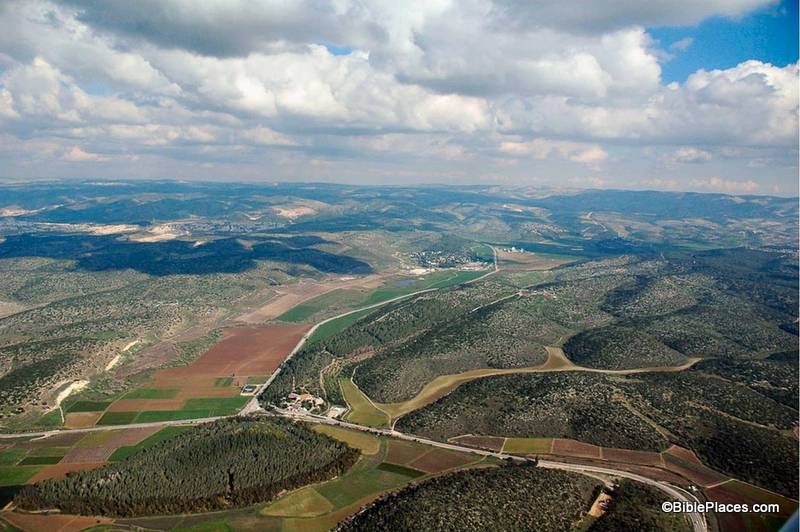
This week’s photo comes from Volume 4 of the revised and expanded edition of the Pictorial Library of Bible Lands and is entitled “Elah Valley Aerial from West” (photo ID #: tb011606772).  One of the improvements in the new edition of the collection is the addition of some aerial photos of the Elah Valley which make it easy to pick out the valley from among the hills of the Shephelah.  In the photo above, the valley can be seen starting at the bottom left corner, moving diagonally up to the center.  (Click on the photo for a higher resolution.)

This photo is extremely useful when discussing the encounter of David and Goliath.  First Samuel 17 sets the stage in the following way:

Now the Philistines gathered their armies for battle. And they were gathered at Socoh, which belongs to Judah, and encamped between Socoh and Azekah, in Ephes-dammim. And Saul and the men of Israel were gathered, and encamped in the Valley of Elah, and drew up in line of battle against the Philistines. And the Philistines stood on the mountain on the one side, and Israel stood on the mountain on the other side, with a valley between them. (1 Sam. 17:1-3, ESV.)

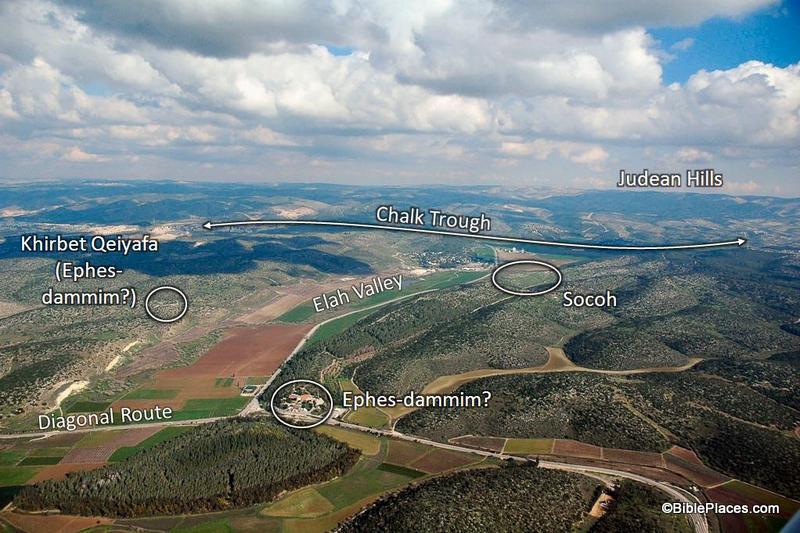
Most of the locations in this passage are visible in this picture.  To assist in identifying them, I’m going to pull from one of the PowerPoint presentations included in the Pictorial Library collection:

In this slide the location of the Elah Valley and Socoh are clearly marked, along with possible locations of Ephes-dammim.  Azekah is not pictured here, but is located just off the photo to the left.  You can easily imagine the Philistine army on one side of the valley and the Israelites on the other, just as it is described in verse 3.

In the background, the Judean Hills are marked which adds to the value of this photo.  When teaching on David and Goliath, I like to point out to my listeners that there was much at stake for David in this battle.  Not only were the Israelite soldiers facing a deadly enemy and not only was the reputation of Israel’s God on the line, but there was another element that we tend not to think about which relates to geography.  If you look at a map of this area you will see that the Elah Valley is an entryway into the Hill Country of Judah, the region where David and his family lived.  Three thousand years after the fact we have the advantage of knowing how it turned out, but if David had lost the battle it is possible that the Philistines would have penetrated into the Judean Hills (as they had when they were encamped at Michmash on the Central Benjamin Plateau).  This would have put David’s family and neighbors at serious risk.  So as David faced Goliath, he was not only fighting for his people and his God … he also was fighting for the safety of his own hometown.

This photo is included in Volume 4 of the Pictorial Library of Bible Lands and can be purchased here.

Share:

Some scholars are suggesting that the depiction on a seal found in the Sorek Valley shows the biblical hero Samson subduing a lion. From Haaretz:

A small stone seal found recently in the excavations of Tel Beit Shemesh could be the first archaeological evidence of the story of the biblical Samson.
The seal, measuring 1.5 centimeters, depicts a large animal next to a human figure. The seal was found in a level of excavation that dates to the 11th century B.C.E. That was prior to the establishment of the Judean kingdom and is considered to be the period of the biblical judges – including Samson. Scholars say the scene shown on the artifact recalls the story in Judges of Samson fighting a lion.
But excavation directors Prof. Shlomo Bunimovitz and Dr. Zvi Lederman of Tel Aviv University say they do not suggest that the human figure on the seal is the biblical Samson. Rather, the geographical proximity to the area where Samson lived, and the time period of the seal, show that a story was being told at the time of a hero who fought a lion, and that the story eventually found its way into the biblical text and onto the seal.

The story continues and explains some of the geographical connections. This discovery reminds me that while Samson’s life largely centers in the Sorek Valley, the most prominent city of that valley is never mentioned in the narrative (Judges 13-16). If the interpretation of this seal is correct, the people of Beth Shemesh remembered their local hero with some pride.

A high-resolution photo of the seal by Raz Lederman is available here.

HT: Joseph Lauer

Share:

Archaeologists at Hazor have discovered 14 large storejars full of grain burned in a massive conflagration during the period of the judges (c. 1300 BC). Volunteer Rob Heaton shares his experiences in the last days of the dig and more.

The 2012 Lautenschläger Azekah Archaeological Expeditions Blog is being updated daily. Yesterday they confirmed the discovery of ancient fortifications.

Matti Friedman describes a day of digging at the Philistine city of Gath.

The Israel Antiquities Authority’s Archaeological-Educational Center invites the public to

“Archaeologists for a Day” program at Adullam Park in the Shephelah on Monday, July 30. The cost is 20 NIS and pre-registration is required at [email protected], Tel: 02-9921136, Fax: 02-9925056. The invitation (Word doc in Hebrew) provides more details.

Seth Rodriquez has identified the most interesting photos for a Bible teacher from NASA’s Visible Earth website.

High-tech aerial photos remove the ground cover so you can see what lies below.

In a new article at The Bible and Interpretation, Yosef Garfinkel reviews some attacks on his work at Khirbet Qeiyafa and provides “an unsensational archaeological and historical interpretation” in which he provides 14 “facts,” concluding that “the site marks the beginning of a new era: the establishment of the biblical Kingdom of Judah.” That last word is problematic.

At Christianity Today, Gordon Govier interviews evangelical scholars about the potential impact of the discoveries at Khirbet Qeiyafa.

A 19th-century map of Jerusalem has been discovered in an archive in Berlin.

The story about Islamic clerics wanting to destroy the Egyptian pyramids is not true.

HT: Roi Brit, Joseph Lauer, Jack Sasson

Share:

Luke Chandler is volunteering at the excavations on the northern side of the Elah Valley and he briefly notes a few items of interest:

  • An early Iron Age inscription has been discovered.
  • This may be the final season of excavating Khirbet Qeiyafa.
  • The excavators have identified the next site they wish to excavate.
  • Chandler has also has posted a series of photos from the first week of the dig.

Don’t miss his great photo of a sling stone!

Khirbet Qeiyafa west gate, tb010410826
Excavations near western gate of Khirbet Qeiyafa
(photo source)
Share:

In the 1920s, archaeologists had the chance to study remains underneath Al Aqsa Mosque. The findings of a Jewish mikveh, Byzantine mosaic, and other pre-Islamic items were not made public until recently. Nadav Shragai describes their importance and connects them with the discoveries made in the Temple Mount Sifting Project.

Shragai mentions in that same article that rebar and other construction material is now laying on the Foundation Stone, the holy rock inside the Dome of the Rock. Leen Ritmeyer has photos.

“The Palestine Archaeological Databank and Information System is now accessible openly without registration.”

The Tel Burna team has aerial photos showing the great progress they have made.

“The Church of the Nativity in Bethlehem on Friday became the first World Heritage Site to be listed under the name of Palestine.” (JPost)

Four caves in Mount Carmel with early evidence of human occupation were also designated as a World Heritage site.

The ESV Concise Bible Atlas is now available. The 64-page paperback sells for $10, and both size and price may be attractive to the weak and the poor. (See here for my comments on its big brother.)

John Monson is interviewed this week on the Book and the Spade, with attention given to his upcoming participation in the Khirbet Qeiyafa excavation and the shrines discovered there.

The widening of Highway 1 will slow down traffic from Tel Aviv to Jerusalem for many years.

Matti Friedman retells the story of the discovery of the Cave of the Treasure, a cache of more than 400 copper objects more than 5,000 years old.

“An ancient Phoenician port in Beirut dating back to at least
500 B.C. was destroyed Tuesday,” said archaeologists. There’s no port there, according to the
Archaeological Assessment Report.

The Day of Archaeology 2012 was yesterday, but posts will continue to be added for another week.

HT: Charles E. Jones, Jack Sasson

burna-aerial-img_0842
Fortifications, silos, and architecture from the 9th-8th centuries at Tel Burna
Share:

The first season of excavations at Tel Azekah in more than 100 years begins in a few weeks and the directors have announced an impressive schedule of guest lectures:

The Lautenschläger Azekah Expedition and its Directors—Prof. Oded Lipschits, Prof. Manfred Oeming and Dr. Yuval Gadot—are proud to present the program of the guest academic lectures for the coming excavation season, starting July 15th. The lectures will be held at 6:00 p.m. in the academic hall of the Nes-Harim Guesthouse. Scholars and students are warmly invited.

Monday, July 16th, Prof. Aren Maeir (Bar-Ilan University, Ramat-Gan) The Excavations of Philistine Gath

Wednesday, July 18th, Prof. Shlomo Bunomovitz (Tel Aviv University) The Excavations of Beth-Shemesh

Monday, July 23rd, Prof. Yosef Garfinkel (The Hebrew University, Jerusalem) The Excavations of Kh. Qeiyafa

Wednesday, July 25th, Mr. Ido Koch (Tel Aviv University) The Judean Lowland under Judahite Hegemony: The Great Eighth Century BCE

Monday, July 30th, Dr. Izhak Shai (Bar-Ilan University, Ramat Gan) The Excavations of Tel Burna

Wednesday, August 1st, Dr. Erez Ben-Yosef (Tel Aviv University) Iron Age Copper Production of the Southern Levant

Monday, August 6th, Dr. Yuval Shahar (Tel Aviv University) Late Hellenistic and Early Roman Period Hideout Systems in the Judean Lowland

Wednesday, August 8th, Ms. Shirley Ben-Dor Evian (Tel Aviv University) Egypt, Philistia and the Judean Lowland during the First Millennium BCE

Monday, August 13th, Dr. Ran Barkay (Tel Aviv University) The Pre-History of the Judean Lowland

Wednesday, August 15th, Prof. Bernard Levinson (University of Minnesota, USA) The Neo-Assyrian Influence upon Deuteronomy

Monday, August 20th, Prof. Manfred Oeming (Heidelberg University, Germany) David against Goliath (1 Sam 17) – an Old Fight in Modern Research

Wednesday, August 22nd, Prof. Konrad Schmitt (Zurich University) [TBA]

See the Azekah website for more information.

HT: Jack Sasson

Shephelah view southwest from Jarmuth panorama, tb030407652
Shephelah of Judah from Jarmuth (Yarmut)
Azekah is visible on horizon on right side
(photo source)
Share: