There have been a number of articles published within the past few months, all of which are related to the content of this blog.

Galil, Gershon.
2009 “The Hebrew Inscription from Khirbet Qeiyafa/Neta’im: Script, Language, Literature and History.” Ugarit-Forschungen 41: 193-242.

I have not read this article yet, but presumably this is Galil’s formal publication of his reading of the Qeiyafa ostracon and of his identification of Kh. Qeiyafa as Netaim, both of which were mentioned previously by Todd (inscription and identification).

Beitzel, Barry J.
2010 “Was There a Joint Nautical Venture on the Mediterranean Sea by Tyrian Phoenicians and Early Israelites?” Bulletin of the American Schools of Oriental Research 360: 37-66.

de Canales, F. González; L. Serrano; and J. Llompart.
2010 “Tarshish and the United Monarchy of Israel.” Ancient Near Eastern Studies 47: 137-164.

Both of these articles argue for the plausibility of Phoenician nautical trade on the Mediterranean Sea in the 10th century B.C. Beitzel argues that the Hebrew expression ’onî taršîš in 1 Kings 10:22 is better translated “ships of Tarshish” as in the ESV, and not “trading ships” as in the NIV. He gathers together the evidence for early Phoenician trading on the Mediterranean and suggests Tarshish was located in the western Mediterranean. De Canales et al. identify Tarshish more specifically with Huelva, Spain, and date the earliest excavated levels to 900-770 B.C., while proposing an even earlier Phoenician presence.

The latest issue of Israel Exploration Journal contains three articles which may be of interest to our readers.

Rendsburg, Gary A. and William M. Schniedewind.
2010 “The Siloam Tunnel Inscription: Historical and Linguistic Perspectives.” Israel Exploration Journal 60/2: 188-203.

Rendsburg and Schniedewind argue that three linguistic peculiarities of the Siloam inscription point to the dialect of the Northern Kingdom of Israel (referred to as Israelian Hebrew). They go on to speculate that the inscription was authored by a refugee from the northern kingdom, and that the purpose of the tunnel may have been to divert water to the refugee population on the Western Hill.


Siloam Tunnel Inscription in Istanbul, Turkey.

Two more cuneiform inscriptions from Hazor are published in this issue of IEJ as well, one a fragment of an administrative docket and the other a fragment of a clay liver model. (Neither of these are the tablet fragments found last year that Todd reported on here.)

Horowitz, Wayne and Takayoshi Oshima.
2010 “Hazor 16: Another Administrative Docket from Hazor.” Israel Exploration Journal 60/2: 129-132.

Horowitz, Wayne; Takayoshi Oshima; and Abraham Winitzer.
2010 “Hazor 17: Another Clay Liver Model.” Israel Exploration Journal 60/2: 133-145.

These two inscriptions supplement the handy volume of all cuneiform inscriptions found in Canaan (up to the date of publication), Cuneiform in Canaan: Cuneiform Sources from the Land of Israel in Ancient Times, by Wayne Horowitz,; Takayoshi Oshima; and Seth Sanders (Jerusalem: Israel Exploration Society, and Hebrew University of Jerusalem, 2006). We should also add to the list:

Horowitz, Wayne and Takayoshi Oshima.
2007 “Hazor 15: A Letter Fragment from Hazor.” Israel Exploration Journal 57: 34-40.

Mazar, Eilat; Wayne Horowitz; Takayoshi Oshima; and Yuval Goren.
2010 “A Cuneiform Tablet from the Ophel in Jerusalem.” Israel Exploration Journal 60/1: 4-21.

Share:

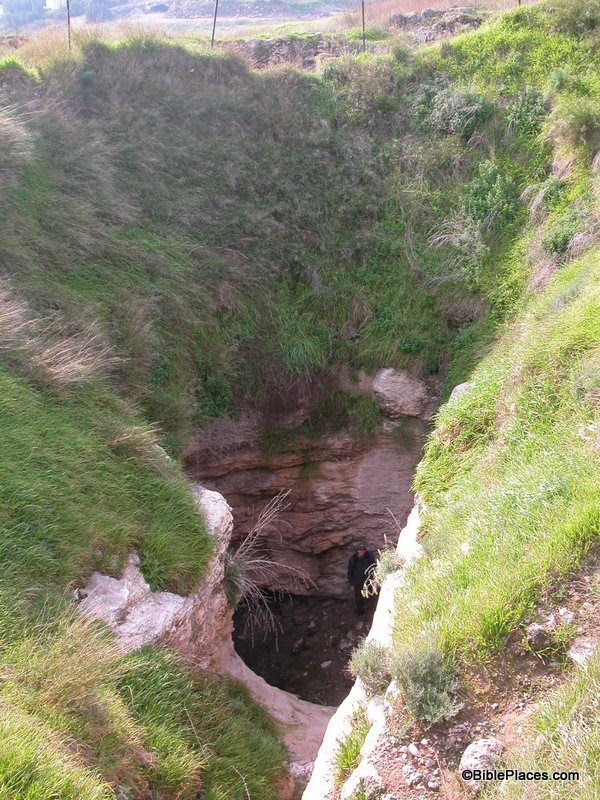
The Baptist Press recently posted an article about the Middle Bronze II water tunnel at Tel Gezer. The excavation team is currently clearing out the tunnel and conducting a detailed study of it. Below is a picture of the entrance to the tunnel taken in 2004 by Todd Bolen. The tunnel begins to the left of where the man is standing and descends underground past the left side of the picture. (Recent pictures from inside the tunnel are posted with The Baptist Press article.)

Here’s how the article describes the tunnel:

The challenge is excavating a large, rock-hewn water tunnel at Tel Gezer that is believed to have been carved out by Canaanites between 1800 and 1500 B.C. — around the time of Abraham. Tons of debris must be removed from the ancient tunnel before the real work can even begin. …

The Gezer system also is unusually large, measuring 12 feet wide by 24 feet tall, Parker noted. It is believed that the ancient people used donkeys to ferry water from the source to the surface. The width allowed two animals, loaded with jugs, to pass side by side. The height of the tunnel perplexes the expedition team, and they hope to find an explanation as they pursue the dig. …

Last summer the team began the arduous tasks of removing tons of rubble from the tunnel. During a three-week dig, they cleared 72 tons of dirt and rocks. Team members dug out the tunnel and put debris in large sacks which were hoisted out with a crane. Due to the 38-degree slope, Parker compared it to working on a steeply pitched roof.

The Middle Bronze II period was a time when the Canaanite city-states grew strong. Large public works were widespread in the region, such as city walls, massive earthen ramparts, and glacis (i.e., defensive slopes below the city walls). So the cooperation and organization needed to dig a water tunnel was relatively common during that period, but (as the article points out) elaborate water systems were not. Sophisticated water systems (such as the ones at Hazor, Megiddo, and Hezekiah’s Tunnel in Jerusalem) are more characteristic of Iron Age II cities.

Side Note: The article mentions that 1800 to 1500 B.C. is “around the time of Abraham.” The date of Abraham’s lifetime is a debated issue related to the “Early Date vs. Late Date” controversy about the Exodus. The article apparently assumes a Late Date position. My personal conviction (and that of Todd Bolen) is that the Early Date position is the correct one, which would place Abraham’s lifetime at approximately 2150 to 2000 B.C. If this is correct, then construction of the Gezer water tunnel would have occurred during the time of Israel’s 430-year sojourn in Egypt.

The Baptist Press article can be found here. Details about the dig this summer can be found here. The excavation’s homepage can be found here.

HT: Joseph I. Lauer

Share:

Zechariah’s Tomb

A 3-minute video has been added to a Jerusalem Post article about a Byzantine church at Khirbet Midras that may have been the traditional site of Zechariah’s tomb. The article was originally posted on February 3rd. Unfortunately the video contains a couple of historical errors (such as referring to the Madaba Map as “a document”[!] that was “recently found”[!!]), but it does provide more information about the site than the article itself. More information about the discovery can be found here and here.

Is this truly the site of Zechariah’s tomb? Given the fact that (so far) there is only circumstantial evidence that the church was dedicated to Zechariah, and the fact that the Byzantines do not hold a very good track record for correctly identifying holy sites … I wouldn’t get my hopes up.

HT: Joseph I. Lauer, Ferrell Jenkins

Lod Mosaic in New York

The New York Review of Books did a recent post on their blog about the Lod Mosaic. It examines the mosaic in detail, and provides several stunning photographs. The mosaic is currently on display in the Metropolitan Museum of Art and is making a tour around the US, traveling from New York to San Francisco, Chicago, and Columbus.

Boston Globe Article on the Western Wall Tunnels

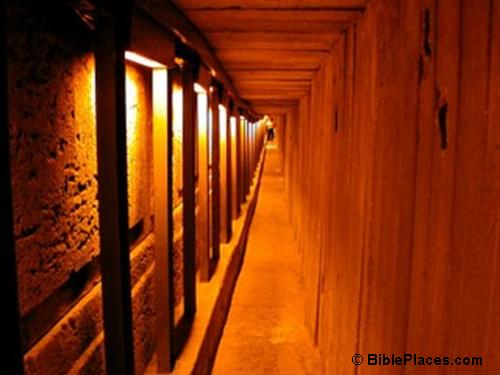
Last Sunday, The Boston Globe posted a brief article about the Western Wall tunnels. The article provides some general information about the wall and its history (both ancient and recent) but contains a couple of errors. (Namely, it states that the Jews worship the Holy of Holies[!], and that the tunnels go under the Temple Mount while in reality they travel alongside the massive retaining wall of the Temple Mount.) However, the article provides details on how you can make a reservation to take a tour and briefly describes what you will see there.

HT: Joseph I. Lauer


Anson Rainey

Of course, one of the biggest news events of the week is that Anson Rainey died on Saturday (as was posted yesterday on this blog). On Friday, interestingly enough, Biblical Archaeology Review posted a lengthy statement by Rainey in the “Scholar’s Study” section of their website. In this statement, he defends himself against recent accusations made by William Dever that he is not an archaeologist. 

The statement provides a survey of Rainey’s archaeological experience and his contributions to the field. The introduction to Rainey’s statement can be found here. The actual statement can be found here.

Mummies in Milwaukee

The Mummies of the World exhibit is currently being displayed in the Milwaukee Public Museum

This is “the largest exhibition of mummies and related artifacts ever assembled.” It will be in
Milwaukee until May 30th.

Bible Alive Seminar in Dallas

For those of you who live in the Dallas area, the Bible Alive seminar is coming to Park Cities Presbyterian Church on April 1-2. This two day event is “a multimedia contextual immersion experience in understanding God’s Word in its original historical, cultural, geographical, literary, and visual context.” The seminar was put together by Preserving Bible Times and will be taught by Doug Greenwold. More information about this event can be found here.

Share:

There is so much going on that I’m going to start the “Weekend Roundup” today and continue it tomorrow.

Shmuel Browns has posted many photographs of the “Church of Zechariah” at Khirbet Midras that was announced a few days ago.  These photos (here and here) reveal just how well-preserved the mosaic floor is.

In his interview on the LandMinds show, Leen Ritmeyer explains how he determined the location of the original Temple Mount.

On his blog, Leen Ritmeyer addresses “Tunnel-vision politics in Jerusalem” with some helpful photos and a diagram.

Zahi Hawass has an update on the state of Egyptian antiquities.  He is a very important man, as he himself observes, “I am the only source of continuing truth concerning antiquities….I am the guardian of these monuments that belong to the whole world….I want everyone to relax, and know that I am here.”

“An ancient church mentioned in the Bible has been discovered in western Turkey.”  This claim from the excavators of Laodicea is false.  The Bible describes a group of people who met for worship in
Laodicea in the first century (Rev 3:14-22).  The archaeologists found a building where Christians met in the fourth century.

This article in Jewish Ideas Daily points out some of the irony of Ahmadinejad welcoming “home” the Cyrus Cylinder.  I wonder what the chances are that it will ever be returned to the British Museum.

I encourage you to pray for Anson Rainey who is very ill and hospitalized now in Petah Tikva. 

Visiting information was posted on the Agade list (or you may contact me).

HT: Joe Lauer, Daniel Wright, Agade

Share:

A large public building that was turned into a church was recently excavated at Khirbet Midras in the Shephelah.  The area was populated in the Second Temple period and is well known for a beautiful rolling stone tomb (since destroyed by vandals). 

The archaeologists are suggesting that the church commemorated the burial place of the prophet Zechariah.  Given that the sources for this appear to date nearly 1,000 years after Zechariah’s death (c. 500 BC), it may be best to regard this as a dubious Byzantine tradition.  Some of the overstated wording of the IAA press release suggests that this claim is going to be the basis for reconstruction and promotion of the site.  From the press release:

A public building of impressive beauty dating to the Byzantine period, in which there are several construction phases, was exposed in the excavation. In the last two construction phases the building was used as a splendid church. However, based on the results of the excavation and as evidenced by the artifacts, it seems that this church is built inside a large public compound from the Second Temple period and the Bar Kokhba uprising which was used in the first construction phases of the compound.
The church, in its last phases, was built as a basilica, at the front of which is a large flagstone courtyard from which worshippers passed into an entry corridor. Through a shaped opening one enters into the nave where there were eight breathtaking marble columns that bore magnificent capitals which were specially imported from Turkey. At the end of the nave is a raised bema and on either side of the nave are two wide aisles. All of the floors in the building were adorned with spectacular mosaic floors decorated with faunal and floral patterns and geometric designs that are extraordinarily well preserved. Located behind the bema are two rooms, one paved with a marble floor and the other that led to an underground tomb devoid of any finds. Branching out beneath the entire building is a subterranean hiding complex in which there are rooms, water installations, traps and store rooms. This complex belongs to the large building from the Second Temple period which the Byzantine church was built into. Among the artifacts discovered in the hiding complex are coins from the time of the Great Revolt (66-70 CE) and the Bar Kokhba uprising (132-135 CE), stone vessels, lamps and various pottery vessels that are characteristic of the Jewish population from the settlement at that time.
As previously mentioned, researchers who visited the site are of the opinion that this place is the residence and tomb of the prophet Zechariah. Ancient Christian sources identified the burial place of the prophet Zechariah in the village of Zechariah, and noted that his place of burial was discovered in 415 CE. The researchers believe that in light of an analysis of the Christian sources, including the Madaba Map, the church at Horbat Midras is a memorial church meant to mark the tomb of the prophet Zechariah. This subject will be examined and studied in the near future.

The full story and the two photos posted below are available at the IAA website (also at the MFA website).


Byzantine church at Khirbet Midras.
Photos courtesy of the Israel Antiquities Authority
Share:

I enjoy historical fiction, but I seem to be unable to combine my interest in the biblical world with a good story because worthwhile books are just not being written.  I was happy to hear that Tim Frank has just published a book set in the late 8th century of Judah.  Daughter of Lachish tells the story of a girl who survived the siege of Sennacherib and tries to rebuild her life in its aftermath.  From the bookjacket:

The mighty Assyrian army has invaded the tiny kingdom of Judah to crush the rebellion against the great king Sennacherib. After a long siege, the Assyrians capture the fortified city of Lachish. They show no mercy to the vanquished people. But one girl is able to escape-Rivkah. She hides in the hills and finds refuge in the company of other survivors. In a devastated land they seek to rebuild their lives. The words of the prophet Micah-spoken to the people over many years-speak to Rivkah anew, allowing her to see the events in a new light.
image
Drawing on extensive scholarly research, Daughter of Lachish brings to life the world of Ancient Judah. It melds archaeology and biblical studies to tell a story of the people who first heard the words of the Psalms and Prophets. It is a story of one girl, her search for a place in the world, and her quest to make sense of loss and joy. Through her eyes we experience the daily tasks, the seasons of the agricultural year, the bonds that hold together a household and a village, and the tensions that threaten to tear them apart.

Tim Frank brings extensive knowledge of the ancient world to his writing, serving as a supervisor at the Lahav Research Project (Tell Halif), excavating at Tel Burna (near Lachish), and presently working in the Middle Eastern collection at the Cobb Institute of Archaeology.  Judith McKinlay praises Frank’s abilities as a storyteller:

I could not stop reading this story. This is a biblical world engagingly alive, with its carefully researched details of the Assyrian war machine devastating life in eighth-century Judah and its strong characters determined to survive. I felt for Rivkah, survivor of Lachish. With biblical passages interwoven, most significantly the prophecies of Micah, met in person in the latter part of the novel, it is also a tale true to the biblical faith.
—Judith McKinlay, University of Otago

Full details and ordering information are here.  The book costs more than your average mass-market work of fiction and that’s because this isn’t a book for the “mass market.”  For a great education that takes me on a delightful journey, I’m happy to pay a little more, with hopes that we’ll see more such works in the future.

Share: