The Jan/Feb 2009 issue of Biblical Archaeology Review has a summary of the Kh. Qeiyafa excavations.  Most of the information has already been reviewed at this blog and others, but the article is nicely presented with beautiful photographs (online teaser here).  The article concludes with editor Hershel Shanks pressing excavator Yosef Garfinkel to release photographs of the ostracon.

So what does the inscription say? The decipherment has been assigned to Haggai Misgav, a Hebrew University epigrapher. “So can we see a high-resolution image of the inscription?” I asked Garfinkel. “Maybe our readers would have some helpful suggestions for Misgav,” I urged. All to no effect. Yossi stuck to the time-honored tradition that a readable picture of the inscription remain a secret until the scientific report is published in a scientific journal by the scholar assigned to publish it: Remember the Dead Sea Scrolls.
“Be a hero! Break the mold,” I urged Yossi. No way, he responded. He did tell us that the first line contains the Hebrew words “don’t do,” and that “king,” “judge” and “slave” also seem to be legible, but “it is still premature to talk about the content,” he maintains.
So when will we see a picture of the inscription with all of its indistinct letters? If the past is any guide, it will be a year or more. Is this any way to run a railroad?
Haggai Misgav has a reputation for being a very competent epigrapher. But he can only be helped, not hurt, by what other scholars (and even amateurs) have to say prior to his official publication. You can be sure, he will show the ostracon and high-resolution pictures (and infrared images as well) to friends and colleagues. He will take some of their suggestions and thank them in his publication of the ostracon. So why not enlarge the circle? It cannot hurt, and it may help. In any event, an early look at the inscription will not detract from his fame as the publisher of the famous ostracon from Qeiyafa.

As an aside, if you have this issue of BAR, or online access by personal or institutional subscription, take a look at the third article in the “Strata” column, “Gold-Plated Building Stone Found Near Temple Mount.”  Very interesting.

(HT: Joe Lauer)

The discussion about the site identification of Qeiyafa is continued by Nadav Na’aman in the Journal of Hebrew Scriptures (8/24; full pdf online).  He disagrees with Garfinkel’s identification of the site as Shaaraim, in his article entitled “Shaaraim – The Gateway to the Kingdom of Judah.”  The abstract reads:

The article discusses the location of the city of Shaaraim mentioned in Josh 15:36 and 1 Sam 17:52. It first argues that its proposed identification with Khirbet Qeiyafa, north of the Elah Valley is mistaken. Then it argues that Shaaraim is located on the main road that led from the Valley of Elah to the city of Gath. This article proposes that the place-name Shaaraim means “gate” and that the city was named so because it was located on the western border of Judah with Philistia, a place that was seen as the gateway to the kingdom of Judah.

Na’aman makes some points that I have made previously, and that I think are obvious and difficult to circumvent.  I am working on an article on the subject and thus will restrain myself from further analysis at this time.
Share:

I’m in the midst of compiling my “Top Five” list of archaeological discoveries of the year, and since Khirbet Qeiyafa stands a chance at making the top of the list, I thought it might be appropriate to share a recent “introduction” to the site that was included in the latest BiblePlaces Newsletter.  This may be especially helpful to those who have not had the time to read some of the lengthy posts here.


Defining terms: Khirbet is a word with a meaning similar to “tell.”  Whereas a tell has many layers, a khirbet consists of one or two, meaning that people only lived there in one or two periods in ancient times.  Khirbet is often translated “ruin,” as opposed to a tell, which is translated as “mound.”


Qeiyafa is the name the locals gave to this particular ruin.  Sometimes the modern names preserve the ancient name (for instance, Beisan was the Arabic name of biblical Beth Shean). 


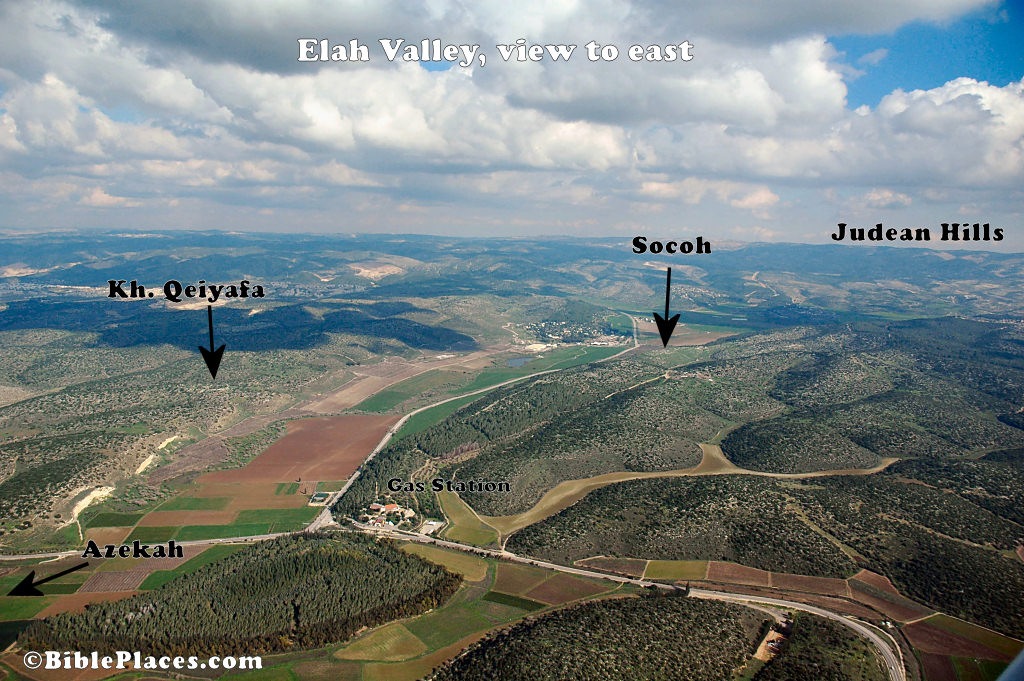
Where is it?:  Kh. Qeiyafa is located in the western foothills (Shephelah) of the Judean hill country.  More specifically, it sits on the northern side of the Elah Valley.


Elah Valley, that sounds familiar: Yes, that’s because when David fought Goliath, the two armies were situated on hills on opposite sides of the Elah Valley (1 Sam 17:2-3).

Elah Valley aerial from west, tb011606772_marked


David and Goliath?: That’s where this whole story gets real interesting.


Tell me more: After two seasons of excavating, the ruins at Kh. Qeiyafa date to approximately 1000 B.C.  According to the biblical chronology, David became king over Judah in about 1000 B.C.


Too bad they didn’t find an inscription: Actually, they did!  It may be the earliest Hebrew inscription.  It is quite difficult to read, which is why a translation has not yet been published.


Is Qeiyafa in the Bible?: Maybe.  The excavator once suggested that the site was Azekah (1 Sam 17:1).  Now he has proposed that it is Shaaraim (1 Sam 17:52).  Another scholar has identified the site as Gob (2 Sam 21:18-19).  I have argued that it may be Ephes-dammim, where the Philistine army was camped when they fought David (1 Sam 17:1).


What’s the bottom line:
1) This is an important site from the time of David.

2) Critical scholarship that has tended to minimize the importance of the Israelites during this time may need to revise their conclusions. 

3) The inscribed potsherd is likely to be a big story when it is translated. 

4) Continued excavations will likely reveal more in future years.


Where can I find more?: You can google Qeiyafa, go straight to the excavation’s website (#1 and #2), read my analysis of why the site may be Ephes-dammim, and why I don’t think it is Shaaraim or Gob.  Other posts I have written (or will write) may be found here.

Share:

I have more to say about Khirbet Qeiyafa, but time is tight right now and a more careful presentation will have to wait.  But there are a few developments I can note and a few comments I can respond to, all in brief fashion.

First, G. M. Grena posted on the comments here this morning that the PowerPoint presentation that excavator Y. Garfinkel gave at the ASOR meeting last week is now available in pdf format.  This is a great resource for those who want to know more but couldn’t be there. 

Second, if you’re interested in following the ostracon on its tour of the most expensive cameras in the world, you can do that here.  Thanks again to G. M. Grena for alerting us.

Now, to an article by Bloomberg about Qeiyafa which includes two quotations from scholars.  The first is from N. A. Silberman, known for his extreme views that much of the Old Testament was written very late by priestly propagandists.

“To find an apple tree in some town in the Midwest doesn’t mean the Johnny Appleseed legend is exactly correct,” said Silberman, co-writer with Israel Finkelstein of “The Bible Unearthed: Archaeology’s New Vision of Ancient Israel and the Origin of Its Sacred Texts.”

This is really quite an apt analogy.  Except for the fact that the site was found precisely in the exact area where the battle of David and Goliath was fought.  And it dates precisely to the time period when the Bible says that David lived.  Sorry, sir, you can’t wish this away so easily.

The excavator of Qeiyafa, unfortunately, doesn’t do much better.

Garfinkel, gesturing toward a nearby hill where he said the Philistine city of Gath once stood, said he believes his find brings to life the tale of David killing the Philistine giant Goliath with just two stones.
He said he would have agreed with Silberman’s views on David before the dig: “Once it was excavated, it changed the whole situation.”

So until this summer Garfinkel apparently held to the view that Silberman espouses, which is that Judah was a sparsely populated hinterland during the time of David (and for the next several hundred years).  But he finds a small walled city and a potsherd with writing on it, and suddenly, everything has changed?  This tells me either that he has a super-high estimation of the value of what he found, or he is ignorant of some important data.  How does Qeiyafa revolutionize things when decades ago, a much more impressive fortification from the 10th century was found at Gezer (11 miles to the north)?  What about Azekah about 1 mile to the west?  True, it hasn’t been excavated (by someone other than Robert Alexander Stewart Macalister 100 years ago), but shouldn’t that very fact give someone (both Silberman and Garfinkel) pause before concluding that Judah was weak and impoverished in the “time of David”?  Who knows what you’ll find at Azekah!  Just down the road is Gath, which is proving to look quite similar to what we would expect from the biblical account. 

Now, perhaps Garfinkel was speaking not of the (lack of unique) fortifications, but rather of the ostracon.  Surely, this is an important discovery.  Just how important we may not know until the text is recovered by photography and it is published.  But, is it really accurate to say that on the basis of this one as-yet-undeciphered ostracon that “it changes the whole situation”?  It’s not like we don’t have other 10th century inscriptions from the area–the Gezer Calendar has been known for 100 years, and the Tel Zayit inscription was discovered a few years ago.  So we have known that ancient Judah was literate and had fortified cities in the Shephelah for a long time now.  But Garfinkel (apparently) denied these realities meant anything because he would have agreed with Silberman’s views.  But now, on the basis of his finds, everything has changed in his mind.  This all suggests to me that some scholars come to conclusions without carefully considering all of the evidence.

Chris Heard at Higgaion has posted a few comments that I want to note.  The first point is outstanding and in sharp contrast to the two quotes above:

Reports of the “low chronology’s” death may be greatly exaggerated, or premature, but Khirbet Qeiyafa must surely influence our picture of 10th-century Judah. Let us not overstate the case: what we (the interested public) know of Khirbet Qeiyafa at this point hardly “proves that David killed Goliath” or anything of that sort. However, Khirbet Qeiyafa does counterbalance the increasingly common portrayal of 10th-century Judah as a cultural backwater.

Yes, indeed.  Overstatements are far too common among scholars talking to journalists.  But this part I cannot agree with:

The identification of the site as Sha‘arayim seems quite likely now, completely independent of anything learned from the ostracon.

This conclusion is unwarranted on the basis of the current evidence.  It seems to rely on the excavator’s word, and not the data.  But I urge caution.  1) Last year the excavator said the site was Azekah.  Frankly, that’s most unlikely on many accounts.  It comes from the urge to have your site be something important.  It demonstrates that the excavator did not properly consider the data from history and geography in making the identification.  2) Historical geography seems to have been ignored in this identification of Qeiyafa as Shaaraim as well.  I have discussed this before and will be saying more about it.  3) The sole basis for identifying Qeiyafa as Shaaraim is this: Shaaraim means “two gates.”  (The three reasons listed on slide 33 all argue against identifying Qeiyafa as Shaaraim, which I will demonstrate in the future.) The excavator has excavated one and eyeballed what he believes is another one from the same time period.  No excavations have been done of the second gate.  The meaning of the name is significant, but my question is: does it override other evidence? 

Again, I simply suggest that more study occur before we decide that the identification as Shaaraim “seems quite likely now.”

If all of this is too basic for you and you’d prefer to read about some analysis about radiocarbon dating related to Qeiyafa, see this post by Abnormal Interests.  John Hobbins also has some more thoughts about the site identification, to which I’ll respond in the future aforementioned post.

Update (12/5): I have removed reference to the Ephes-dammim credit line in the pdf file as that has
now been updated (see comment below).

Share:

The LA Times has a good article on the recent photographing of the 5-line early Hebrew ostracon found at Khirbet Qeiyafa.  One portion:

The result is hundreds of high-resolution images shot with different light filters. Using a process called spectral imaging, Boydston and Bill Christens-Barry, another imaging expert, aimed to maximize the contrast of the ink, made of charcoal and animal fat, against the terra-cotta piece.
Although they didn’t find any hidden text, the images will be sent back to Israel. Other high-tech images were produced — using slightly different imaging techniques — at Cedars-Sinai Medical Center in Los Angeles and two other technical shops on the East Cost. [sic]
Once the shard’s message is fully scrutinized and decoded, findings will be published in scholarly journals by Yosef Garfinkel of Hebrew University, who led the dig. A few words already deciphered — “slave,” “king,” “land” and “judge” — indicate that it may be a legal text, lending weight to some scholars’ belief that King David wielded considerable power over the Israelites.

The article gives much background about the firm that took the photographs, including mention of an early digital camera that they created – that weighed 300 pounds (136 kg)! 

HT: Paleojudaica (who also notes some speculation about the contents of the ostracon)

Share:

The Book and the Spade radio program just posted the first of two interviews with Qeiyafa excavator Yosef Garfinkel (the link there is updated every week for the current program).

National Geographic reports on the Qeiyafa excavation.  Much of the story reports what has been covered elsewhere, but there are some problems with the article.  (Does mentioning these help to prevent their perpetuation by journalists or others?)

The article begins:

The remains of an ancient gate has pinpointed the location of the biblical city Sha’arayim, say archaeologists working in Israel.
In the Bible, young King David is described as battling Goliath in the city, before eventually killing him in the Elah Valley.

Ahem.  Is it really that hard for the NG journalist (Mati Milstein) to open the Bible (1 Samuel 17) and read the story of David and Goliath?  The battle did not occur in a city, and Shaaraim is mentioned only as a point on a road that the Philistines used to flee.  It’s quite a creative re-telling that puts the battle in the city, but Goliath’s eventual death in the valley.  Even if the writer couldn’t find a Bible (or locate one on the Internet), couldn’t he have asked the archaeologist he was interviewing?  Since this is the entire reason why anyone cares about this excavation as opposed to the hundreds of others in Israel (and this is evidenced by its placement in the first two paragraphs), shouldn’t NG try to get at least this right?  If they can’t, can you trust anything in the article?

Later in the article, archaeologist Amos Kloner comments on the site identification:

“This is an initial idea, all aspects of which must be examined,” he said. “[But] it doesn’t matter if there is a second gate … This provides no indication of a Judean population there.”

Apparently Garfinkel hasn’t convinced everyone that the mere presence of a second gate absolutely and infallibly confirms that Qeiyafa is Shaaraim.  I think, however, that Kloner is wrong if he follows Garfinkel in the idea that Qeiyafa must be a Judean site in order to be Shaaraim.  In fact, as I argued before, I think a better case can be made from the only source that we have that at the time of the
battle, Shaaraim was in Philistine hands. 

The article closes with this quote from Garfinkel:

Garfinkel said he will continue to explore the Elah site in search of further evidence.
“Maybe we’ll find an inscription on the gate indicating who built the city: ‘I David, son of Yishai, built this city,'” he said with a laugh.

That’s a typical archaeologist kind of joke, and it wouldn’t be worth a response, except that Garfinkel has suggested elsewhere that he is serious about the possibility that David built the Qeiyafa fortress. 

I think it is entirely possible that David built the Qeiyafa fortress, but if he did, Qeiyafa is not Shaaraim.  You can have one, but not the other, unless you believe the biblical account is completely confused.  This is the big problem with those scholars who want to claim the “middle ground” between maximalists and minimalists: they claim validation for their results based upon data which they believe is faulty.  In other words, the scholar says, our evidence that Qeiyafa is Shaaraim is the biblical text which mentions this site (Shaaraim) in this area (Elah Valley).  The Bible says that Shaaraim existed before David became king.  We can believe the Bible that Shaaraim was a city in this area, but we can’t believe the same biblical story that Shaaraim existed before David.  This is very typical scholarly logic, but it is usually dressed up in fancy language, and supported by one questionable hypothesis built upon another dubious theory.

UPDATE (10 p.m.): The initial paragraphs of the NG article have been changed:

The remains of an ancient gate have pinpointed the location of the biblical city Sha’arayim, say archaeologists working in Israel.
In the Bible young David, a future king, is described as battling Goliath in the Elah Valley near Sha’arayim.

Share:

Owen Chesnut has blogged about Archaeologist Yosi Garfinkel’s presentation (and questions) yesterday at the ASOR meeting about Khirbet Qeiyafa.

The excavators have posted a “chronicle” of events related to the discovery of the Kh. Qeiyafa ostracon, including when they celebrated with a beer and when (and by whom) details leaked to the public. (HT: Yitzhak Sapir).

National Geographic has a good article on the problem of the looting of archaeological sites in Israel. 

If you’ve ever bought an antiquity, you help to create the demand, and perhaps this article will help shed light for you on just how destructive the antiquities market is.

PBS broadcast a special earlier this week on the Bible and archaeology, entitled “The Bible’s Buried Secrets.”  You can watch the entire 2-hour show online, get a summary, or read the whole transcript. 

The perspective was decidedly mainstream, with no indication that there is a large group of conservative scholars who reject many of the conclusions of mainstream scholars.  The program was well produced and featured interviews with many scholars. 

Share: