Haaretz:

Israel’s leading ultra-Orthodox rabbis are waging a new offensive against Jews visiting Jerusalem’s Temple Mount.
Rabbis Shalom Elyashiv, Chaim Kanievsky and Ovadia Yosef sent a letter recently to Rabbi Shmuel Rabinovich, the overseer of holy places in the Western Wall complex, urging him to reiterate the religious decree signed 40 years ago by most rabbis in Israel forbidding Jews from entering the Mount.
The rabbis’ efforts follow the publication in Haaretz last month of the visit of Rabbi Moshe Tendler, the son-in-law of prominent U.S. rabbi Moshe Epstein, to the Temple Mount.
Rabbi Tendler was photographed visiting the plaza atop the Mount, where the Dome of the Rock Islamic shrine now sits, igniting a firestorm of controversy in the ultra-Orthodox community. Several other prominent ultra-Orthodox rabbis have ascended the Mount in recent years, including Rabbi Dov Kook of Tiberias, the husband of Elyashiv’s granddaughter.
The rabbis’ statement calls for a complete ban on entering any part of the Temple Mount complex for fear of compromising the “purity” of the area.
The declaration stated that “as time passed, we have lost knowledge of the precise location of the Temple, and anyone entering the Temple Mount is liable to unwittingly enter the area of the Temple and the Holy of Holies,” referring to the inner sanctuary of the Temple tabernacle.
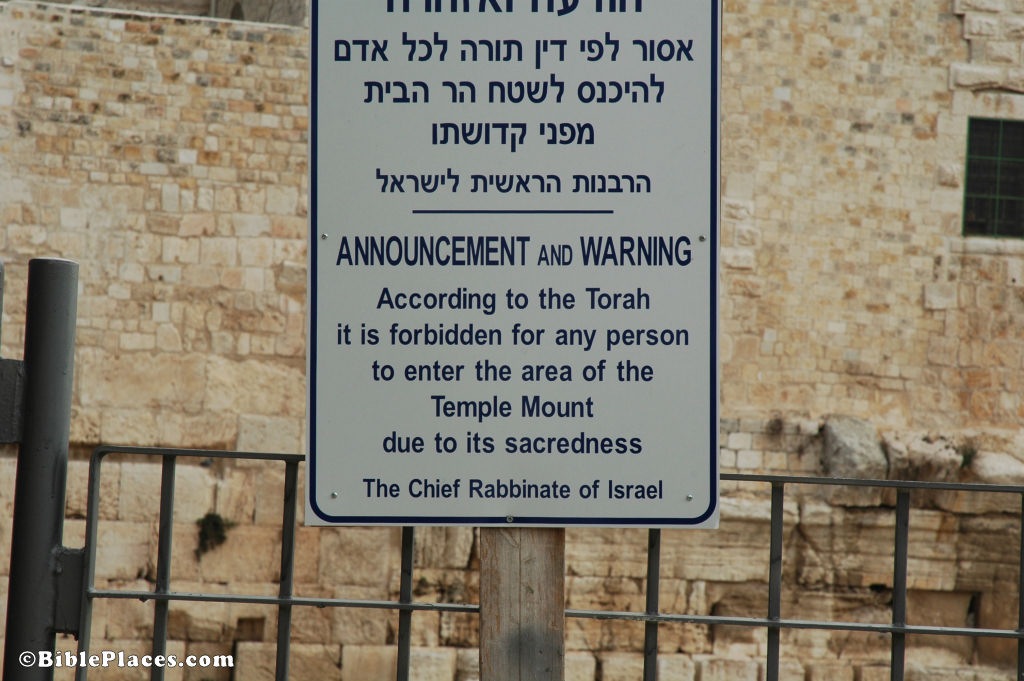
Temple Mount entrance forbidden by rabbis sign, tb122604453

The story continues here.

HT: Joe Lauer
Lela Gilbert has an article in the Jerusalem Post on the recent trend of denying that a Jewish temple existed in Jerusalem.  It includes a lengthy interview with archaeologist Gabriel Barkay, and concludes:

IN SPITE of these discoveries, Temple denial remains a growing phenomenon in Europe and America, particularly in leftist intellectual circles. It is supported by the reality that there are no visible remains of the temples of Jerusalem on the Temple Mount. Barkay contends that there were remains still visible in the 1960s and 1970s, which have either been removed or covered up by gardens.
“The Islamic Wakf says, ‘We are not going to let you dig, but show us any remains of the Temple.’ You cannot have it both ways. If you don’t allow people to dig, then don’t use this absence of remains as an argument.
“Temple denial is a very tragic harnessing of politics to change history. It is not a different interpretation of historical events or archeological evidence. This is something major. I think that Temple denial is more serious and more dangerous than Holocaust denial. Why? Because for the Holocaust there are still living witnesses. There are photographs; there are archives; there are the soldiers who released the prisoners; there are testimonies from the Nazis themselves. There were trials, a whole series of them, starting with Nuremberg. There are people who survived the Holocaust still among us. Concerning the Temple, there are no people among us who remember.
“Still, [to deny the Temples], you have to dismiss the evidence of Flavius Josephus; you have to dismiss the evidence of the Mishna and of the Talmud; and you have to dismiss the writings of Roman and Greek historians who mention the Temple of Jerusalem. And you have to dismiss The Bible. That is, I think, way too much.”

Previous related post: Muslims Recognize Temple’s Existence

HT: Joe Lauer

Leen Ritmeyer has a posted (with a follow-up) on his identification of several stones in the eastern wall of the Temple Mount that are clearly pre-Herodian.  Ritmeyer dates them to the time of King Hezekiah, suggesting that he was the one to build the 500-cubit square Temple Mount that Ritmeyer has previously identified.  He includes some helpful illustrations and photos.

A review of current excavations in Turkey is given at Today’s Zaman.  New Testament sites being excavated include Alexandria Troas, Miletus, Hierapolis, Sardis, Smyrna, and Laodicea.  There are many other sites as well.  Many of these cities have very impressive remains, unlike many sites in Israel.  Today’s Zaman also has an article on recent discoveries at Sardis.

NASA has a photo of a street of Ephesus at night, with (the planet) Jupiter illuminating the way.
Across the way in Greece, the ancient hippodrome of Olympia has been discovered.  This is a good story that counters the myth that everything to be found has already been found.

A couple fragments of the Dead Sea Scrolls have now been published by James H. Charlesworth. 

One of the fragments may be from the Samaritan Pentateuch, and the other appears to be from Nehemiah, making it the first portion of that book to be found among the DSS.  Paleojudaica gives more info and links.

If you’re a tourist in Israel and have a question, you can now call the 24-hour tourist hotline.  It’s easy (dial *3888), but it’s not a toll-free number.

Like the quarry found last year, this one is north of the Old City.  From the Jerusalem Post:

For the second time in the past year, archeologists have uncovered a Second Temple Period quarry whose stones were used to build the Western Wall, the Israel Antiquities Authority announced Monday. The latest archeological discovery was made in the city’s Sanhedria neighborhood, located about two kilometers from the Old City of Jerusalem. The quarry was uncovered during a routine "salvage excavation" carried out by the state-run archeological body over the last several months ahead of the construction of a private house in the religious neighborhood. The quarry is believed to be one of those used to build the Jerusalem holy site because the size of the stones match those at the Western Wall. "Most of the stones that were found at the site are similar in size to the smallest stones that are currently visible in the Western Wall, and therefore we assume that the stones from this quarry were used to build these structures," said Dr. Gerald Finkielsztejn, director of the excavation. The stones were dated by pottery found at the site, he added. "This is a rather regular quarry except that there are really big stones," Finkielsztejn said. The largest of the stones found at the quarry measures 0.69 x 0.94 x 1.65 m, while some of the stones were apparently ready for extraction but were left in place. The quarry was probably abandoned at the time of the Great Revolt against the Romans in 66-70 CE, he said.

The Jerusalem Post is reporting that stones in the Western Wall are crumbling.  A little background:

The “Western Wall” is a 60-meter section of a 480-meter long western compound wall of Herod’s Temple Mount.  This portion of the wall has been revered by Jewish people for centuries as a place of prayer because the temple does not exist and access to the temple court areas has been forbidden (either by rabbis or Muslim rulers or both).

Three distinct sections of construction are visible in the prayer portion of the Western Wall today. 

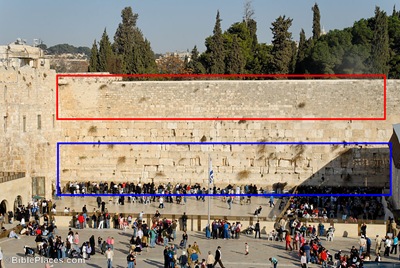
The lowest seven courses (blue box in photo below) were constructed by King Herod in the 1st century B.C.  The wall above this was destroyed, probably mostly in the Roman destruction of A.D. 70.  Arab rulers in the 7th-8th centuries rebuilt part of the wall and these stones are visible above the Herodian stones (between blue and red boxes). 

In the 19th century, there were problems with Muslims throwing objects and trash from the Temple Mount down on Jewish worshipers at the wall and so the British-Jewish philanthropist Moses Montefiore donated so that the wall could be built to a higher level.  It is these stones (in red box) that are the subject of this JPost story.  Read the article to learn more about whether the rabbis will permit restoration or not.

Western Wall, tb122006991
The crumbling stones are the smallest and most recent stones (red box). 
The original Herodian stones are in the blue box.
Update (4/17): Leen Ritmeyer has a lengthy explanation of the situation on his blog.

The Canadian Jewish News has an article about the archaeologist who found Iron Age period remains on the Temple Mount a few months ago

Yuval Baruch, left, made archeological history in October 2007 when he uncovered pottery artifacts on the site of Jerusalem’s Temple Mount. They are considered to be the first physical evidence of human activity during the time of King Solomon’s Temple (the First Jewish Temple). Baruch, who is Jerusalem’s district archeologist at the Israel Antiquities Authority, speaking at the Berney Theatre here, outlined his world-famous discovery as part of a lecture series put on by the Canadian Friends of the Hebrew University.

And the interesting part:

“I was not supposed to be left there alone, as the Waqf always has someone present when Israeli archeologists are on the site. It was in the evening after 8 p.m., and by chance the Arab electrical workers left me and a member of my staff for about 15 minutes while they went to pray. When I was alone in that brief time, I found the pottery shards among dust near the bedrock level,” he says.

And what he found:

Baruch’s findings include animal bones; ceramic bowl rims, bases and body shards; the base of a juglet used to pour oil; the handle of a small juglet; and the rim of a storage jar. In addition, a piece of a whitewashed, handmade object was found. It may have been used to decorate a larger object or may have been the leg of an animal figurine. The finds are dated from eight-to six-century BCE.

And I bet you can’t believe this:

“The reaction of the Muslim authority [the Waqf] was to ignore the finds,” he adds, which he says was not surprising since over the years the Waqf has tried to undermine Jewish historical ties to the site. “The Waqf’s official position is that there was never a Jewish Temple on the Temple Mount, he says.”

You can read the full story here.