Archaeologists working at Huqoq in Galilee discovered an extensive underground complex used by Jewish villagers to hide from the Romans during the First and Second Jewish Revolts. The site will be open to visitors on March 29 and April 5 with free registration.

In a new relief sculpture discovered in eastern Turkey, “Antiochos of Commagene calls on the people to ‘obey and respect the law.”

Lechaion, one of the harbors of ancient Corinth, is at least 500 years older than previously thought.

Israeli authorities arrested Palestinians who built a parking lot on top of Umm ar-Rihan, a Second Temple period archaeological site in the northern West Bank.

New release: Jerusalem through the Ages: From Its Beginnings to the Crusades, by Jodi Magness (Oxford University Press, 624 pages, $40; also at Amazon)

New release: Transjordan and the Southern Levant: New Approaches Regarding the Iron Age and the Persian Period from Hebrew Bible Studies and Archaeology, edited by Benedikt Hensel (Mohr Siebeck, €109)

New release: What’s in a Divine Name? Religious Systems and Human Agency in the Ancient Mediterranean, edited by Alaya Palamidis and Corinne Bonnet (De Gruyter; $165; free download)

James Riley Strange reviews Ancient Synagogues Revealed 1981–2022, edited by Lee I. Levine, Zeev Weiss, and Uzi Leibner.

Infusion Bible Conference is offering a digital download of “The Last Days of Jesus” conference (video lectures and notebook) for $69.

The Ancient Arabia website features a digital atlas, a gazetteer, and a thematic dictionary.

All Israel News has an article about two tabernacle replicas in Israel.

Hayah Katz believes that decline of Christian interest in biblical archaeology has contributed to increasing Jewish interest in the field.

Leon Mauldin just visited Ostia, the port city of Rome, and he shares some photos from his visit.

Ferrell Jenkins has posted photos of Corinth’s temple of Apollo and Erastus inscription.

Abigail Leavitt: “I spent the past week digging at Khirbet Rafid, a site across the highway from Tel Shiloh.”

HT: Agade, Gordon Franz, Gordon Dickson, Arne Halbakken
Share:

Excavation results have been published for a salvage dig at Zanoah, a site located near Beth Shemesh and mentioned in Joshua 15:34 and Nehemiah 3:13 and 11:30.

Jerusalem Post: “A scroll unearthed in the Judean Desert is shedding light on the ancient practices of astrology and mysticism in a discovery that has intrigued historians and archaeologists alike.”

Haaretz: “Archaeologists have uncovered the ruins of a Canaanite temple built to greet the rising sun atop the mound of Azekah.”

“Archaeologists have discovered about 8,600-year-old bread at Çatalhöyük, a Neolithic settlement in central Turkey.”

“The Pompeii Archaeological Park is launching a 100-million-euro project aimed at regenerating the archaeological and urban landscape of the ancient Roman city. As well as reimagining the way visitors interact with the site, the project will carry out the largest archaeological campaign at Pompeii in more than 70 years.”

Jason Borges shares highlights from his recent trip through Caria, including stops at Magnesia, Bodrum (Halicarnassus), Tlos, and Oenoanda.

A professor at Columbia University is leading the Mapping Mesopotamian Monuments project.

Haaretz (subscription): Roman routes are an “unexploited tourist opportunity” in Israel.

In conjunction with the “Legion” exhibit now at the British Museum, Mary Beard writes about the role of women in Roman military life.

“The Louvre’s Department of Near Eastern Antiquities is hosting ten major works from New York’s Metropolitan Museum of Art, whose Department of Ancient Near Eastern Art is currently closed for renovation.” Now through September 2025.

Webinar on April 18: “Amorites, Their Origins, and Their Legacy,” by Aaron Burke ($7-13)

Aren Maeir shares three of his more popular lectures now on YouTube.

New release: 1 & 2 Kings: A Visual Commentary, by Martin O’Kane (Sheffield Phoenix, $47.50 with code “scholar”). “With its over one hundred and seventy-five full-colour images, from Christian mediaeval manuscripts and Persian and Ottoman miniature paintings to contemporary Jewish art, the volume shows why stories from 1&2 Kings feature so prominently in the artistic and cultural worlds the three religions have helped to shape.”

The Lexham Geographic Commentary set is now on sale for Logos Bible Software at 55% off. For $108, you get three volumes that have already been released and three that are forthcoming.

Bible Mapper Atlas has posted a collection of map links for Holy Week, including two for Sun/Mon, two for Tues/Wed, and two for Good Friday and Easter Sunday.

HT: Agade, Arne Halbakken, Keith Keyser

Share:

“A rare coin from the time of the Bar Kochba revolt, bearing the name ‘Eleazer the Priest,’ has been discovered at the foot of a cliff in the Judean Desert by Israeli archaeologists.” The IAA is also welcoming the public to join them in the hunt for antiquities in the Judean wilderness.

The bust of a huge statue of Ramses II was discovered in the el-Ashmunein area in Minya Governorate in Egypt.

Archaeologists have uncovered a painting in the House of Leda at Pompeii that “depicts Phrixus and Helle, two twins from Greek mythology, as they travel across the sea on a magical ram while fleeing from their evil stepmother.”

The Latin Patriarchate of Jerusalem has inaugurated its Biblical Studies and Archaeology Center.

The NY Times has a story on the purple dye factory at Tel Shiqmona.

With the opening of the entrance pavilion to the Tower of David Museum, The Jerusalem Post has a story about the design and construction process.

Amy Erickson explores the question of why the story of Jonah was so frequently depicted in the catacombs of Rome.

The plant remains discovered in the Philistine temples at Gath are the subject of the latest episode of This Week in the Ancient Near East.

Nathan Steinmeyer explains why the Babylonian king Nabonidus may be considered the world’s first archaeologist.

Zoom lecture on Mar 12, 11:00 Eastern Daylight Time: “The cities of the Zagros and their scenes on the Assyrian wall reliefs,” by Dlshad Aziz Marf (Zoom link)

Dewayne Bryant is a guest on Digging for Truth to talk about the historicity of King David.

Now online: The full episode of National Geographic’s “Buried Secrets of the Bible with Albert Lin: Sodom & Gomorrah” (45 min)

The latest Jerusalem in Brief looks at “a tower named after a Philistine giant, some new books, and a dinner party in the middle of World War I.”

HT: Agade, Ted Weis, Gordon Dickson, Keith Keyser

Share:

The oldest gold artifact discovered in Jerusalem attests to Phoenician presence in the city in the time of King Solomon. Writing for Haaretz, Ariel David disagrees.

“The discovery of numerous plants in two temples unearthed at [Gath] unraveled unprecedented insights into Philistine cultic rituals and beliefs – the food ingredients in their temple, the timing of ceremonies, and plants for temple decoration.”

A new multi-level sunken entrance pavilion opens this month for the Tower of David Museum.

Abigail Leavitt provides a report on the short excavation season at Fazael (Phasael) in the Jordan Valley.

Israel’s Good Name reports on his visit to the Lod Mosaic Center.

Shmuel Browns has posted a few drone photos taken around Israel.

Carl Rasmussen’s video series “Encountering the Holy Land” for Logos Bible Software is on sale ($18).

Course registration is now open for Spring online courses at the Jerusalem Seminary, including Biblical Feasts, Biblical Hebrew, Israel Matters, and Jewish Life: Then and Now. Scholarships and discounts are available.

I will be speaking next month in Jerusalem University College’s Culture Counts online series on “The Psalms of David and Solomon.” Registration is free and includes access to the recording.

HT: Agade, Arne Halbakken, Gordon Dickson, Gordon Franz, Steven Anderson

Share:

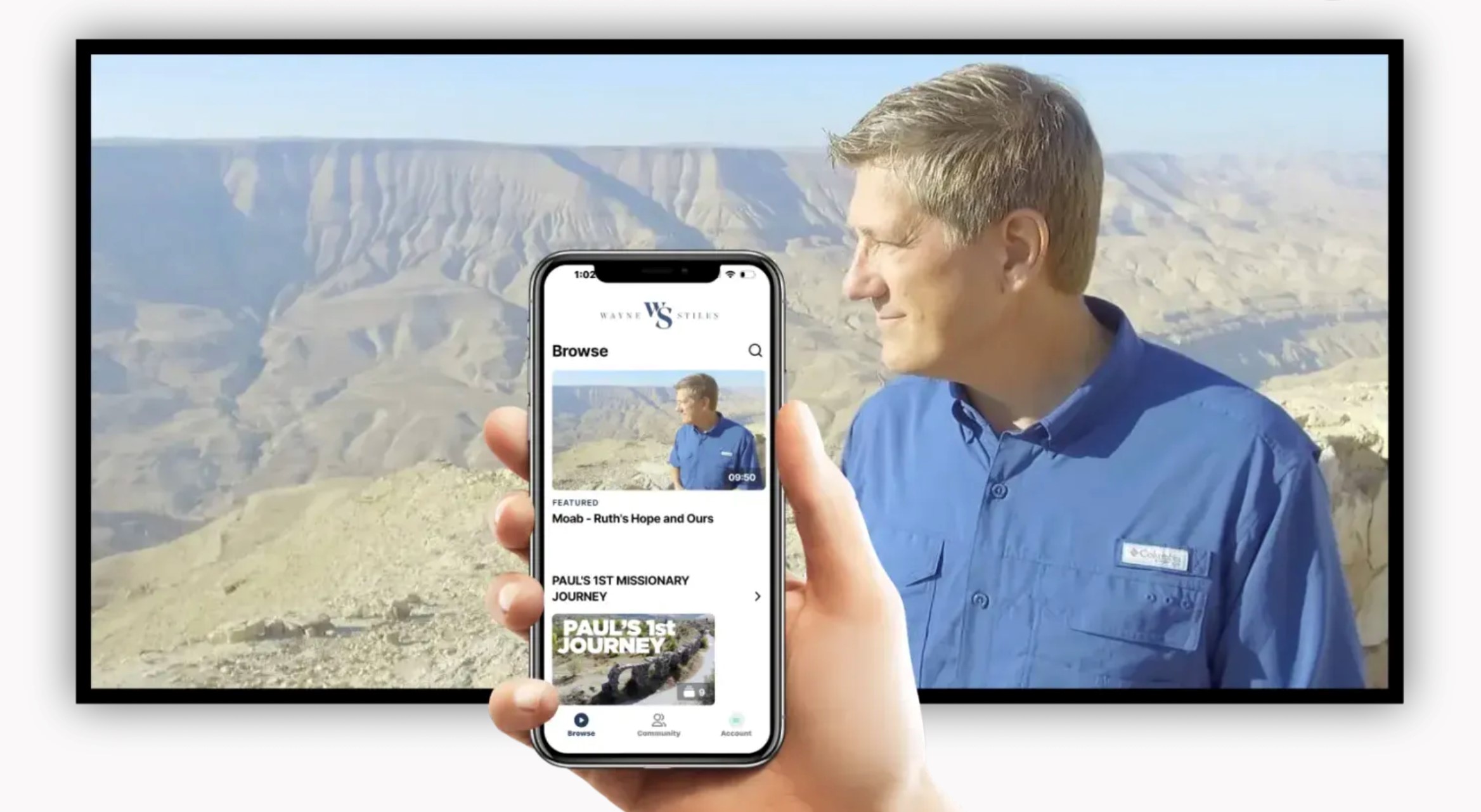
My longtime friend, Wayne Stiles, has spent the past seven years developing a wonderful website that features more than 200 videos that connect the Bible and its lands to life. He has traveled and filmed extensively in Israel, Jordan, Egypt, Greece, Turkey, and Italy. 

The links below take you to the various regions and countries with trailers to watch. There’s even an app so you can watch it on the go—and on tours! The cost for joining is nominal—and a whole lot cheaper than taking a tour—and you experience more than many tours combined could offer. 

In addition, you can use this code (BOLEN) to get a $10 credit—which allows you to rent two full episodes or to buy one of your choosing. 

Judah and the South (39 episodes, including Gath, Libnah, Timna Valley, Negev Highlands—and more)

Galilee and the North (23 episodes, including Sepphoris, Tabgha, Hazor, Capernaum, Cana—and more)

Samaria and the Center (20 episodes, including Beth-shan, Jericho, Dothan, Gibeon—and more)

Jerusalem (24 episodes, including the Temple Mount, Kidron Valley, Walls and Gates, Western Wall—and more)

Greece (19 episodes, including Patmos, Rhodes, Philippi, Athens, Corinth—and more)

Rome and Malta (20 episodes, including Appian Way, Roman Forum, Malta, Pompeii—and more)

Turkey (29 episodes, including Troas, Ephesus, Assos, Tarsus, the Churches of Revelation—and more) 

Egypt (8 episodes, including the Pyramids, Valley of the Kings, Nile River, Karnak Temple—and more)

Jordan (9 episodes, including Petra, Mount Nebo, Moab, Machaerus, Ammon—and more)

Interviews (11 interviews, including Bryant Wood, Scott Stripling, Carl Rasmussen, Charlie Dyer, and me)

If you are reading the Bible in 2024, Wayne also has a new Reading the Bible Lands program that goes through the whole Bible with videos, devotionals, and my photos—with the opportunity for Live Zoom calls with Wayne and other members to discuss the Bible reading and Q&A time. 

Some years ago I wrote the following about Wayne, and I don’t think I can say it any better now:

“Wayne Stiles has a unique gift for bringing the biblical world into our own. Some teachers are history gurus, but they can’t translate their research into how it affects us today. Wayne is superb at doing this in his books, on his blog, on his podcast, and at the sites. He is passionate, accurate, and faithful.” 

Wayne’s resources are outstanding in every way, and I’m very thankful for the ways he has applied his giftings and energies to create excellent tools to increase our love for and understanding of God’s Word.

Share:

A monumental tomb from the Roman era has been excavated at the Apollo Smintheus Sanctuary in western Turkey.

The head of Dionysus was discovered in Cyrene following a major storm.

Greece has reopened to tourists the palace where Alexander the Great was crowned.

Nathan Steinmeyer provides a list of the top ten biblical archaeology stories of 2023, in no particular order.

Jessica Nitschke lists ten exciting discoveries in Near Eastern archaeology last year.

Paleojudaica lists the top ten stories for 2023.

Hurriyet Daily News identifies the top 10 archaeological discoveries in Turkey in 2023.

The Greek Herald names the top four Greek archaeological discoveries of the year, one of which is in Jerusalem.

Gizmodo surveys the best archaeological discoveries from around the world.

“The Lexicon of Greek Personal Names (LGPN) traces every bearer of every name, drawing on a huge variety of evidence, from personal tombstones, dedications, works of art, to civic decrees, treaties, citizen-lists, artefacts, graffiti etc.: in other words, from all Greek literary sources, documentary sources (inscriptions and papyri), coins, and artefacts.”

“30 antiquities, with a collective value of $3.7 million, were returned to Greece” by the Manhattan District Attorney.

Jonathan Robie explains how artificial intelligence is beneficial in creating Bible translations.

Zoom lecture on Jan 23: “Scrolls and Scribes: How Well has the Bible Survived?,” by Hugh Williamson

Walking The Text has just released its “Proclamations of Christmas Study Guide.”

Leon Mauldin shares photos of the Arch of Constantine, with a close-up of the Battle of the Milvian Bridge.

HT: Agade, Arne Halbakken, Ted Weis, Gordon Dickson

Share: