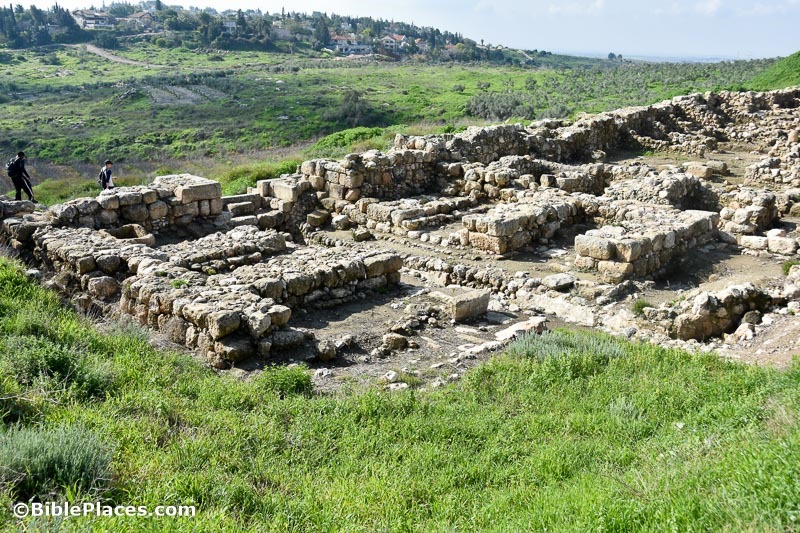
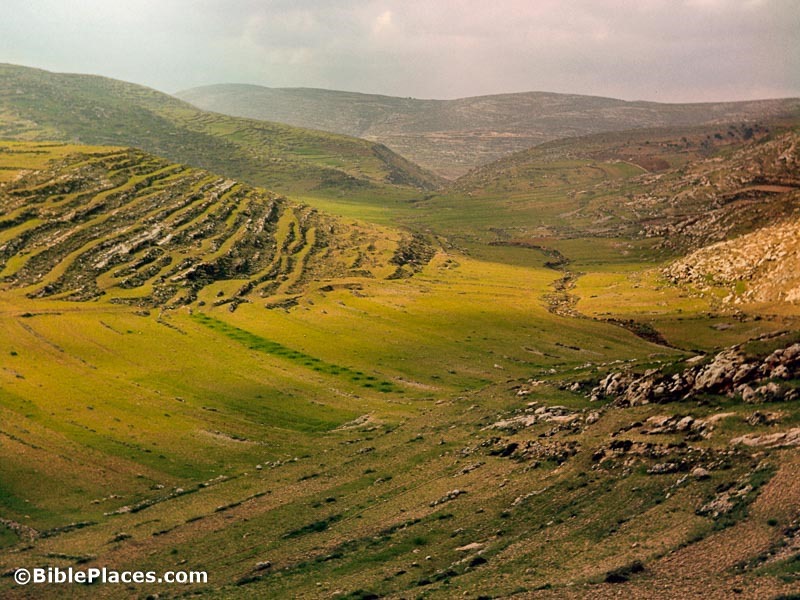
I believe that there is no better way to experience Israel than by hiking it. That doesn’t mean that your first trip to Israel should be a pure hiking tour. I would suggest instead that you first learn the land as a whole, and that requires being on a bus so you can cover the ground. But as you have opportunity on that or subsequent trips, you will find that nothing is as rewarding as walking through the land. The air you breathe, the dust you kick up, the surprises you see, the connections you make—all of these are vastly different than the view from the bus window.

It’s not necessarily easy going on a hike, especially if you’re not traveling with someone with experience. The best hiking maps are in Hebrew, and the logistics can be challenging as well. But if you’re not in a hurry and you make some preparation, you can have a successful trip with memories that last a lifetime.

Over the years, a few people have written books (in English) for hiking in Israel. (Here’s an older one I like.) But trails are altered and the books become dated and go out of print.

Israel by Foot is a new website dedicated to helping hikers in Israel. The creator, Erez Speiser, wrote me some weeks ago to ask about the possibility of writing a guest post for this blog. But I love what he is doing and I would rather tell you myself.

I predict that Erez’s website is going to change some of your lives. Because you will start reading of the possibilities, get motivated, and then realize that you really could do this.

There are a number of options on Israel by Foot, but readers of this blog might start with “Bible Walks,” where Erez (who created all of the content himself) gives detailed descriptions for about five hikes, including the distance, the climb, the best time of year, directions to the trail head, and Google Map points. That is all free; for $5 you can purchase a detailed hiking map and GPS files for any particular hike. (You know how much you’ll be willing to pay for a detailed map in English when you are lost? :-))

I love the “Inn to Inn Hikes” section. That’s because I don’t enjoy hiking so much with 40 pounds on my back. Multi-day hikes are just much more difficult logistically. (I led a 11-day hike for a couple dozen people once, but it worked so beautifully because we had a trail van carrying our sleeping bags and food. Heavy backpacks would have completely changed the calculus.)

Just reading the options for the “Inn to Inn” will motivate some of you to start planning for your 30th wedding anniversary trip or your 60th birthday present to yourself or something! How about: Judean Desert (Arad to En Gedi via Masada) in 4-6 days. Or Sea to Sea (across the Upper Galilee) in 5 days. Or the northern (and most beautiful!) section of the Israel National Trail – from Dan to Arbel!

Erez has another section of single-day self-guided hikes. These are easier to incorporate into another trip. There are several dozen options listed in various regions of Israel.

You might consider if a “hiking-based” trip could be a way to spend some quality time with some of your older kids. Or maybe a person you disciple or a small group you lead. Some married couples are ideally suited for trips like this. I know there are lots of other places to travel, and this is not on the cheaper end for those living outside of Israel, but I believe that amazing memories are made when (1) you are walking outdoors (2) in a place where you are surrounded by the Bible and (3) you are feeling a small measure of pain.

Share:

The Tel Moza website gives details for joining the spring excavation as well as background about recent discoveries.

A family volunteering at an excavation in Lower Galilee discovered remains of an iron industry from the 6th century AD.
 
Some of the latest discoveries from Shiloh are described in a somewhat disjointed article in the Jerusalem Post.
 
The “Tomb of the Kings” in Jerusalem has been reopened to visitors (again) by France, which owns the site. Access is allowed only to the outer courtyard.
 
Naama Sukenik explains how new technology is being used to provide insights into counterfeiting dyes in the ancient textile industry.
 
Mark Barnes looks at the significance of the Mount of Olives in the Bible, including some interesting comparisons and contrasts between David’s and Jesus’s time there.
 
Who is Gallio and why is he so important to New Testament history? Bryan Windle explains in a well-illustrated article.
 
The “world’s oldest natural pearl” has been discovered in excavations on an island near Abu Dhabi.
 

“Ancient Assyrian stone tablets represent the oldest known reports of auroras, dating to more than 2,500 years ago.”

“Life at the Dead Sea” is a new exhibit about the cultural history of the lowest place on the planet that recently opened at the State Museum of Archaeology Chemnitz.

An exhibit of Egypt’s southern neighbor, “Ancient Nubia Now,” is on display until January 2020 at the Museum of Fine Arts in Boston.

Sculptures from the Torlonia Collection will go on public display for the first time ever at the Capitoline Museums in Rome beginning in March.
 
The Washington Pentateuch is going on display at the Museum of the Bible.
 
The archaeological museum in Basra is adding English labels in hopes of welcoming more international visitors.
 
Jaafar Jotheri provides an overview of excavations in Iraq in the last year.
 
A conference will be held at the Louvre on November 25 on Tappeh Sialk: A Key Site for the Archaeology of Iran.
 
Farrell Monaco will be lecturing on “Dining with the Romans” at the Walters Art Museum on November 10.
 
4,500 tourists watched the sun illuminate the face of Ramses II in the temple of Abu Simbel.
 
Wayne Stiles is leading a tour of Israel (and pre-tour to Egypt) in October 2020.
 
There will be no roundup next weekend.
 
HT: Ted Weis, Mike Harney, Joseph Lauer, Keith Keyser

Share:

Wayne Stiles just walked the last five miles of the Appian Way into Rome, and he shares his experiences along with a video. Only one section was a hair-raising experience!

A preliminary report from the Swedish excavations at Hala Sultan Tekke in Cyprus is now online.

Israeli security inspectors discovered 69 coins from the time of Alexander the Great being smuggled from Gaza into Israel. But one expert suggests the coins are fake.

The Summer Session program of the American School of Classical Studies at Athens is now accepting applications. Scholarships are available.

Why do newspapers write dishonest headlines like this? “A Chance Discovery Changes Everything We Know About Biblical Israel.” Shame on Haaretz.

The lectures are in Hebrew, but you may find the topic list to be of interest for this year’s “New Discoveries and Insights” conference at Tel Aviv University.

The schedule is now online for next week’s Annual Conference, “New Studies in the Archaeology of Jerusalem and its Region.”

The final list of speakers and their topics for the 22nd Annual Bible and Archaeology Fest is now posted.

Yahoo Groups is shutting down. This will affect lists such as Explorator and ANE-2.

The En-Gedi Resource Center website has a new home, with new organization and a “Hebraic Studies” search bar to make it easier to find what you’re looking for.

Carl Rasmussen shares a number of photos of Göbekli Tepe.

John DeLancey is blogging each day on his tour of Greece, Rome, and Pompeii, now wrapping it up on Day 13.

Ferrell Jenkins explains why a photo he took of the cedars of Lebanon in 2002 is one of his favorites.

Bryan Windle has put together another great archaeological biography, this one on King Nebuchadnezzar.

HT: Ted Weis, Keith Keyser, Agade

Share:

Amanda Borschel-Dan of The Times of Israel provides a valuable summary of the Siloam Street/Stepped Street/Pilgrim’s Path that has been in the news for the last decade or so. One particular point of interest: the street will not be fully opened to the public for a few more years, because it is still being excavated 7am to 10pm every day.

“Archaeologists have uncovered a well-preserved fresco of two fighting gladiators in the ancient Roman city of Pompeii.” Very nice.

“Scientists report that they may have found the earliest written record of a solar storm in ancient Assyrian tablets.”

Egypt announced the discovery of 20 well-preserved wooden coffins in Luxor.

“Archeologists working in Luxor’s “Valley of the Monkeys” have discovered an “ancient ‘industrial area’ once used to produce decorative items, furniture and pottery for royal tombs.”

The Egyptian Exploration Society has formally accused Oxford professor Dirk Obbink of stealing and selling papyri fragments from the Oxyrhynchus collection.

With Saudi Arabia opening up for tourism, tour agencies are quick to create tours to scam evangelicals.

The Arab World Institute in Paris is presenting an exhibition highlighting the pre-Islamic history of the Al ‘Ula region in Northwest Saudi Arabia.

Tim Frank’s “Visualizing Food Storage in Ancient Houses” article includes a number of video visualizations from sites like Izbet Sartah, Tel Batash, and Beersheba. These could be quite useful.

A new record has been set in the “world’s oldest marathon,” a race from Aphek to Shiloh.

Wildlife inspectors spotted ten bottlenose dolphins off the coast of Israel and have posted footage.

Only 30-40 acacia gazelles survive in Israel, and rangers recently discovered a fawn had been born.

“Cruise passengers held their breath as a 22.5 meter wide cruise liner became the largest boat to pass through Greece’s narrow Corinth Canal.” There are some nice pictures.

HT: Ted Weis, Keith Keyser, Agade, David Padfield

Share:

Tourism:
National Geographic has a beautifully illustrated article on the history of Jerash (ancient Gerasa).

Saudi Arabia is now giving visas to foreign tourists.

A $6 million, 9-year project has made much of Jerusalem’s Old City accessible to wheelchairs. And now you can rent a golf cart at Jaffa Gate (for $100/hour).

The entry fee for Rome’s Colosseum is jumping to €16.

Ferrell Jenkins shares a number of photos from his visit to the Brook Besor.

The first photograph of the Acropolis of Athens was taken in 1842.

I enjoyed talking about my visit to Susa on The Book and the Spade. Part 2 is now posted.


Lectures:
Peter Machinist will be lecturing on “Assyria and the Hebrew Bible: A Reassessment” at NYU on Nov 14. Registration required.

Felix Höflmayer, Katharina Streit, & Lyndelle Webster will be lecturing at the Albright Institute on Oct 31 at 4:00. Their topic:  The Austrian-Israeli Expedition to Lachish After Three Years of Excavation.


Videos:
New series on YouTube: “The Holy Land: Connecting the Land with Its Stories is a nine-episode series hosted by Dr. John (Jack) Beck that takes you to regions throughout Israel to experience the land, the culture, and the customs that surround the sacred stories of the Bible.” The first two episodes have been released, and you can see a 2-minute special feature about Jerusalem here.

The latest video from Biblical Israel Ministries and Tours: “It Happened Here” – Life Lessons from Israel: Beth Shemesh (6 min).

Appian Media is posting regularly to their YouTube channel, including some behind-the-scenes videos.

We’ll have more in part 3 tomorrow.

HT: Agade, Joseph Lauer, Ted Weis, Keith Keyser, Explorator

Share:

A resident of the northern Israeli village of Araba discovered a Bronze Age settlement on his way to work.

This week Bryan Windle looks at el-Araj, the other candidate for Bethsaida. He provides the evidence both for and against this identification.

The Kingdom of Copper: Copper Production and Social Complexity in Iron Age Faynan, Jordan, is a good story that has been very creatively produced. (The subdomain “storymaps” is suggestive.)

In the last few years, Zedekiah’s Cave (aka Solomon’s Quarries) has become “a major venue for concerts and cultural events.”

Jerusalem looks as it has for the thousands of years, but that’s all about to change, writes Michael Kimmelman in the NY Times, because they are building a cable car to the Western Wall. (I think a case is considerably weakened when it is grossly overstated. And the cable car does not go to the Western Wall.)

Tourism to the West Bank is growing.

A high-tech analysis of the Temple Scroll helps to explain why this very thin parchment was so bright and possibly why it was so well preserved.

The excavations at Gath made it on Jeopardy this week. And you can now register for the penultimate season there.

Leon Mauldin shares several photos from Shepherds’ Field in Bethlehem.

If you enjoy virtually touring Israel, you can join John DeLancey as it posts daily about his current trip.

Tomorrow Duke is celebrating the conclusion of its years of excavating at Sepphoris.

Ahmed Shams describes the Library of Congress’s collections of photos related to the Sinai Peninsula Research project.

Archaeology in Jordan (AIJ) is a new, biannual open access (OA) newsletter published online by ACOR aimed at raising scholarly awareness of archaeological and cultural resource management projects being carried out in Jordan and to make this information accessible to a wider audience.”

I am on The Book and the Spade this week, talking with Gordon Govier about my visit to Susa, the Persian capital where Esther lived.

There will be no roundups for several weeks.

HT: Agade, Joseph Lauer, Charles Savelle

Share: