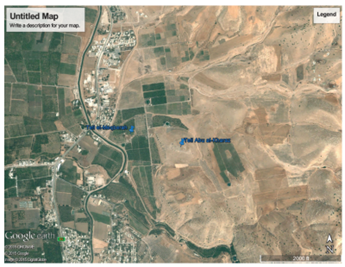
Just before Palm Sunday, Jesus made the trek from Jericho to Jerusalem. What did he see?

A good book to read this week in the days leading up to Good Friday is The Final Days of Jesus, now $3.99 on Kindle.

The Temple Institute has built a sacrificial altar to be used in the Third Temple. Leen Ritmeyer comments.

Who is buried in the Prophetess Hulda’s tomb on the Mount of Olives? Miriam Feinberg Vamosh considers the question in a premium article at Haaretz.

The city of Afula plans to preserve its archaeological remains which span from the Chalcolithic to the Crusader periods.

Aren Maeir visited Hebron and took some photos of the ancient fortifications.

Leon Mauldin is in Athens now and shares some photos from the acropolis museum.

A large underground city has been discovered in Cappadocia.

You can vote for your favorite excavation photo in this year’s AIA Photo Contest. (No registration required.)

Now $0.99 on Kindle: The World and the Word: An Introduction to the Old Testament, by Eugene H.
Merrill, Mark Rooker, and Michael A. Grisanti. Also $0.99 on Vyrso.

HT: Agade

Share:

Now online: Secrets of the Bible: The Fall of Jericho with Dr. Bryant Wood. (55 min)

Malerie Yolen-Cohen suggests 11 things to do in Israel that you may not have considered before.

The Holy Land Magazine is directed towards Christian tourists to Israel.

Ferrell Jenkins writes about Solomon’s Quarries in Jerusalem and the American missionary who discovered them in the 19th century.

Jenkins also shares a great quote from André Parrot who writes that “knowledge gained from books is certainly not enough, for names which are not attached to any reality are nothing more than ghosts.” Read the whole paragraph (and then book your next trip, or start a fund for your grandkid).

Turkish authorities are trying to figure out how to increase religious tourism to the site of ancient Ephesus.


The LA Times provides some background on the making of the Jerusalem 3D IMAX movie.

“The Siege of Masada” premieres on March 27 on the Smithsonian Channel. The one-hour special examines the evidence behind Josephus’ account.

Gerald McDermott addresses the question of whether the land of Israel should still be significant for Christians in a chapel message DTS.

HT: Agade, Jay Baggett, Ted Weis, Charles Savelle, Wayne Stiles

Share:

Iraq’s government reports that ISIS has bulldozed ancient Calah (modern Nimrud).

In light of ISIS’s recent destruction of Mosul, Iraq is vowing to protect ancient Babylon.

The Oriental Institute of the University of Chicago has issued a statement.

Citizens of Iraq and Syria are working to protect their historic treasures from destruction by ISIS.

A project has begun to “use crowd-sourced imagery to digitally reconstruct the heritage that has been destroyed.”

Daniel Pipes argues that “the ISIS record fits into an old and common pattern of destruction of historical artifacts by Muslims.”

The U.S. government has returned more than 60 artifacts illegally smuggled out of Iraq, including the head of an Assyrian lamassu from the palace of Sargon II.

Egypt will no longer grant visas to individual tourists upon arrival. You will need to apply in advance from an Egyptian embassy. Or travel instead to Israel, Jordan, Turkey, or Greece.

The Associates for Biblical Research has just released a new video, Digging Up the Sin Cities of Sodom and Gomorrah.

How was Trajan’s Column in Rome constructed? National Geographic features a stop-motion video that suggests an method. It is quite an extraordinary accomplishment.

We’ll have more links tomorrow.

HT: Agade, Charles Savelle

Share:

The 26-mile race to be held on April 9 follows the path of the Benjamite who ran to tell Eli of the capture of the Ark of the Covenant (1 Samuel 4). From the official website:

One of the first runs recorded in human history—long before the “marathon” told of in Greek mythology—is mentioned in the Bible, in the beginning of the book of Samuel. At the end of the war between the Israelites and the Philistines, the “man of Benjamin” runs from the battlefield at Eben Ezer (modern day Rosh Ha’ayin) to Shiloh, city of the shrine. His runner’s mission is to inform Eli the priest of Israel’s defeat in this war, the falling of his sons, and the capture of the Ark of the Covenant.
Many centuries later, after the Six Day War, the founder of the Maccabiah games, Yosef Yekutieli, set out to measure the length of the course from Rosh Ha’ayin to Shiloh, in the Benjamin region. He was amazed to find that the length of this historic path precisely matched that of the modern marathon – 42 kilometers (the official length of the Olympic running contest, determined in 1908 at the London Olympics). In the 1970s, Yekutieli initiated various marathons in the wake of the Biblical “man of Benjamin”. It is truly amazing, the thought that if only someone had informed the Baron de Coubertin, founder of the 42 km Olympic run, of the Biblical story, then perhaps instead of “marathon” it would be called one of the following: Shiloh Race, Man of Benjamin, or Bible Race.

More details here.

Shiloh aerial from east, bb00120068
Shiloh aerial from the east
Photo by Barry Beitzel, available in the Pictorial Library of Bible Lands
Share:

Chris Jones has a careful assessment of the damage at the Mosul Museum. Some of the items destroyed were replicas but many were originals.

The Iraqi Prime Minister has condemned the destruction of antiquities from Nimrud and Nineveh by IS. The United Nations Security Council has condemned the latest “barbaric terrorist acts.” Some experts see the video primarily as propaganda. Ferrell Jenkins provides some background and photos he took in 1970.

Militants have also taken control of Ezra’s tomb in Iraq.

Syria is blaming Turkey for the flow of artifacts out of the country.

What are Judean Pillar Figurines? Erin Darby explains our interest, their importance, and their use for protection and healing.

One of the divers gives his account of the discovery of the treasure of golden coins in the Caesarea harbor.

The downside of such discoveries is increased looting by everyone who thinks that they’ll be the next to find buried gold.

D. Scott Stripling: 2014 Excavations at Kh. el-Maqatir: A Proposed New Location for the Ai of Joshua 7–8 and Ephraim of John 11:53-54

The Jezreel Expedition used airborne LiDAR to prepare for an old-fashioned foot survey that showed that Jezreel is much larger than previously thought.

Dothan appears only twice in the Bible, and Wayne Stiles explains the lesson we can learn from Joseph and Elisha.

The Biblical Museum of Natural History recently opened in Beit Shemesh and it includes a skull of what they identify as behemoth.


Popular Archaeology has a profile of the recent excavations of Tel ‘Eton (biblical Eglon?).


Haaretz: What does it mean when a biblical figure “sat in the gate”?

Shmuel Ahituv has been awarded the 2015 Israel Prize for Bible Studies.

Israeli and Jordan authorities have signed a historic agreement on water sharing that includes sharing water from a desalination plant to be built in Aqaba.

The city of Jerusalem plans to build seven public swimming pools.

Newly released: I. M. Swinnen and E. Gubel, eds., From Gilead to Edom. Studies in the Archaeology and History of Jordan, in Honor of Denyse Homès-Fredericq on the Occasion of Her Eightieth Birthday. Akkadica Supplementum XII. Wetteren: Cultura, 2014.

I’ll be traveling the next couple of weekends and unable to collect stories or write round-ups. If you see anything of interest, send me an email and I’ll include it at the next opportunity.

HT: Ferrell Jenkins, Charles Savelle, Agade, Joseph Lauer

Share:

The largest treasure of gold coins ever found in Israel was recently discovered in the harbor of Caesarea. Most of the coins date to the Fatimid period (ca. AD 1000). There’s a close-up of a well-preserved coin here. Seven high-res images are available here.

The Jerusalem Post has photos and a video of the recent snowfall in Israel. Record snowfall was recorded in Istanbul, and the snow was heavy in Lebanon and Jordan. Yahoo has more photos of Jerusalem here. And Shmuel Browns has some photos from his neighborhood in the German Colony.
Leen Ritmeyer suggests that some paving stones on the Temple Mount pre-date the Roman destruction.

The next stop for the Passages exhibit is the happy town of Santa Clarita, California.

Some of the Dead Sea Scrolls are coming to the California Science Center next month, along with the Jerusalem IMAX movie.

Ever wanted to volunteer in Israel? Wayne Stiles suggests 15 volunteering opportunities.

James Pritchard’s HarperCollins Atlas of Bible History is not the best atlas out there, but it’s currently only $3.99 for Kindle. As one reviewer notes, the text may be more useful on the screen than the maps.

This week on the Book and the Spade: Herod’s palaces and ancient olive oil, with Clyde Billington.

Ferrell Jenkins explains how Pilate used coins to promote the emperor cult.

Codex Vaticanus is now online.

Aren Maeir’s recent lecture at GVSU is now posted on Youtube.

Eric Cline will be lecturing at the Oriental Institute in Chicago next week.

Gabriel Barkay, Zachi Dvira, and others involved in the Temple Mount Sifting Operation are coming on a fundraising tour in April and May. Check out their blog to learn how you can arrange talks or dinners with them.

The Islamic State is reportedly looting ancient sites “on an industrial scale.” Some people are trying to stop it.

HT: Ted Weis, Joseph Lauer, Charles Savelle, Jock Stender

Gold coins discovered in Caesarea harbor
Photo copyright: Clara Amit, courtesy of the Israel Antiquities Authority
Share: