The New York Times reports on the reopening of the ruins of Babylon to the public.

BABYLON, Iraq — After decades of dictatorship and disrepair, Iraq is celebrating its renewed sovereignty over the Babylon archaeological site — by fighting over the place, over its past and future and, of course, over its spoils. Time long ago eroded the sun-dried bricks that shaped ancient Babylon, the city of Hammurabi and Nebuchadnezzar, where Daniel read the writing on the wall and Alexander the Great died. Colonial archaeologists packed off its treasures to Europe a century ago. Saddam Hussein rebuilt the site in his own megalomaniacal image. American and Polish troops turned it into a military camp, digging trenches and filling barricades with soil peppered with fragments of a biblical-era civilization. Now, the provincial government in Babil has seized control of much of Babylon — unlawfully, according to the State Board of Antiquities and Heritage — and opened a park beside a branch of the Euphrates River, a place that draws visitors by the busload…. Now with the support of some officials in Baghdad, the local government has reopened the excavated ruins of Babylon’s ancient core, shuttered ever since the American invasion in 2003. It has done so despite warnings by archaeologists that the reopening threatens to damage further what remains of one of the world’s first great cities before the site can be adequately protected.

The full story is here.

The traditional tomb of Ezekiel is being renovated by the Iraqi government. From the Jerusalem Post:

The Iraqi government has launched a project to renovate the interior of the prophet Ezekiel’s shrine in the small town of Kifl, south of Baghdad, and the country’s Ministry for Tourism and Antiquities says it hopes to eventually repair and renovate other Jewish sites across the country.
“The ministry is concerned with all Iraqi heritage, whether it is Christian or Jewish or from any other religion,” ministry spokesman Abdelzahra al-Talaqani told AFP. “The present plans do not include the synagogues in Baghdad, Basra, Mosul, Fallujah and other places because of lack of funding, but I think they will be included in future plans.”
Iraqi Jewry was once one of the largest and most prominent Jewish communities in the Middle East.
But after Israel’s establishment, more than 120,000 Iraqi Jews moved to Israel in the 1950s in a clandestine operation dubbed Operation Ezra and Nehemiah amid an outbreak of anti-Jewish violence.
Outside the shrine of the prophet – who followed Jews into the Babylonian exile in the sixth century BC – is a 14th-century brick minaret, while the inside is shaped like a synagogue, with old wooden arks that used to contain Torah scrolls and the remains of a Mehitza – a separation for men and women….
The tombs of the prophets Daniel, Ezra, Nahum and Jonah are also purported to be located in Iraq.

You can add this to your list of sites to visit on your next trip.

Ezekiel's Tomb, Kifel, Iraq, mat13265Traditional tomb of Ezekiel, exterior, 1932
Photo: Library of Congress, Prints & Photographs Division, LC-DIG-matpc-13265
Ezekiel's Tomb interior, Kifel, Iraq, mat13271Traditional tomb of Ezekiel, interior, 1932
Photo: Library of Congress, Prints & Photographs Division, LC-DIG-matpc-13271

If you’re interested in the visit of the Catholic Pope to Israel next month, the Israel Ministry of Tourism has established a website: Holyland Pilgrimage: A Bridge for Peace.  Questions of just how interested in peace the pope is have been raised following reports of his plans to meet with a terrorist-supporting mayor in Galilee.

The ministry has also created a 5-minute video in preparation for the visit.  The video features stunning aerial photography of numerous sites in Israel and is worth watching even if the pilgrimage doesn’t get you excited.

From the press release of the Israel Antiquities Authority (with link to photos, and direct link to photos):

One of the Most Spectacular Mosaic Floors Ever Discovered in Israel was Restored and Renovated and Can Now be Seen by the General Public (30/3/09) 
The 1,500 year old (!) mosaic is in the ancient synagogue at Ma‘on-Nirim The mosaic, which is decorated with a seven-branched candelabrum and images of different animals, was conserved and returned to its original location. The site is now open to the general public and admission to it is free.
The site of the mosaic floor, which is part of a synagogue from the Byzantine period (fifth and sixth centuries CE), is located in the settlement of Ma‘on-Nirim, in the western Negev, and will be open to the public this week. This mosaic originally measured 3.70 x 7.80 m but was damaged when the road to Kibbutz Nir Oz was paved in 1957. The mosaic floor and the remains of the synagogue were discovered during salvage excavations that were undertaken on behalf of the Department of Antiquities in 1957. The mosaic’s state of preservation has deteriorated in recent years as a result of the unsuitable conditions in which the mosaic was kept and a lack of maintenance. Therefore, in 2006, it was removed from the site and transferred for treatment to the Conservation Laboratories in the Rockefeller Museum in Jerusalem….
According to the archaeological findings the northern wall of the synagogue’s sanctuary was breached in the middle of the sixth century CE and an apse, which is a circular niche that protrudes outward, was installed in the opening. The level of the earlier floor was raised and a breathtakingly beautiful mosaic floor surrounded by marble columns was constructed on top of it in the northern part of the sanctuary. The synagogue had a basilica plan in which there was a nave with a mosaic floor that was flanked by two aisles paved with stone tiles. The ceiling was built of wooden beams and clay. The decoration on the mosaic floor consists of a vine tendril that stems from an amphora to form a trellis of medallions that are adorned with scenes of everyday life from the vineyard and from wine production and with different animals. The images portrayed in the upper rows include a seven-branched candelabrum that stands on three legs shaped like lion’s feet, and near them etrogim, a shofar and a lulav, and alongside the candelabrum – palm trees and lions, which are symbols of Judah. An Aramaic inscription is incorporated in the mosaic. The upper part of the inscription blesses all of the community followed by a dedication to three individuals who donated generous contributions.

The complete press release is here.

HT: Joe Lauer

Today the feast of Purim is celebrated in Jerusalem (it was yesterday elsewhere in the world), and the Jerusalem Post carries a column on a site in Iran that tradition identifies as the tomb of Mordechai and Esther.  Iran has thus far been outside of my areas of travel, so I do not have anything to contribute to this particular discussion.  The Book of Esther is one of the most brilliant literary compositions, and as I read through it with family and friends on Monday night I was struck by Mordechai’s words to Esther: “For if you keep silent at this time, relief and deliverance will rise for the Jews from another place, but you and your father’s house will perish” (4:14).  My first response was to marvel at the way that God has protected his people, time and again, over the millennia.  My later response was to consider the striking parallel with the rise of a new Persian threat against Israel and those who will or will not act to stop it.  I will leave that for your own consideration and quote here the first few paragraphs of the JPost column by Michael Freund:

A few months ago, the normally hostile Iranian regime took the rather unusual step of adding a Jewish holy site to its National Heritage List. On December 9, 2008, Iranian news outlets reported that the tomb of Mordechai and Esther, the heroes of the Purim saga, would now be under official government protection and responsibility.
The move cast a brief spotlight on the site, which is well-known to Iranian Jews but largely unfamiliar to those outside the country. And with Purim being celebrated this week, it is worth taking a moment to ponder this relic of our ancient past.
The mausoleum housing the shrine of Mordechai and Esther consists of a simple brick structure crowned with a dome which was built five to seven centuries ago over the underground grave sites. It is located in the northwestern city of Hamadan, about 335 kilometers west of Teheran. According to tradition, Hamadan is believed to be the site of the city of Shushan, which played such a central role in the events described in the Book of Esther.

The column continues here.

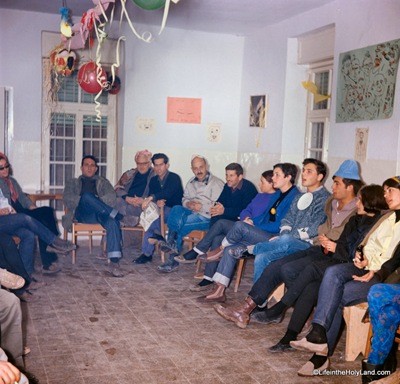
Expedition members Purim party with Yigael Yadin, db6703260105Purim Party, Megiddo excavation team, March 1967
with Yigal Shiloh, Immanuel Dunayevsky, Yigael Yadin, and Amnon Ben-Tor
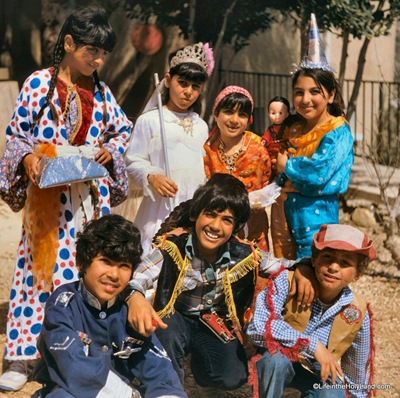
Children in Purim costumes, db810319p175Children in Purim costumes, 1981
Photos by David Bivin, Views That Have Vanished CD

The medieval ruins at Acco have been well preserved and restored, but a visit to the biblical tell of Acco is quite disappointing.  Plans are underway to improve conditions, with a government grant of more than $5 million (23 million NIS) for the “Tell Akko” Tourism Project. The Israel Antiquities Authority report describes part of the project: 

The tell is a historic site that extends across c. 200 dunams and constitutes an important landmark at the entrance to the city. The renewed site combines the historic spots that existed in the region with modern attractions for the entire family, and includes a system of footpaths and bicycle trails, vantage points, archaeological finds and stations providing information on archaeology, history and ecology. Among other things, it will be possible to learn there about the manufacture of glass and the production of purple dye as they were done in the past in the same region, remains of which were found on the tell.
In addition, in September 2009 an “open theater” will be established on top of the southern slope of the tell, which will be used for large public events such as theatrical and musical performances….
The director of the Israel Antiquities Authority, Mr. Shuka Dorfman said, “This important enterprise is putting into practice the vision of the Antiquities Authority of exposing the archaeological remains to the public at large. The Israel Antiquities Authority is acting to make the antiquities sites as accessible and comprehensible as possible for the visiting public by means of preparing the sites, vantage points, archaeological exhibits and information stations that cover a variety of topics. In this way Tel Akko, which has not been fostered to date and was damaged over the course of time by development activity and natural hazards, will become a recreation venue for the residents of Akko and the region, and for tourists, and will connect them to the rich cultural heritage of Akko”.

Tell Acco excavations, tb100905637ddd

Tell Acco, October 2005

HT: Joe Lauer