A new study reveals that the earliest bathhouses in Pompeii were not very hygienic.

“A gang of four antiquities robbers was caught red-handed on Sunday afternoon while digging inside an ancient Roman-period burial cave near Hittin, on the edge of the Arbel Valley.”

The latest video from Expedition Bible traces the route of Abraham from Iraq through Syria, Turkey, Jordan, and Israel.

Elizabeth Shenk reports on the use of AI in dating the Dead Sea Scrolls, and she includes a number of quotations from scholars about the dating of Daniel.

Marek Dospěl provides an introduction to the Nimrud Letters.

Marta Lorenzon writes about the social meaning and functionality of mudbrick architecture. “By tracing the full chaîne opératoire — from soil selection to mixing, molding, drying, and construction — we can approach mudbrick not only as a building technology but also as a reflection of cultural practice, community identity, and human engagement with the environment.”

The NY Times posted an obituary for Gabriel Barkay (gift link).

The first guest on The Book and the Spade radio program was Gabriel Barkay, and that recording from 1984 is now online.

Israel’s Good Name writes about his travels on the outskirts of Elkana.

Chris McKinny and Amy Balogh discuss the Flood Tablet from the Epic of Gilgamesh.

Hybrid lecture at the Albright on Feb 4: “Unearthing an Imperially Glorious Byzantine Church near Bet Shemesh: From Fieldwork to Virtual Reality,” by Benyamin Storchan

Hybrid lecture at the Albright on Feb 25: “Willibald Goes to Jerusalem: A Trip Through the City Then and Now,” by Christie Pavey

Releasing soon: Archaeology and the People of the Bible: Exploring the Evidence for the Historical Existence of Bible Characters, by Titus Kennedy

The Sacred Thread and the BibleProject have released the 8-day Lord’s Prayer Reading Plan on YouVersion.

Friends of ASOR Tours are giving two days of insider tours in Philadelphia in April.

“Bible Mapper is pleased to announce the launch of Bible Mapper, Jr.! The new site hosts a growing collection of resources specifically designed to help kids understand where the stories of the Bible happened and why it matters. Each map lesson includes a kid-friendly map, a Bible reading, a Life Lesson, and an article that unpacks what happened in the story and how it can help us follow God more closely.”

HT: Agade, Arne Halbakken, Ted Weis, Explorator

“Excavations at the ancient city of Smyrna in central Izmir have uncovered a mosaic floor featuring a ‘Solomon’s Knot’ motif.”

Nathan Steinmeyer writes about the latest discoveries at the house believed to have once belonged to Nero’s second wife.

A new IAA research project plans to trace the origin of thousands of pottery vessels based on the mineral and chemical composition of the pottery kiln.

“The Huqoq Excavation Consortium will benefit from a $1.6 million grant from the U.S. Department of State to the W.F. Albright Institute of Archaeological Research.”

Aren Maeir attended the Jerusalem and Samaria conference which included visits to Samaria and Mount Ebal. His beautiful photos fit with my observation that January is the best month for taking photos in Israel.

Protected archaeological sites have inadvertently become safe harbors for plants and animals.

BibleMapper’s latest audio-visual reading is of Joshua 17, illustrating the description of the tribal territory of Manasseh.

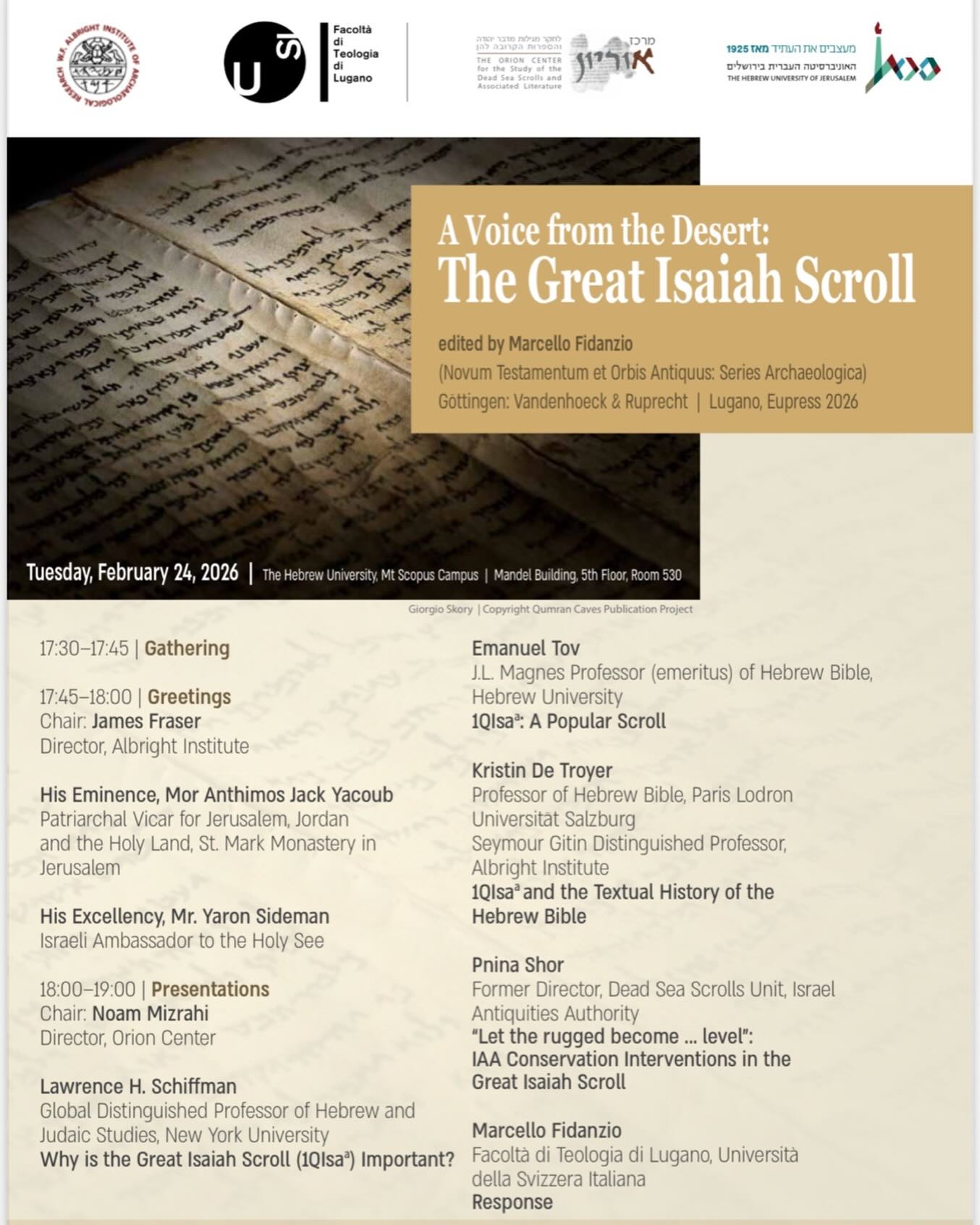
The Great Isaiah Scroll: A Voice from the Desert, edited by Marcell Fidanzio, was written to accompany the special Israel Museum exhibit on the scroll, which I’m told will go on display in late February.

Jerusalem Seminary is offering several free lectures in the coming weeks:

  • Jan 24: Baruch Haba: An Introductory Lesson in Biblical Hebrew
  • Jan 30: The Torah that Jesus Read – Insights into God’s First Words, by Baruch Kvasnica
  • Feb 7: Bethsaida: Discovering the Last Lost City of the Gospels, by Ethan Knapp

The British Museum is hiring a treasure hunter to recover its lost Greek and Roman artifacts.

Gabriel Barkay’s life is remembered by Zachi Dvira, Chandler Collins, the Jerusalem University College, The Jerusalem Post, and The Times of Israel.

HT: Jack Sasson, Arne Halbakken, Explorator

“Archaeologists working at the site of Abusir, one of the main burial grounds of the ancient Egyptian capital of Memphis, have uncovered an extensive temple complex dedicated to the solar deity.”

A large, well-preserved mosaic from the 4th-6th centuries AD was discovered in Antakya (biblical Antioch) during rebuilding work following the 2023 earthquake.

Workers in Rome are using lasers and spending $1 million to clean the 154-foot-tall Column of Marcus Aurelius.

Hurriyet Daily News surveys Turkey’s top 10 archaeological discoveries of 2025. Daily Sabah gives a month-by-month review of top finds.

Turkish Archaeological News surveys the major stories in the month of December, including a new maritime exhibition area opening at the Troy Museum and some rare evidence of Phoenicians in ancient Anatolia.

National Geographic writes about 2025 archaeological discoveries related to the Bible (subscription required)

PaleoJudaica has posted its top ten list for 2025.

Bryan Windle identifies the top three reports in biblical archaeology for the month of December.

Daniel Justel writes about children in the ancient (and present-day) Near East. “He recently edited a special edition volume for the journal Childhood in the Past, entitled Children in the Ancient Near East.”

“Türkiye’s National Intelligence Organization (MIT) has made public a rare historical intelligence document concerning Thomas Edward Lawrence, widely known in the West as ‘Lawrence of Arabia,’ shedding light on how British intelligence activities were perceived and monitored in the late Ottoman and early Republican periods.”

Friends of ASOR webinar on Jan 21: “Experiencing Khirbet et-Tannur: The Story of a Nabatean Temple from the Second through 21st Century,” by Sarah Wenner

Owen Jarus identifies six ancient cities archaeologists have never found, including Akkad and Al-Yahudu.

Citizens and tourists are invited to visit the Jerash Archaeological Museum, the oldest in the country of Jordan.

The palace of Pella, where Alexander the Great was born and grew up, is now open to visitors.

Tehran Times has a short illustrated article on the ancient city of Susa.

“Archaeological artifacts should not be for sale in thrift shops. But putting them in a museum is harder than it sounds.”

HT: Agade, Ted Weis, Arne Halbakken, Explorator

A ritual bath was discovered in excavations beneath the Western Wall Plaza. A sealed layer of ash indicates that the mikveh was in use until the Roman destruction in AD 70. The 2-minute video shows imagery of the large space being excavated underneath the prayer plaza.

An extraordinary stalactite cave has been discovered near Ofra in Samaria.

The Great Isaiah Scroll was originally two scrolls, written separately and then joined together. The break is between (what was later marked as) chapters 33 and 34.

“A new version of a bill whose purpose is to extend Israeli authority over antiquities and heritage sites in the West Bank, aims to include Areas A and B — where the Palestinian Authority has civilian control — under the scope of its applicability.”

Some very old cedar beams on the Temple Mount were left uncovered, provoking a protest.

The Times of Israel interviews Avraham Faust and Zev Farber about their new book, The Bible’s First Kings – Uncovering the Story of Saul, David, and Solomon. “The book brings together archaeology, anthropology, and biblical scholarship to support the thesis that the kingdom did exist and that findings from the ground offer evidence for it.”

The Biblical Archaeology Society has posted a list of excavation opportunities for 2026, including Azekah, Dan, el-Araj, En-Gedi, Hazor, Jerusalem, and Tel Shimron. They also are offering Dig Scholarships of $2,000 to qualified individuals. They are also accepting donations for scholarships.

The theme of the latest volume of ‘Atiqot is “Archaeological Perspectives on Water Use and Management.” All articles are available for download.

Zoom lecture on Jan 13: “Herod’s Many Faces as Reflected in His Art and Architecture,” by Orit Peleg-Barkat

Religion in Ancient Israel: Essays in Honour of John Day, edited by Katherine E. Southwood, Stuart Weeks, and H.G.M. Williamson (Bloomsbury, $87-106)

Accordance is selling many photo collections at 40-67% off, through Monday.

Israel’s Good Name reports on his visit to the Israel Aquarium in Jerusalem.

HT: Agade, Ted Weis, Arne Halbakken, Explorator, Paleojudaica

Archaeologists working at Hyrcania discovered tools used to make Holy Land souvenirs in the Byzantine period. They have also found a couple of Greek inscriptions and a Hebrew inscription.

The find of the month for the Temple Mount Sifting Project is an skewed palm-chisel, also known as a scarpel.

Leen Ritmeyer writes about, and illustrates, the origin of Hanukkah.

The Jerusalem Tracker is being split into two editions, with the first focusing on new books and articles related to Jerusalem. The second highlights new pop/social media and blogs, digital resources, developments, and upcoming events about Jerusalem.

I’ve learned that the free “Geography and the Bible” seminar being hosted by Jerusalem University College on January 10 includes a $300 travel course voucher for all registered attendees who join the seminar live online.

“After years of delays and spiraling costs, Rome inaugurated two new metro stations on Tuesday, including one by the Colosseum, showcasing archaeological discoveries that might become tourist attractions in their own right.”

Archaeologists are not agreed over the significance of the victims of Pompeii wearing woolen cloaks in August.

Imagery in an AI-generated video about ancient Rome is filled with errors.

Webinar on Jan 7: “Beyond Edutainment: Reclaiming Archaeology in a Clickbait World,” by Amanda Hope Haley

New release: Stones Still Speak: How Biblical Archaeology Illuminates the Stories You Thought You Knew, by Amanda Hope Haley

“Iraq’s famed Tigris is heavily polluted and at risk of drying up.”

Archaeologists may have discovered the Mycenaean palace in the region of ancient Sparta.

James Davila notes a couple of fascinating comments that Irving Finkel recently made concerning writing at Göbekli Tepe and a supposed Babylonian looting of the Library of Ashurbanipal.

We will post our annual roundup of stories, including the top 10 discoveries of the year, on Monday. There will be no roundup next weekend.

HT: Agade, Arne Halbakken, Alexander Schick, Explorator

Archaeologists have discovered a luxurious pleasure barge from the Ptolemaic era in the harbor of Alexandria.

A 20-year renovation project of the Colossi of Memnon has been completed. These two giant alabaster statutes in Luxor depict Amenhotep III.

“Italian authorities said on Friday they had arrested 34 ‘tomb raiders’ suspected of looting treasures from archaeological sites in Sicily and the neighboring region of Calabria.”

The NY Times writes about the contribution of Itiner-e, the new dataset of all roads in the Roman empire (gift link).

A rainstorm turned waters draining into the Persian Gulf blood red.

BAS Dig Scholarship winners share their experiences excavating at el-Araj (Bethsaida), Azekah, Antiochia ad Cragum, Iklaina, Sanisera, and Keros.

A three-month exhibition entitled “Nefertari: Reviving the Beauty of the Most Beautiful: The Tomb and Its Story” is on display at the (old) Egyptian Museum.

New release: Persia’s Greek Campaigns: Kingship, War, and Spectacle on the Achaemenid Frontier, by John O. Hyland (Oxford University Press, $140; Amazon)

All nine volumes of Die Bibel in der Kunst | Bible in the Arts are available online. Some of the articles are in English.

“The Guardian of Amphipolis” is a 15-minute documentary about the kid who discovered the famous tomb of Amphipolis and spent his life protecting archaeological treasures in the area.

On Digging for Truth, Bryan Windle examines the evidence for the claim that the Christmas holiday has pagan roots. If you prefer a text version, you can find that here.

HT: Agade, Alexander Schick, Ted Weis, Explorator