“A 6,000-year-old copper fishing hook, possibly used for catching sharks or other large fish, has been discovered during an Israel Antiquities Authority excavation in Ashkelon.”

Andy Cook posts a short video he just filmed in the drainage channel underneath the City of David.

Sussita National Park is now open to the public. The site, also known as Hippos, overlooks the Sea of Galilee on its eastern side.

Bible History Daily addresses the question of who lived in the ancient city of Hazor: commoners, elites, or a mix of the two. This issue is explored further in an article by Shlomit Bechar in the latest issue of Biblical Archaeology Review.

Several dozen articles on the topic of “The Ancient Written Wor(l)d” have been published in the latest issue of ‘Atiqot (open access). One of the articles challenges the identification of the signet ring of Pilate.

“Jerusalem was named one of TIME magazine’s 50 most extraordinary travel destinations, as part of the publication’s third annual list of the World’s Greatest Places.”

“Caesarea was given awarded the ACTA Archeological and Cultural Award for the best foreign archeological site by GIST, Italy’s foremost tourism press agency.”

Chandler Collins will now be posting information about excavations and publications about Jerusalem on Facebook, Twitter, and Instagram.

As Emily Master steps down after five years as Executive Director of the Friends of the Israel Antiquities Authority, she identifies three milestone projects completed in this time: a renovated Davidson Center, the Shelby White and Leon Levy Lod Mosaic Archaeological Center, and the Jay and Jeanie Schottenstein National Campus for the Archaeology of Israel.

Aren Maeir’s latest publication is in a volume dedicated to Indiana Jones. (Despite the date of its posting, the book appears legitimate.)

New release: In the Shadow of the Wall: The Life and Death of Jerusalem’s Maghrebi Quarter, 1187–1967, by Vincent Lemire (Stanford University Press, $32; Amazon).

ASOR webinar on April 13: “New Perspectives on Jerusalem’s 7th Century BCE Elite,” by Yuval Gadot

Online lecture on April 27: “The Archaeology of Mount Zion in Jerusalem – Past, Present, and Future,” by Shimon Gibson. Registration is free and required.

On YouTube: “The Jewishness of the New Testament: An Interview with R. Steven Notley” (17 min)

Israeli authorities are forecasting severe heat waves this summer, with temperatures possibly reaching 120 degrees F (49 C).

The Infusion Bible Conference digital download of all 42 videos of “The Last Days of Jesus” is now on sale for $30 off. Purchase includes the pdf notebook with 170 pages of notes, resources, and recommendations.

Focus on the Family is celebrating Passion Week with a series of devotionals by Will Varner, illustrated with photos from BiblePlaces.com.

HT: Agade, Arne Halbakken, Alexander Schick, Explorator

Archaeologists have discovered the oldest pearling town on an island in the Persian Gulf.

Writing for Christianity Today, Mark Wilson recounts the history of Antioch on the Orontes, including its significant place in the early church and the numerous earthquakes it has suffered.

Jason Borges provides some essential information for visiting Antalya, a beautiful city on the southern coast of Turkey. I would add a day-trip recommendation for Termessos.

This 10-minute video explains the ancient craft of parchment-making, in the city which gave its name to parchment (Pergamum).

“The coveted metal copper and a sheltered location turned the Cypriot village of Hala Sultan Tekke into one of the most important trade hubs of the Late Bronze Age.”

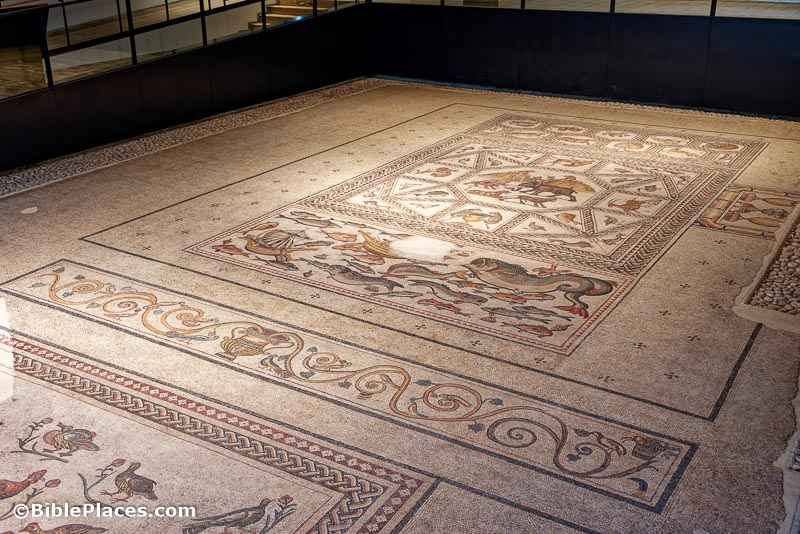
“The exhibition ‘The colours of the Romans. Mosaics from the Capitoline Collections,’ on show in Rome’s Montemartini Museum, has been expanded to include a new section presenting 16 newly restored works dating from the late Roman period and never before shown in public.”

Entrance to the Pantheon in Rome will no longer be free.

The most expensive coin ever sold at auction was sold using false provenance and the owner of the auction house has been arrested.

“Governments, law enforcement officials and researchers have linked a mounting number of the Met’s relics to looters and traffickers.”

New release: The Public Lives of Ancient Women (500 BCE-650 CE), edited by Lucinda Dirven, Martijn Icks, and Sofie Remijsen (Brill, $143).

HT: Agade, Arne Halbakken, Explorator

The site of Horvat el-Bira, a Roman villa with a later Byzantine church, was cleaned up by local residents during the recent Good Deeds Day.

Ruth Schuster tells the story of Yodfat (Jotapata) in the Jewish Revolt of AD 66-70 and describes the archaeological evidence of its defeat.

Melanie Lidman follows up on the various mistakes that the IAA made in failing to identify the “Darius Ostracon” as a modern inscription.

UC San Diego Today tells the story of Neil Smith, from his days as a 19-year-old using GIS in Wadi Faynan to his work today in co-directing the Center for Cyber-Archaeology and Sustainability.

Israel Today is offering a free virtual tour of Hazor on April 16.

Aren Maeir is on The Ancients podcast to discuss the Philistines.

New release: The Koren Tanakh of the Land of Israel – Leviticus ($50). This volume “provides background scholarship for the book of Leviticus, including archaeology, flora/fauna, ancient Near East parallels, language cognates, historical, and geographical perspectives, to the sacrificial procedures, laws, and narratives of the book.”

New release: Ahab’s House of Horrors: A Historiographic Study of the Military Campaigns of the House of Omri, by Kyle R. Greenwood and David B. Schreiner (Lexham Press, $20).

Paleojudaica is celebrating 20 years of blogging. That’s a remarkable run well worth celebrating!

HT: Agade, Arne Halbakken, Explorator

Researchers have launched a global contest with $250,000 in prizes for teams to use AI for decoding unrolled scrolls from Herculaneum.

The Moabite king Mesha is the latest subject of Bryan Windle’s archaeological biography series.

Nathan Steinmeyer explains the significance of the Cyrus Cylinder and its relevance to the Bible.

Jason Borges tracked down the Istanbul Airport Museum and explains how to find it.

“In a new study, genetics and archaeology combine to reveal the ancient origins of humanity’s first beast of burden,” the donkey.

The Codex Sassoon, to be auctioned off on May 16, will be displayed in Tel Aviv, Dallas, Los Angeles, and New York over the next two months.

Chris McKinny, Amy Balogh, and Kyle Keimer discuss “Biblical Geography—The Missing Ingredient” on the Biblical World podcast.

On This Week in the Ancient Near East podcast, “The Archaeology of Ancient Fingerprints, or Profiling Potters for Fun and Profit.”

HT: Agade

Andy Cook was at the Pool of Siloam excavations on Thursday, and he interviewed an archaeologist working there about what’s next.

“The recently renovated Davidson Center Archaeological Garden in Jerusalem’s Old City opened an exhibition on Monday featuring a number of rare and ancient artifacts related to the Temple Menorah.”

Joe Zias looks at some unknown inscriptions on the “Tomb of Absalom” in Jerusalem and suggests renaming the monument the “Tomb of Zacharias,” father of John the Baptist.

A Herodian wall and Second Temple period burial caves at Samaria-Sebaste has been destroyed by road construction.

“Military officials intercepted an antiquities-smuggling ring in the West Bank.” The Jerusalem Post story reports on several other recent antiquities busts.

A seven-mile stretch of the Jordan River south of the Sea of Galilee is being cleaned of its pollution and developed for tourism.

Aren Maeir recounts his two-day trek in eastern Samaria, including a climb up Sartaba.

Adam Montefiore, known as the English voice of Israeli wines, looks at the history of winemaking in the land of Israel.

Seetheholyland.net has added a page for the newly discovered tomb of Salome.

Phillip J. Long writes about the traditional location of the Garden of Gethsemane and the nearby grotto.

Accordance is offering 40-74% off on many graphics resources, including several of our photo collections. Ends Monday.

HT: Agade

Pool of Siloam March 20232635b

Pool of Siloam excavations, March 16. Photo by Andy Cook (Experience Israel Now)

Archaeologists working in the temple of Dendera discovered a Sphinx-like statue that may depict Emperor Claudius.

“Egyptian officials have released photos of an ancient scroll, the 52-foot-long (16 meters) Book of the Dead papyrus recently discovered in Saqqara. The 10 images show ancient illustrations of gods and scenes from the afterlife, as well as text on the document, which is more than 2,000 years old.” The released photos were first posted on the government’s Facebook page.

The British Museum’s Curator’s Corner provides a lesson in how to read ancient Egyptian hieroglyphs (27 min).

New release: Ancient Egypt, New Technology: The Present and Future of Computer Visualization, Virtual Reality and Other Digital Humanities in Egyptology, edited by Rita Lucarelli, Joshua A. Roberson, and Steve Vinson. (Brill, $174; free download)

The first-ever detailed study of the theater at Pergamum reveals that it is larger than the theaters at Smyrna, Ephesus, Miletus, or Aspendos. An aerial photo shows the locations of the theater, stadium, and amphitheater in relation to the acropolis.

Turkish Archaeological News has a roundup of major stories for the month of February. They also provide a damage assessment of cultural properties one month after the earthquake.

“The revamped archaeological museum of Argos in the Peloponnese and its upgraded display collection will soon reopen to the public.”

Archaeologists have discovered for the first time wooden stakes described by Julius Caesar and used as a kind of ancient barbed wire.

New research suggests that humans may have first begun riding horses around 3000 BC.

New exhibition at the San Antonio Museum of Art: “Roman Landscapes: Visions of Nature and Myth from Rome and Pompeii”

The Global Smyrna Meeting on the Seven Churches of Revelation will be held June 4 to 10, featuring many scholars in the field including Mark Wilson, Mark Fairchild, James Hoffmeier, David deSilva, and Ben Witherington.

HT: Agade, Arne Halbakken, Ted Weis, Mark Hoffman, Explorator

Pool of Siloam excavations in late February. Photo courtesy of John DeLancey.