A new study suggests that the mining operations in the Timna Valley and Faynan thrived in the 10th century because of good management. The underlying journal article is here.

Moshe Gilad wonders whether the Bible can be used as an archaeological travel guide to Israel, and his article in Haaretz is based on the responses of Israel Finkelstein, Aren Maeir, and Yoram Bilu.

Saul Jay Singer writes about the life of Yigael Yadin and his father Eliezer Sukenik.

A couple of scholars are suggesting that Mary Magdalene was not from Magdala. (Now seems to be the perfect time for such a proposal, with all the great finds coming out of 1st-century Magdala…) The underlying journal article is here.

Questions have been raised about artifacts in the Israel Museum that were donated by Michael Steinhardt.

John DeLancey and Kyle Keimer complete their four-part tour of the archaeological wing of the Israel Museum.

The Museum of the Bible and Digital Interactive Virtual Experiences are offering virtual tours of Caesarea on January 20 and Qumran on January 27.

The materials in the Israel Film Archive are now online for public viewing. The Times of Israel identifies some highlights.

Andrew Lawler is on The Times of Israel podcast talking about his recent book, Under Jerusalem. (I enjoyed the book, and I hope to say more later.)

The Jerusalem Post reviews Adventure Girl: Dabi Digs in Israel, an illustrated book for children.

Israel’s Good Name reports on his trek around Horvat Hanut and Salvatio Abbey.

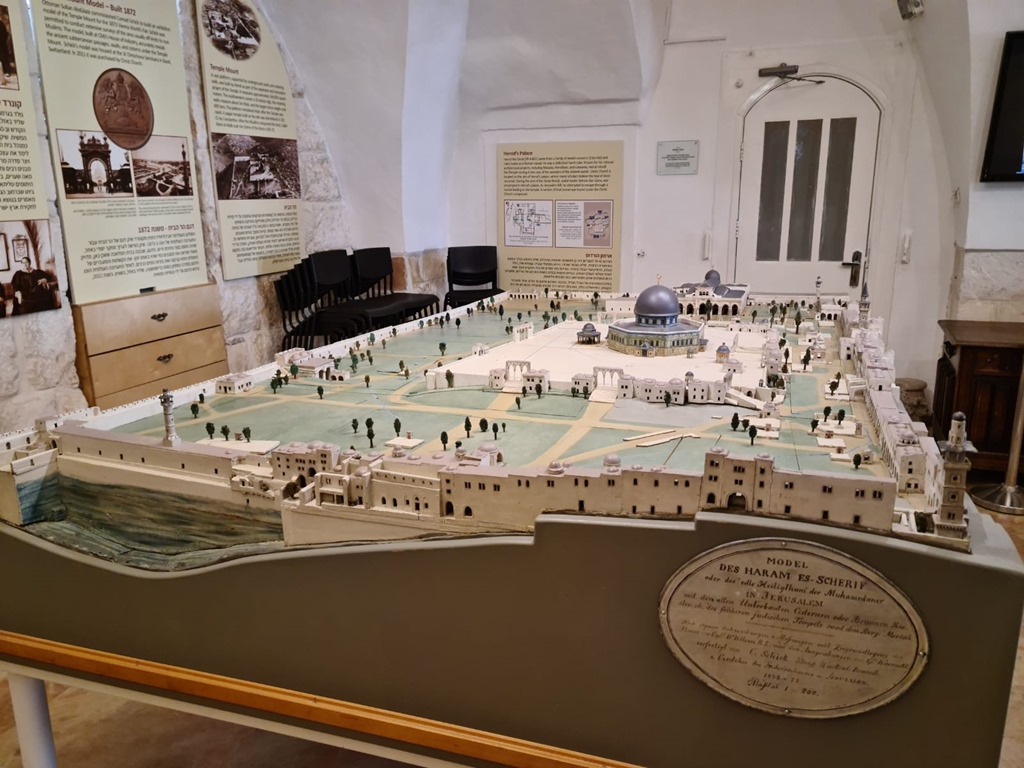
The 200th anniversary of the birth of Conrad Schick is on January 27, and Christ Church in Jerusalem will be having a special event to celebrate on the 28th (10:00-13:00). Their museum includes some of Schick’s models, including the one pictured below.

HT: Agade, Joseph Lauer, Arne Halbakken, Wayne Stiles, Alexander Schick

2

Model of Conrad Schick on display at Christ Church, Jerusalem. Photo by Michael Schneider.

Bob Rognlien has created a 12-episode teaching video series which includes hundreds of photos, maps, reconstructions, and illustrations based on his book, Recovering the Way.

Shelley Wachsmann writes about the challenges and opportunities of deep submergence archaeology.

Smithsonian Magazine has a well-illustrated piece on Assur, one-time capital of ancient Assyria.

New release from Carta: Under the Yoke of Ashur: The Assyrian Century in the Land of Israel, by Mordechai Cogan

The recordings are now available from “The Dead Sea Scrolls: A Second Public Conference” held online in June 2021.

Walking the Text has just released the 3rd edition of “The #1 Mistake Most Everyone Makes Reading the Bible.” You can get a free copying by clicking the button to “join Walking the Text.”

“Live Science makes predictions about what archaeologists will uncover in the new year.” Only the last, regarding Qumran, may be of interest to our readers.

The latest issue of ‘Atiqot is now online.

Andy Cook and Cyndi Parker will be speaking in Warner Robins on Feb 4-5 on the topic of “Discovering the World Jesus Knew.”

HT: Agade, Joseph Lauer, Alexander Schick, Arne Halbakken, Baruch Kvasnica

The discovery of bullae in Jerusalem indicates that at the time of Hezekiah there were two central treasuries, one a temple treasury and the other the royal treasury of Judah located at the “Royal Building” in the Ophel excavations. The underlying article will be posted soon at the website of the Jerusalem Journal of Archaeology, but is available now on Academia.

An analysis of remains found under a toilet south of ancient Jerusalem reveals that the people who used it were infected with a variety of parasites.

“Almost four miles of alleys in Jerusalem’s Old City were recently made wheelchair-friendly, while an innovative accessibility system for visually impaired people is also being installed after ten years of work.”

There is a new virtual tour of the City of David. To access it, you have to enter your email address, but once you are in, you can virtually walk around the tour areas of the City of David. I am more impressed with the 360-degree views than the very brief explanations given, but I do not know of anything comparable.

The Anglo-Israel Archaeological Society has announced its upcoming lectures to be held on Zoom:

  • Jan 20: Three Decades of Excavations at Bethsaida, by Rami Arav
  • Feb 17: New Light on Iron Age and Persian Period Jerusalem, by Yuval Gadot
  • Mar 15: Did Rabbis Write Down the Mishnah? Orality and Writing in the Jewish World in Late Antiquity, by Philip Alexander

Aren Maeir reflects on his work as an archaeologist in an interview in the Discussions with the Diggers series.

Israel’s Good Name reports on a couple of recent excursions in the vicinity of Givat Ze’ev in the territory of Benjamin.

Suzanne Singer, one of the original correspondents for Biblical Archaeology Review, has died in Jerusalem.

HT: Agade, Joseph Lauer, Alexander Schick, Arne Halbakken, Mark Hoffman

Excavations revealed an ancient synagogue in Side near Antalya (biblical Attalia), a city where Paul preached, albeit six centuries after his visit.

“A team of researchers has successfully digitally unwrapped the mummified body of the pharaoh Amenhotep I, who lived around 3,500 years ago.”

Mark Boslough claims that the Sodom cosmic airburst theory has significant shortcomings.

108-year-old Sumerologist credits Istanbul museum for long career.”

“A digital model of Babylon is under development.”

Virtual workshop on January 11 at the Albright Institute: The Religious Soundscape of the Holy Land: From the Crusades to the Late Ottoman Empire

Webinar on January 20: “The Not-So-Innocents Abroad: The Beginnings of American Biblical Archaeology,” by Rachel Hallote

Carl Rasmussen writes about an anchor stock at Malta with the name of an Egyptian deity on it.

John DeLancey and Kyle Keimer give a virtual tour of highlights in the archaeological wing of the Israel Museum (part 1 of 4).

HT: Agade, Joseph Lauer, Alexander Schick, Arne Halbakken, Charles Savelle

Hundreds of Israelis trekked to Har Karkom on December 21 to see the “Burning Bush” phenomenon.

Israel’s (quasi-)observance of the sabbatical year may provide income for Gaza’s farmers.

Dozens of ancient sites in Jerusalem are suffering from neglect.

Israeli police caught a group of antiquities thieves plundering Horvat Zaak, a Jewish village from the Second Temple period in southern Judea.

Elisabeth Yehuda writes about wine production in the Latin Kingdom of Jerusalem.

The Israeli government has approved a $48 million aid package for the tourism industry, some of which is designated for retraining programs.

The list of speakers and topics has been released for JUC’s Transitions in the Land online seminar. Registration is free and open to all.

The complete series of 26 episodes is now available of “Conversations in the Archaeology and History of Ancient Israel with Israel Finkelstein.”

Releasing today: Footsteps Every Day: A Daily Devotional is a year-long journey through all four Gospels, led by Bob Rognlien, author of Recovering the Way. The website includes a video introduction and sample devotions.

Ralph W. Klein died this week.

Bryan Windle highlights the top three reports in biblical archaeology for the month of December.

Three new top 10 lists for 2021:

HT: Agade, Joseph Lauer, Alexander Schick, Arne Halbakken, Charles Savelle

Two statues believed to be dating back to 2,000 years were unearthed during excavation works in the ancient Roman city of Blaundus in western Turkey.”

Five marble statue heads from the Hellenistic and Roman periods were discovered in excavations at Cnidus (Knidos).

A 4,000-year-old mound and an architectural structure inside it have been unearthed after the water level of Atatürk Dam receded 15 meters in the southeastern province of Adıyaman.”

“The Temple of Venus and Roma, located in the Roman Forum opposite the Colosseum, has undergone a €2.5 million restoration sponsored by the luxury fashion house Fendi.”

Biblical Archaeology Review has posted its annual list of dig opportunities for 2022. The Biblical Archaeology Society is offering dig scholarships of $2,000.

The first-ever Spring Bible and Archaeology Fest will be held on April 2 and 3.

“Left in ruins by jihadists, Iraq’s once-celebrated Mosul museum and its 2,500-year-old treasures are being given a second life.”

Austen Henry Layard, renowned as the excavator of Nimrud, used his archaeological fame to catapult him into a career of politics and diplomacy.

The National Library of Israel has a new section on its website to share manuscripts from St. Catherine’s Monastery and related materials.

The final reports for the Tall Zirā‘a / Gadara Region Project have now been published. The volumes are also available in pdf format for free.

New exhibition at New York University: Pompeii in Color: The Life of Roman Painting (Jan 26 to May 29).

BBC Radio episode on the Hittites: “Melvyn Bragg and guests discuss the empire based in the Land of Hatti during the Late Bronze Age, in modern Turkey, and the discoveries there over the last century.”

Carl Rasmussen begins a series on anchor stocks discovered at Malta and their possible relationship to Paul’s shipwreck.

Lectures from La Sierra University’s recent Archaeology Discovery Weekend are now online, including these two by Mark Wilson:

HT: Agade, Joseph Lauer, Arne Halbakken, Alexander Schick, Charles Savelle, Explorator