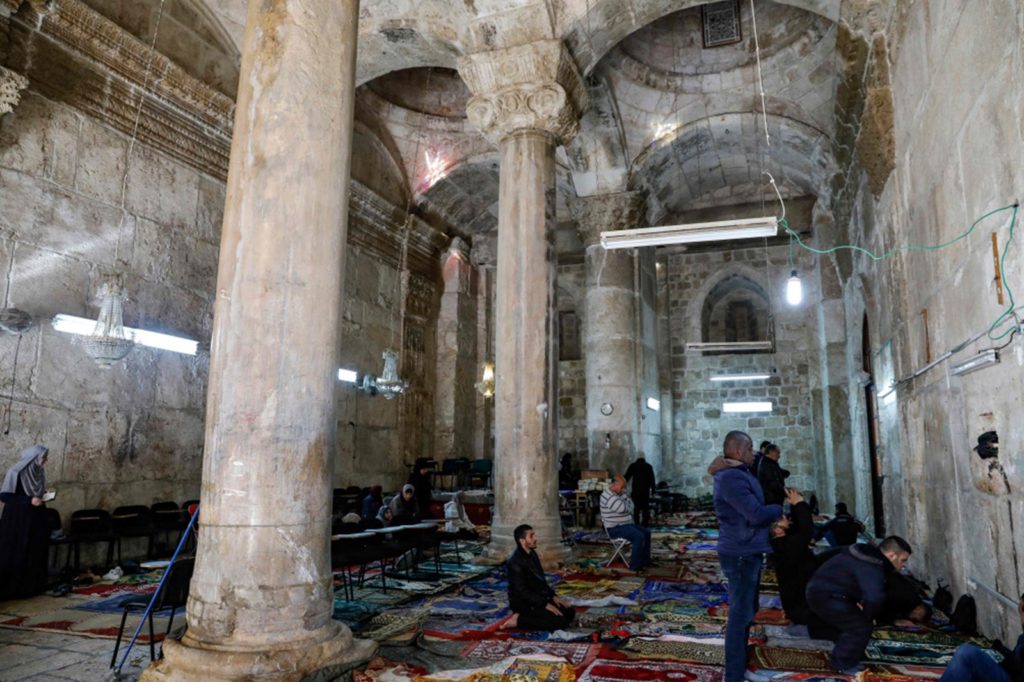
Archaeologists believe that a public bath excavated in Sepphoris may have been used by Rabbi Judah the Prince.

Archaeologists excavating at the Negev town of Shivta have found a lamp wick dating to the Byzantine period.

Kiriath Jearim has a large platform which must have been cultic and could only have been built by the northern kingdom of Israel. Or so says Israel Finkelstein. (Haaretz premium)

A total of 1,500 landmines have been cleared since the spring near the Jordan River baptismal location of Qasr al-Yahud.

Migdal Aphek, the Crusader castle also known as Mirabel, will soon be open to the public following conservation works.

Dennis Mizzi asks, “What does Qumran have to do with the Mediterranean?”

The Annual Conference on the Excavations of the Institute of Archaeology at the Hebrew University will be held on Thursday.

Israel’s Good Name reports on a university field trip to the Hebron area.

Biblical Byways has a couple of tours to Israel coming up, including a Spanish tour in April.

Tim Frank’s latest book, Household Food Storage in Ancient Israel and Judah, is now available in paperback and as an e-book.

The Lexham Geographic Commentary on the Gospels was chosen as the Best Book in Biblical Studies in Christianity Today’s 2019 book awards. You can read an excerpt about the birthplace of
Jesus here.

HT: Agade, Ted Weis, Joseph Lauer

Peter Feinman summarizes some papers on the subject of the 10th century BC given at the recent ASOR conference.

Andrea Nicolotti looks for archaeological evidence for the scourging of Jesus.

“Italy’s highest court ruled that a 2000-year-old bronze statue, known as ‘Victorious Youth,’ should be returned to that country by the Getty Villa.”

A well-illustrated BBC feature explains how ISIS’s destruction of a mosque revealed an Assyrian palace.

I am very happy that Wipf and Stock has re-published David Dorsey’s The Roads and Highways of Ancient Israel. For too long, you could only find used copies of this excellent resource for $200 and up.

Lois Tverberg’s excellent Reading the Bible with Rabbi Jesus is on sale with bigger discounts if you order 2-4 copies.

Everything at Eisenbrauns is 30% off with coupon EEOY18.

Bible Land Passages has now released 10 episodes that connect the biblical stories to the biblical world, using historical, geographical, and archaeological data. The episodes are available for free online as well as for purchase on DVD. The latest episode is entitled “Khirbet Qeiyafa: Witness to David’s Kingdom.” Episode 11, “The Power of Jesus in Galilee,” will be released next month.

HT: Agade, Ted Weis, Charles Savelle, Joseph Lauer

In Caesarea, a remarkable Crusader-era cache of 24 gold coins and an earring was found in a small bronze pot, hidden between two stones in the side of a well.

The NY Times has a summary of the Pilate ring discovery. Robert Cargill prefers the theory that the ring belonged to one of Pilate’s papyrus-pushing administrators. Ferrell Jenkins shares a number of related photos.

Archaeologists working at Timna Park opened their excavation to volunteers from the public for three days during Hanukkah.

The second in a series of 12 objects from the Temple Mount Sifting Project is an arrowhead from the 10th century BC.

Jim Davila tries to unravel the latest with the Qumran caves with potential Dead Sea Scroll material (with a follow-up here).

Matthew Adams gives an update on the Jezreel Valley Regional Project on The Book and the Spade.

Israel is on pace to hit a new annual record of 4 million tourists this year.

Episode 1 in Wayne Stiles’s excellent “The Promised That Changed the World” is now available. You can sign up to get free access to all three episodes.

HT: Agade, Ted Weis, Charles Savelle, Joseph Lauer

The discovery of a cuneiform fragment at Tel Mikhmoret recorded a slave sale and revealed physical evidence of the presence of Babylonians in biblical Samaria.”

Authorities have recovered from antiquities thieves a Neolithic stone ritual mask that comes from the Hebron hills.

Archaeologists have found evidence for trephination in a Late Bronze tomb at Megiddo (Haaretz premium).

“In one of the largest tombs ever found in Luxor, Egypt, archaeologists have discovered a sarcophagus holding the mummy of a woman named Pouyou who lived during the 18th dynasty.”

Egyptian officials announced that treasures from the tomb of Tutankhamun will tour ten cities in the world prior to the 2020 opening of the Grand Egyptian Museum in Giza. The exhibit is currently in Los Angeles and then heads to Paris. The other cities have not yet been announced.

“Inside the Cloak-and-Dagger Search for Sacred Texts” is in this month’s issue of National Geographic. As you would expect, the text is engaging and the photos beautiful.

“National Geographic has commissioned leading British indie production company, Caravan to produce The Bible from Space, a two-part documentary special which reveals the truth behind the biggest, most incredible stories from the Old Testament.” You can be sure that any TV production which promises to “reveal the truth” does not.

Carl Rasmussen is having second thoughts about the route of Paul’s ship from Chios to Miletus.

Luke Chandler is leading a tour of Israel in June, with the option to stay longer and join an archaeological excavation.

SourceFlix has released a 4-minute video about Tel Dibon, including footage of an early-morning fly-over. Ferrell Jenkins writes about the same site and provides some nice photographs.

A board game dating to the time of Abraham, the Royal Game of Ur, is making a comeback in Iraq.

The online Massive Open Online Course (MOOC) entitled “Biblical Archaeology: The Archaeology of Ancient Israel and Judah” begins on Wednesday.

The Institute of Biblical Culture is offering your choice of a free class.

If you’re not a subscriber to the BiblePlaces Newsletter, you can sign up in a few seconds. We send about three issues a year, with one coming next week.

HT: Agade, Ted Weis, Charles Savelle

Appian Media has released a trailer for their new series, “Searching for a King.” They have some impressive footage. They also are asking for some quick help with a survey.

“At the annual meeting this week of the American Schools of Oriental Research in Denver, Colorado, scholars will discuss whether to rechristen the 118-year-old society on the grounds that its moniker is irrelevant and racist.” There’s more here.

Mary Shepperson recounts the “turbulent life” of the British School of Archaeology in Iraq. The article includes some interesting photos.

Iraqi technicians are restoring ancient Babylon under a U.S.-funded project, with the goal of making the site worthy of UNESCO World Heritage Site status.

New book: Archaeogaming: An Introduction to Archaeology in and of Video Games, by Andrew Reinhard.

Mosaics looted from Turkey and sold to Bowling Green State University are now being returned.

Lawrence Schiffman explains how Dead Sea Scroll forgeries were exposed by high-tech tests.

Yosef Garfinkel’s recent lecture at the Lanier Theological Library is now online, and Carl Rasmussen recommends it. The library has also made available many seminar videos from 2012 to present.

Artofthe.Bible is a new catalog of 5,800 works of art from wikimedia arranged in 116 Bible stories.

“A Biblical Spice Rack” was published in Bible Review in 1997 and is now available online through Bible History Daily.

Robert Alter has completed his translation of the entire Hebrew Bible. It will be released in time for
Christmas. (An Amazon coupon code good through today will save $5 off purchase of $20 or more: NOVBOOK18.)

HT: Joseph Lauer, Agade, Ted Weis, Mark Hoffman, Charles Savelle, Chris McKinny

“An extremely rare, minuscule biblical stone weight inscribed in ancient Hebrew script with the word “beka” was discovered in rubble taken from excavations at the foundations of the Western Wall.”

“Archaeologists exploring Montfort Castle in the Galilee discovered a previously unknown, richly decorated Gothic hall where the secretive knights’ order gathered for their assemblies.” (Haaretz premium)

A member of the Tall el-Hammam Excavation Project believes that civilization on the northern end of the Dead Sea were obliterated by “a massive airburst caused by a meteor” circa 1700 BC, leaving the region desolate for at least 600 years. The claim is explicitly linked with Sodom’s destruction in a 2015 conference paper available here.

A tomb at Megiddo now provides the earliest evidence for the use of vanilla.

The Times of Israel has more background on the release of photos of biblical scenes from the mosaics of the synagogue of Huqoq.

Alexander Wiegmann’s YouTube channel includes photogrammetric models, including one of the Mount Ebal altar.

A conference is being held next month in Jerusalem to refute the recent theory that the temple was not located on the Temple Mount.

You can see what a day of digging at Tel Burna is like with this new 10-minute video produced for this year’s ASOR conference.

I’ve been using and enjoying Readwise this past month. It’s a great way to review my Kindle highlights. Use this link to get a free month for you (and for me).

HT: Joseph Lauer, Agade, Gordon Franz, Chris McKinny