A 4th-century basilica with a large reception hall has been excavated in Ostia.

A team of researchers has used AI to figure out the rules of an ancient Roman board game.

Authorities are taking action to reduce graffiti at the ancient site of Persepolis.

New benches outside the Roman Colosseum enable the visitor to comprehend just how much larger the amphitheater was before earthquakes destroyed the outer ring.

“A new study suggests that Alexandria on the Tigris was more than a regional city; it functioned as a capital of ancient global trade, linking India, Mesopotamia, and the Mediterranean for more than five centuries.”

New release: The Transjordan in Biblical Literature: A Critical Spatial Approach, by Aubrey Taylor McClain (Gorgias, $76). 

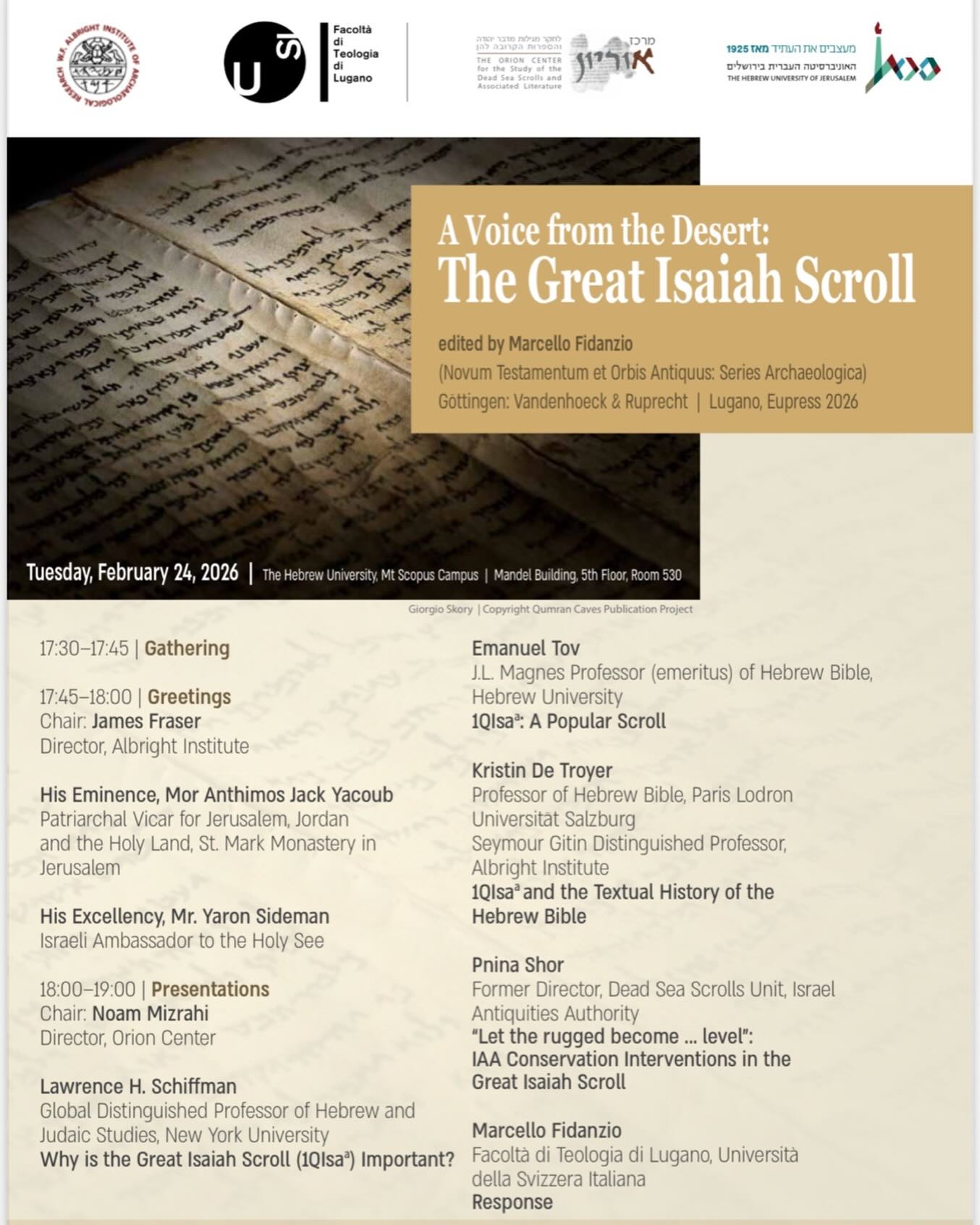
A book launch for A Voice from the Desert: The Great Isaiah Scroll will be held on Tuesday, Feb. 24, 5:30, at The Hebrew University, Mt. Scopus Campus, Mandel Building, 5th Floor, Room 530. Presentations will be made by Lawrence H. Schiffman, Emanuel Tov, Kristin De Troyer, Pnina Shor, and Marcello Fidanzio. The event is open to the public, and no registration is required.

Walking The Text has just released a “behind the scenes” series for The Lord’s Prayer. Six episodes reveal the backstory of the location shoots, the biblical scholarship, and a night in a bunker when missiles were in the air.

HT: Agade, Arne Halbakken, Ted Weis, Explorator

A stone tool workshop from the Second Temple period was discovered on Mount Scopus in Jerusalem during an investigation by the Israel Antiquities Authority into a gang of antiquities thieves.”

“A rare bronze scale pan was discovered during excavations in the ancient Jewish town of Sussiya by a father and daughter participating in an educational dig.”

A seal discovered in the Temple Mount Sifting Project is a rare find “from Jerusalem’s ‘Second Persian Period,’ the brief 14-year window of Sassanid rule between 614 and 628 CE.”

A Roman cemetery was discovered in the village of Jifna, north of Ramallah.

“The elderly patriarch and matriarch of a prominent Israelite family living in an imposing building in the Judean lowlands nearly 3,000 years ago appear to have enjoyed their own spacious room in a strategic part of the large home, suggesting they continued to play a prominent role within the multi-generation household into their golden years.”

The latest Jerusalem in Brief looks at the history of Absalom’s Pillar through a 19th-century photo, and more.

Hybrid lecture on Feb 26: “A Book in Two Scrolls: On the Bisection of Isaiah,” by Marcello Fidanzio (registration required). This lecture is in conjunction with the Great Isaiah Scroll exhibit which opens to the public on Tuesday (through June 6). The exhibition book is now available for sale in e-book (pdf) format.

Hybrid lecture at the Albright on March 4: “Current Research on the Holy Sepulchre and Faunal Remains,” by Luca Brancazi (Zoom link)

New release: Ashkelon 10: The Philistine Cemetery, by Daniel M. Master, Adam J. Aja, and Rachel Kalisher (Eisenbrauns, $91 with code NR26).

New release: Lahav VIII: The EB III and LB II to Iron II Strata in the Western City at Tell Halif: Excavations in Field III, 1977–1987, by Oded Borowski and Joe D. Seger (Eisenbrauns, $91 with code NR26).

Following the British Museum’s review of the anachronistic use of the term “Palestine,” PaleoJudaica explored what language Second Temple-era Jews used for the land.

Israel’s Good Name describes his visit to the Friends of Zion Museum in Jerusalem.

Bible Mapper Atlas has created a free poster map of Jerusalem in the time of Nehemiah.

HT: Agade, Arne Halbakken, Ted Weis, Explorator, Alexander Schick

Researchers working at Petra discovered a “rare 116-meter pressurized lead pipeline, an extraordinary feature in the eastern Mediterranean outside urban building interiors.”

An Iron Age Phoenician scarab seal was discovered on Sardinia.

“A recent study of the Ishtar temple at Assur has identified an unusual feature beneath the temple’s earliest floor: a thick layer of prepared sand.”

“A newly discovered chronicle from the early eighth century is giving medieval historians a rare new window onto the political shocks and religious debates that reshaped the eastern Mediterranean in the decades before and after the rise of Islam.” PaleoJudaica has more here.

“Imagine your car, your savings account, and your power grid were all the same thing, and alive. In the ancient Near East, that was the ox.” Lauren K. McCormick has written “an ode to oxen.”

Carlo Rindi Nuzzolo writes about the possibilities that 3D scanning opens up for the understanding of ancient artifacts.

Zoom lecture on Feb 21: “Piramesse – from the City of Wonders to Terra Incognita,” by Henning Franzmeier

Bible Archaeology Report shares the top three reports in biblical archaeology for the month of January.

HT: Agade, Arne Halbakken, Explorator

A beautiful seal with a Hebrew inscription from the time of Hezekiah was discovered in the Mount Carmel range. The seal is believed to have belonged to an official from Judah, and LMLK seal impressions were also found at the site.

The Caesarea aqueduct will be restored in a project that will take 40 months and cost 40 million shekels ($13 million). “The work will include planning, conservation, the constructive stabilization of each of the aqueduct’s 85 arches, engineering treatment of the upper aqueduct (the water channel itself), and of course, arranging a safe pedestrian crossing under the arches.”

The Grotto in Bethlehem’s Church of the Nativity will be restored for the first time in 600 years.

The Humble Skeptic visited the Hecht Museum and asks whether an ossuary discovered in 1983 that mentions Joanna the granddaughter of Theophilus might be related to the two individuals mentioned in the Gospel of Luke (18 min).

Bryan Windle shares the results of his research into the excavations of Jericho in a two-part episode of Digging for Truth.

BibleMapper has posted an audio-visual reading of very interesting Genesis 14.

The Duke University Chronicle writes about the relationship of Carol and Eric Meyers over many years of teaching and leading excavations in Galilee. (The story doesn’t mention it, but interested readers may want to pick up Eric’s An Accidental Archaeologist: A Personal Memoir. I personally enjoyed it.)

Aren Maeir announces that the 8th Annual “Jerusalem Days” conference will be held on July 7-10 at Yad Yitzah Ben-Zvi in Jerusalem on the topic of “Jerusalem: Between East and West.”

John James Davis, professor and president of Grace Theological Seminary, died this week.

Gabriel Barkay was honored this week in an event attended by many friends, colleagues, and students. The report of the evening includes recorded tributes by Paul Wright and Andy Vaughn.

HT: Agade, Arne Halbakken, Ted Weis, Keith Keyser, Explorator

Rock carvings found in southwestern Sinai depict a killing scene and a boat.

“A US-led research team has verified the first Mediterranean mass grave of the world’s earliest recorded pandemic, providing stark new details about the plague of Justinian that killed millions of people in the Byzantine empire between the sixth and eighth centuries.”

The musty aroma that comes from Egyptian mummies is “a complex mix of volatile organic compounds,” and recent research has identified 81 of these VOCs.

Turkish Archaeological News summarizes the top stories for the month of January.

The Times of San Diego writes about the career of archaeologist Tom Levy.

Luke Lukert profiles Bobby Duke, the chief curatorial officer of the Museum of the Bible.

New release: Karkemish of the Hittites on the Euphrates: New Discoveries and New Acquisitions, edited by N. Marchetti (OrientLab; €18, open-access)

Lee M. Jefferson explains why Michelangelo’s Moses has horns.

HT: Agade, Keith Keyser

The opening of the Pilgrims’ Path from Siloam to the Temple Mount is reported by The Times of Israel, The Jerusalem Post, and Israel HaYom.

“A rare 2,000-year-old stone vessel recently uncovered in the Galilee is on display for the first time as part of the exhibition, ‘From the Great Assembly to the Knesset’ at the Knesset in Jerusalem.”

Vanessa Linares writes about the discovery of vanilla-spiced oil in a Middle Bronze Age tomb at Megiddo.

John DeLancey made a video of his walk on the new trail that runs from Chorazin to Capernaum.

Aren Maeir notes his visit to the excavations at Tel Goren (En Gedi), now in their second season.

A Ram for Mars, the third book in Christopher D. Stanley’s “A Slave’s Story” trilogy has been released ($5 on Kindle; paperback coming soon). I highly recommend the first two in the series and look forward to this one.

New release: Gaza: Archaeology and History, by Wolfgang Zwickel (Ägypten und Altes Testament, Zaphon, € 160)

Gordon Govier writes about Gabriel Barkay, the “Jewish archaeologist who inspired a generation of American Christians.”

HT: Agade, Keith Keyser