Some tour groups visit every church as part of their pilgrimage to the Holy Land, while others visit only those they can’t avoid. Whatever your persuasion, it’s hard to deny that there are some beautiful buildings that have been constructed at or near biblical sites. You might choose one because of its architectural symmetry, because of the significance of the event it commemorates, or because of a special experience you enjoyed there.

The boundaries here are very broad. By “church” we include everything from a cathedral to a chapel and it can be anywhere in the biblical lands, from Israel to Rome.

Thanks for joining in! You can look for a reporting of the results on Thursday.

The National Parks Authority has begun a $750,000 project to restore the Lower Aqueduct between Abu Tor and the Temple Mount in order to open it to visitors for Sukkot.

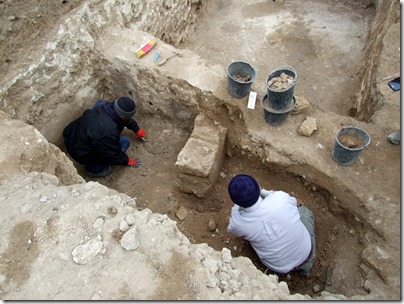
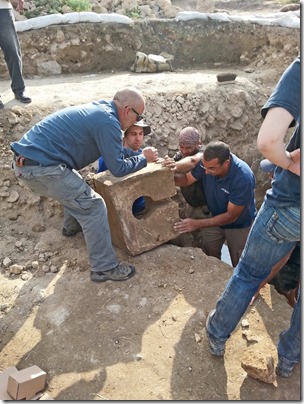
A stone workshop has been excavated in Galilee between Nazareth and Cana. The archaeologist suggests that perhaps the large stone jars mentioned in John 2 came from a cave like this one.

Archaeologists working in the Hittite capital of Alacahöyük have discovered a secret tunnel.

An article in Haaretz highlights similarities of Philistine culture to Cypriot cities and technology, supporting the theory of their Aegean origins.

A collection of metal artifacts discovered near the coast of Caesarea over several decades has been turned over to the Israel Antiquities Authority.

Seventy percent of the work on the archaeological park around the Giza pyramids is complete and the plan is to open it by the end of the year.

The BBC asks, “Will the skyscrapers outlast the pyramids?

The tomb of Suleiman the Magnificent is being excavated in a small town in Hungary.

New book: The Archaeology and History of the Church of the Redeemer and the Muristan in Jerusalem, edited by Dieter Vieweger and Shimon Gibson. Publication details here.

Wayne Stiles has a very good deal going right now on the audiobook version of his excellent Waiting on God.

HT: Agade, Joseph Lauer, Charles Savelle

Readers of this blog are big fans of the Tel Dan Inscription, taking first place with twice the number of votes for the runner-up, the Siloam Inscription. It dropped off steeply from there with only four votes for the Pilate Inscription, two for the Ketef Hinnom silver amulets, and one each for a number of others. Some respondents explained their choice, so let’s take a look at a few of those.


#1: Tel Dan Inscription

First recognized mention of David, the kings of Israel and Judah seen as closely related polities, its early date, royal rhetorical devices, claims of divine intervention for the same event which Kings and Chron claim for another deity (still history on both counts!). Plus its early discussion revealed the disparity we call min & maximalism more clearly than ever before.

Can’t beat this one. Any extrabiblical reference has some weighty significance, but to have one connected to King David is beyond remarkable. Truly an amazing discovery.

The irony that proof of David’s house was preserved in the very place Jeroboam tried to compete with it (1 Ki. 12).

My two cents: While many rightly recognize this stele as important because of its mention of the “House of David,” I think that its significance as witness to the Aramean oppression of Israel has too often been overlooked. I addressed this matter in my dissertation.

Tel Dan Inscription, tb032014241
The Tel Dan Inscription, on display in the Israel Museum


#2 Siloam Inscription (in Hezekiah’s Tunnel)

You can actually see the thing described in the inscription. Furthermore, the activity of excavating the tunnel was in preparation for an event (Sennacherib’s 3rd campaign of 701 BC) which is documented in archaeological artifacts, destruction layers, Sennacherib’s inscriptions, Sennacherib’s reliefs, the Bible, and more!

The construction of the tunnel in the 8th century BC was an amazing feat–starting from opposite ends and meeting. Whatever may be said about how it was done, I think it was engineered by our great God!

Too few inscriptions are found in situ, and this one is so remarkable in part because there can be no doubt what it is describing, and the fact that this tunnel is mentioned in the Bible (twice!) makes this one of the greatest discoveries in “biblical archaeology.”

Siloam Tunnel inscription panorama with background, adr1006059998b
The Siloam Inscription, on display in the Istanbul Archaeological Museum


#3 Pontius Pilate Inscription

Offers historical proof of Pontius Pilate’s tenure of office

Because of Pontius Pilate’s relationship to Jesus

This discovery in 1961 provided the first inscriptional evidence for this Roman prefect (and confirmed that he was a prefect and not a procurator).

Pilate inscription, closeup, tb032014601
The Pilate inscription, on display in the Israel Museum

Though they didn’t receive as many votes, some others received good support:


The “Shasu of Yahweh” inscription

It is surprising to find that the earliest naming of the Israelite God occurs in an Egyptian inscription from Soleb from the 14th-15th century BC.  As Donald Redford notes, it is “a most precious indication of the whereabouts during the late fifteenth century B.C. of an enclave revering this god.”

The Balaam inscription from Tell Deir ‘Alla

How often do we get a new story about a famous biblical character?

Isaiah 66:14 near Robinson’s Arch

Hopeful Jews from the time of Emperor Julian, (4th century AD) allowed back into Aelia Capitolina were hoping to rebuild the Temple.

There were a number of other good suggestions, including:

  • The Baal Cycle Tablets
  • The Merneptah Stela
  • The Black Obelisk
  • The seal of Baruch the scribe
  • The (complete) Soreg inscription
  • The Miriam ossuary

The one that may be my favorite was not chosen by anyone: the Mesha Stele. Someday I need to make my case for why this is such an outstanding inscription. But for now I’ll note only this: it provides a remarkable witness to the Aramean oppression of Israel!

Thanks for participating and/or reading! This has been enjoyable and we’ll plan to do another survey next Tuesday.

We’re heading indoors for this survey, for when an artifact is discovered, particularly one with writing on it, the archaeologist removes it from the site and it usually ends up displayed in a museum.

This survey may be a little more challenging for some of you, because you can’t just open up your Bible and flip around. Instead you need to retrace your steps in the Israel Museum or the British Museum or some other renowned institution. If you can’t do that, you may recall learning about various inscriptions from a tour guide, professor, or pastor. You have many choices, and there are a number of books dedicated almost solely to inscriptions with biblical relevance (including those by McCarter, Fant and Reddish, Hallo and Younger, and Hays).

But you don’t need to have a book handy. Long-time readers perhaps recall the “Artifact of the Month” series by Mike Caba. And if that’s not enough, you can browse Mike’s list of 50 objects in his Bible and Archaeology – Online Museum.

There are some great possibilities and I look forward to seeing what you pick! Just remember to limit your selection to an inscription—perhaps another time we’ll have a survey for favorite artifacts without writing.

(Email readers may need to click through to fill in the survey.)

A high school student found a ballista ball from the Bar Kochba Revolt during recent excavations of Beitar.

Excavators working at Abel Beth Maacah discovered one of the earliest silver hoards ever found.

There’s more information about the excavation of the chariot race mosaic in Cyprus.

To make the looting of Syrian artifacts more difficult, the US State Department announced emergency import restrictions.

“Oxford University researchers say that trees which grew during intense radiation bursts in the past have ‘time-markers’ in their tree-rings that could help archaeologists date events from thousands of years ago.”

Wayne Stiles explains how the Herodium testifies to God’s sovereignty.


The New York Times is no fan of the Ben-Hur remake.

The Associates for Biblical Research are beginning to recruit for their first season of excavations at Shiloh next summer.

Leon Mauldin posts on the end of wicked Queen Athaliah and shares a photo of a model of Jerusalem at the Bible Lands Museum.

If you wanted to know a little more about Enoch’s journey through the world (referenced in
Thursday’s survey results), Paleojudaica explains.

The new NIV Cultural Backgrounds Study Bible is being released on Tuesday. It looks impressive, and you can flip through the entire books of Genesis and Matthew online to see for yourself.

Hundreds of photos, maps, and charts accompany study notes edited by John Walton (OT) and Craig
Keener (NT). The promotional website also includes videos and infographics.

HT: Agade, Ted Weis, Joseph Lauer

Old City aerial at night from southwest, ws052016101
Our most re-tweeted photo of the week was this aerial photo taken by Bill Schlegel of Jerusalem from the southwest. The Citadel of David is in the foreground and the Mount of Olives is in the distance.

This was a fun survey for me to review, and I think it was fun for many of you who suggested a favorite story. Most of the choices were unique, but David and Goliath was chosen four times and several others were picked twice: Gideon, Jesus’s temptation, the Good Samaritan, and Jesus at Caesarea Philippi.

Of all the stories chosen, 70% are in OT. The other 30% were all in the Gospels. Of the stories selected in the OT, they were pretty evenly divided between these four groups: Pentateuch, Joshua-Judges, 1-2 Samuel, and 1-2 Kings, though 1-2 Samuel edged out the others because of the four votes for David and Goliath. Those who chose something in Kings went with a story about Elijah, except for one selection for Josiah and Neco and another for Adonijah’s attempted coup.

Perhaps the most curious vote was for “Enoch’s journey throughout the world,” with a helpful explanation for those of us who might be mystified: “Might not be in most Bibles, but it is in mine.” He or she is right: it’s not in most Bibles!

We should give an honorable mention to Tim Bulkeley for providing not just a suggestion but his own podcast (previously recorded) to explain it. He wrote, “The interplay of peasant (Boaz) and nomadic (Ruth) cultures in their interchange is such fun with her ‘but of course I’m not your servant’ as the key phrase.” The brief podcast provides a simplified summary.

I can’t cover everyone’s choice, so I thought I’d just select one from each of the above sections of the Bible and quote the explanation given. Perhaps this will stir your own thoughts or send you back to the Bible to read the story afresh.


Pentateuch

Jacob wrestling with the Angel of the LORD at Penuel. Why?

When I read Genesis Chapter 32 I can picture Jacob wrestling with the Angel of the LORD there at Peniel (Penuel) and I can almost feel myself sitting there in the background watching as Jacob was able to keep the match up through the night. This must have been an amazing sight to see.

Agreed! This is one of my favorite places to visit in Jordan!

Jabbok River near fords, tb030815364


Joshua-Judges-Ruth

Samson. Why?

Well, it’s probably my second favorite after David and Goliath. But, it’s always amazing to stand in Beth Shemesh and read the story of Samson and visualize the events in a new way. It’s one of those first moments in our trips where the Bible comes to life for people. It also brings richness to a very familiar story, in much the same way as reading David and Goliath in the Elah Valley.

Yes, indeed. This stop always gets me behind on the rest of the day because it’s so hard to resist going through the Samson story blow by blow.

Sorek Valley from Beth Shemesh view west, tb052405993


1-2 Samuel

Saul fighting the Philistines by Mount Gilboa and all the details surrounding that (1 Sam 28-31).

Why?

It combines so many geographical details and routes around the Jezreel Valley, and even helps to make some significant historical connections (why were the people of Jabesh Gilead so concerned about Saul?)  If you count chapter 30, it even has interesting details about the Negev area.  Lots of interesting things happening, geographically.

All kinds of fascinating places here, including En Dor, Jezreel, and Beth Shean! Tour groups need to add an extra day to spend in this area.

Jezreel and Mount Gilboa aerial from west, ws011215042


1-2 Kings
Elijah’s contest with the prophets of Baal on Mount Carmel and his race to Jezreel. Why?

From some vantage points you can see just about all locations and imagine the entire event unfolding before your eyes.

This is another story where I insist on reading the whole passage no matter how windy (or rainy) it is on top of that monastery’s roof!

Jezreel Valley from Mount Carmel panorama, tb032407526


The Gospels

The woman at the well. Why?

Messiah revealed at locale where previous covenants made, i.e., fulfilling the promises. So much to absorb being there. My favorite place in the land.

Great connection here! This story doesn’t “move” from one place to another, but the geographical background is so rich.

Shechem Jacob's well, pcm05907

This was fun. I have another idea for next week, so plan to stop by on Tuesday to share your favorite!