From the Jerusalem Post:

A Roman gate discovered during excavations by the University of Haifa in the ancient city of Hippos, located at Sussita National Park, may cast light on the mystical bronze mask of Pan, considered by archeologists to be the only object of its kind in the world.
Researchers from the university’s Zinman Institute of Archaeology announced on Monday that they believe the gate may have led to the compound of Pan, the god of shepherds, after unearthing it during last year’s excavation season….
“Now that the whole gate has been exposed, we not only have better information for dating the mask, but also a clue to its function. Are we looking at a gate that led to the sanctuary of the god Pan or one of the rustic gods?”
[…]
The researchers concluded that the original gateway was over 6m. high, while the building (propylaeum) itself was even taller,” the archeologist said.
“The propylaeum can probably be dated to the period of the emperor Hadrian, who reigned from 117 to 138 CE, or slightly earlier,” Eisenberg said. “The mask was presumably fixed to a wall or altar at the compound, as its rear side included remnants of lead used for stabilization purposes.”

The full story, including photos, is here. A 3D model of the gate is here.

HT: Joseph Lauer, Charles Savelle
776A0663
Gateway at Hippos
Share:

The Temple Mount Sifting Project has released a new video showing dozens of their discoveries.

Another video released this month features David Hendin explaining the coins of the Jewish War.

Egyptian officials are re-opening the tombs of Queen Nefertari and King Seti I in Luxor, but the cost for a ticket will be steep (about $113).

Researchers suggest that King Tut’s dagger was made from a meteorite.

The BBC has the latest “the Dead Sea is dying” story, including an impressive photo of Mineral Beach.

The ASOR Archive Photo of the Month shows archaeologists and local workers at Qumran in 1952.

In terms of visitors, the Louvre is the most popular museum in the world. The British Museum is #5 and the Vatican Museums are #7.

The Google Cultural Institute “contains more than six million artworks, photos, videos and documents from 1,000 institutions including the British Museum and MoMA.”

The lavish lifestyle of the Roman Empire elite is on exhibit at the Nelson-Atkins Museum in Kansas City.

The Getty Museum has acquired a valuable Greek funeral vase and a Roman marble head.

“The Penn Museum’s ongoing exhibition, ‘In the Artifact Lab: Conserving Egyptian Mummies,’ offers visitors an insider’s look at efforts to document, preserve, and restore ancient objects in the
Museum’s extensive collection.”

A new exhibit at the Met in New York City focuses on Jerusalem between the years 1000 and 1400.

Ashkelon: A Retrospective: 30 Years of the Leon Levy Expedition is a new exhibit running at the Rockefeller Museum in Jerusalem until the end of the year.

Haaretz ran a profile of Geza Vermes on the anniversary of his birthday.

The Israel Antiquities Authority raided a shop in the Mamilla Mall on suspicions of selling looted antiquities.

“For the first time in history the texts and images of all the Dead Sea Scrolls are available in their totality on the Internet.” From Brill for a purchase price of $5,940.

HT: Joseph Lauer, Ted Weis, Charles Savelle, Steven Anderson, Agade, Explorator, Daniel Wright,
G. M. Grena, Rebekah Dutton

Share:

An in-depth article by the Atlantic Monthly has uncovered the original source for the fake Jesus wife papyrus. The Harvard professor who published the artifact now believes that it is probably a modern forgery.

With the help of Google Earth and drones, researchers have discovered a massive ceremonial platform in Petra.

The Jerusalem Post has an update on the on-going renovations at Bethlehem’s Church of the Nativity.

One of the discoveries is a mosaic of an angel.

A $1.3 million gift has launched the restoration of the Edicule in the Church of the Holy Sepulcher.

People are speculating on what they will find.

“Some 1,800 years ago, Roman troops used ‘whistling’ sling bullets as a ‘terror weapon’ against their barbarian foes.”

Israeli authorities have ordered the Jordanian Waqf to halt construction of toilets just outside the Temple Mount.

A collection of 16 coins from the Hasmonean period were discovered in excavations in Modiin.

A Greek archaeologist thinks he may have found the tomb of Aristotle. Others disagree.

“Massive fortifications and sunken ship-sheds thousands of years old have been found in Piraeus, the harbor city of Athens.”

Canaanites living in Gath in the Early Bronze Age were sacrificing animals imported from Egypt.

The journal article is available here.

The Giza pyramid is not square. The ancients were off by about 5 inches (14 cm).

The Guardian has posted a dozen photos of excavations in Egypt in the 1910s, including several of John Garstang.

The Bible and Interpretation has posted an important new article: Addressing Survey Methodology in the Southern Levant, by Aaron Tavger, Joe Uziel, Dvir Raviv, and Itzhaq Shai.

Scott Stripling is on The Book and the Spade this week talking about the latest from his excavations at Khirbet el-Maqatir.

Wayne Stiles traces the geography of God’s dwelling place on earth.

You don’t see this for sale very often: Survey of Western Palestine, 1881 – 1888, 9 vols and 78 maps/plates (set) & The Survey of Eastern Palestine 1889. $10k.

HT: Joseph Lauer, Ted Weis, Charles Savelle, Steven Anderson, Agade, Explorator, Daniel Wright

Share:

Bill Schlegel has produced new two teaching videos as a companion to the Satellite Bible Atlas:
12 The Negev, Part 1, Maps 1-12, 1-13 (10 min)
13 The Negev, Part 2, Maps 1-12, 3-1, 3-2 (12 min)

Also worthy of note is that the second edition of the Satellite Bible Atlas has been released. Purchase of the atlas ($28, includes free shipping in U.S.) includes several free bonuses:

  • All maps as digital files (jpg)
  • 70 new aerial photos (jpg)

These are available as free downloads upon purchase.

Other free downloads include:
The Land and the Bible: A Historical Geographical Companion to the Satellite Bible Atlas – An in-depth commentary on the 11 historical sections in the new atlas. 190 pages, pdf format.


**New: Regional Maps Introduction – A brief commentary on the first section in the Satellite Bible Atlas.
Study Questions for the Satellite Bible Atlas – Ideal for personal or classroom use.

You can learn more and see sample photos here.

Share:

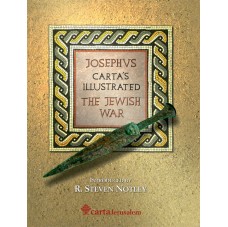
Carta has just released what is likely the most beautiful and most useful edition of Josephus’s The Jewish War ever printed. Here’s why I think this is the edition you (and your students) will want to read:

  • Josephus needs maps, and this edition includes 40 maps. They are on the same page as the events, so you don’t have to flip around.
  • Almost every page has a photo or illustration of some kind. I love full-color double-page spread aerials of Masada, and I love architectural renderings of Herodium and Roman Jericho. This makes an exciting history even better.
  • The color-coded text makes it easier to read, with personal names in red, place names in blue, and references in green.
  • This edition provides both reference systems (Whiston and Loeb) so it’s easy to find your place no matter how another source cites it.

Josephus — Carta’s Illustrated - The Jewish War
Carta’s Illustrated The Jewish War uses the venerable Whiston translation and the maps follow the numbering system in The Carta Bible Atlas, with a table cross-referencing these to The Sacred Bridge.

Carta is offering 30% off through June (with the code “30-off,” bringing the price from $60 down to $42. They’ve also reduced shipping to $5 (from Israel) during the sale as well. This is a great deal on an essential resource.

Perhaps a further word for those of my readers who are not aware of how important The Jewish War is. If you know anything about the first century in Israel outside the New Testament, there’s a good chance it came from this book. There are other sources, but The Jewish War is the best, because it is (1) contemporary, (2) lengthy, (3) interested in subjects related to the New Testament, like Jerusalem, temple, Herod, Galilee, and Pharisees; (4) generally accurate as it was written by a historian who was eyewitness to so much. I will be leading a group of students throughout Israel for the next three weeks and probably not a day will go by when I am not quoting or referencing this book. I encourage my students to read it, mark it, and keep it handy.

jewish-war-carta
Page 1, from the online sample pages
Share:

The Israel Antiquities Authority has issued a press release, forwarded to us by Joseph Lauer, about recent excavations in the Cave of the Skulls in the Judean wilderness. Here are a few paragraphs and photographs from the press release:

Last week, the Israel Antiquities Authority took a first step in the plan by commencing a complicated and extraordinary archaeological excavation in search of scrolls in Nahal Tse’elim. A team from the IAA’s Unit for the Prevention of Antiquities Robbery accompanied by researchers from the Caves Research Center of the Hebrew University and hundreds of volunteers from across the country is participating in the excavation, which is taking place with the support of the Heritage Project in the Ministry of Jerusalem Affairs. The excavation is being directed by archaeologists Dr. Eitan Klein, Dr. Uri Davidovich, Royee Porat and Amir Ganor. For many years, IAA inspectors have been proactively enforcing the law in the desert, during the course of which they have made a number of seizures and foiled bands of antiquities robbers that sought to become rich through the detrimental exposure of items of great historical importance. However, these actions are a mere drop in the ocean and the Israel Antiquities Authority stresses that only by excavating all of the scrolls in the ground and transferring them to the state, will it be possible to ensure their well-being and preservation for future generations.
[…]
The Cave of Skulls, where the excavation is taking place, is located about 80 meters from the top of the cliff, and c. 250 m above the base of the wadi. Because of the difficulty in reaching the site, the Israel Antiquities Authority obtained a special permit from the Nature and Parks Authority to construct an access trail, which requires the use of rappelling equipment for the safety of the participants in the excavation. More than 500 volunteers and field personnel from Israel and abroad were required for the undertaking, and they are sleeping and living in a camp in desert field conditions. Many requests by individuals offering to participate have been denied because of the lack of infrastructure to provide for such a large group of archaeologists, volunteers and interested parties. The current excavation season will end in another two weeks, assuming this will be sufficient time in order to extract the valuable archaeological information from the cave.
According to Amir Ganor, director of the IAA’s Unit for the Prevention of Antiquities Robbery, “The excavation in Nahal Tse’elim is an operation of extraordinary complexity and scope, and one that has not occurred in the Judean Desert in the past thirty years. Despite the rigorous enforcement actions taken against the antiquities robbers, we still witness acts of severe plundering that unfortunately are possible in such large desert expanses. There are hundreds of caves in cliffs in the area, access to which is both dangerous and challenging. In almost every cave that we examined we found evidence of illicit intervention and it is simply heart-breaking. The loss of the finds is irreversible damage that cannot be tolerated”.

1
The cave where the archaeological excavation is being conducted is situated c. 80 meters from the top of the cliff and c. 250 meters above the base of the wadi. Photographic credit: Guy Fitoussi, courtesy of the IAA Unit for the Prevention of Antiquities Robbery.
9
10
Volunteers at work in the archaeological excavation. Photographic credit: Yoli Shwartz, courtesy of the Israel Antiquities Authority.
12
The ancient text that dates to the Year Four of the Destruction of the House of Israel (139 CE), which was seized in a joint operation by the Unit for the Prevention of Antiquities Robbery and the Israel Police. Photographic credit: Shai Halevi, courtesy of the Leon Levy Digital Library, Israel Antiquities Authority.

Arutz-7 has posted a 1.5-minute video.

Share: