Earlier this year I made a seven-day trip to Jordan to take photos. For the first time in my travels in the Middle East, I used a GPS. It worked well. If you’re planning to rent a car and travel around on your own, you might consider it as an option. Here is what I did.
1. I bought a GPS. The one I purchased was not the cheapest, but I was very happy with it.

2. I bought a map set for Jordan (for Garmin). This set actually includes all of the Middle East except Israel. If you need Israel, there’s one here. (Beware the very cheap ones; they are illegal copies.)
3. The most important part of the process is to identify the sites you plan to visit ahead of time. This is particularly important if you are planning to see lots of random tells that aren’t on the maps and that the locals may not be able to help you with.
3a. First, locate the sites of interest on Google Earth. This can be challenging, depending upon how obscure your sites are. If you have a reference source with coordinates, see A.D.’s post on how to convert them to GE points. You may find the Site Index for the Pictorial Library of Bible Lands helpful for its list of coordinates as well. If you are looking for a GE file (kml) of lots of biblical sites in Israel and/or Jordan, search on the web (though reliability varies).
3b. Then, export your chosen sites to a kml file (simple instructions here). Convert that to a format your GPS can read. You can do this at kml2gpx.com or similar sites. Then copy the converted file to your GPS (video instructions here).
That’s it. I would recommend you bring a map or two, just in case your GPS fails on the trip. (I packed my GPS in my carry-on luggage so it wouldn’t be “borrowed” by luggage handlers.) You might even consider bringing a backup GPS if funds allow. (And part of that question is also, how much would it be worth to you in the middle of your trip if your other failed?)
One other step I took, not knowing how the GPS would work, was to use the (now free) Google Earth Pro to print off high-quality images of the sites and their surroundings. I figured this might help me when the GPS map data was wrong or incomplete. Several times these print-outs came in handy.
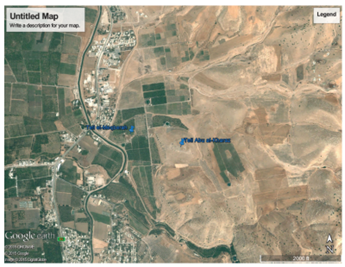
I didn’t find every site I was looking for, but that wasn’t the fault of the GPS. Sometimes I had limited information in originally locating the site in GE. At other times, the site just seemed to disappear (as did Beth-jesimoth, in the midst of a quarrying operation). I missed a few sites because of rental car troubles, but I saw far more than if I had been at the mercy of a bus schedule or even a taxi driver. I also preferred this method to using a guide because most guides don’t like to pull out at 6 am and return after dark.
A few additional notes:
1. There are no good detailed maps for Jordan.
2. Don’t trust the time estimates your GPS gives you. The program data may be limited and it may
assume that you can drive 90 km/h down that narrow alleyway.
3. Sometimes the GPS gets it wrong. Sometimes you think you know better and you get it wrong.
You learn as you go, and it helps to have a flexible schedule.
4. Walking and taking a cab in downtown Amman (or Jerusalem or other major cities) beats driving.
5. Don’t be in such a rush that you don’t get to know the people. (Or, make sure the car breaks down in the right place.)
6. A newer book that is quite helpful in Jordan is Burton MacDonald’s Pilgrimage in Early Christian Jordan: A Literary and Archaeological Guide (Oxford: Oxbow, 2010).
7. Jordan is beautiful in March.


