(Post by Seth M. Rodriquez)

Perhaps one of the largest obstacles to understanding what life was like in Bible times is the difference between a modern city and an ancient city.  A modern city spans hundreds of square miles, but an ancient city was typically only a few acres.  A modern city has no protection around it, but an ancient city was protected by a massive wall.  A modern city has dozens of roads leading in and out of it, but an ancient city had (at most) a handful of gates leading in and out, and often had only one.  So when a modern reader opens the Bible and reads about Boaz doing business transactions at the city gate (Ruth 4) or gossipers sitting in the gate (Psalm 69:12) or Amos calling for justice in the gate (Amos 5:15), the full significance of those passages may be lost.

Our picture of the week comes from Volume 5 of the Pictorial Library of Bible Lands, and shows the remains of the Iron Age gate at Beersheba.  Actually it shows only one chamber within that gate.  During this time period, it was common for gates to have rooms on either side of the passageway.  For example, a double chambered gate had two rooms on one side of the passage and two on the other side.  It was shaped like an E and a 3 facing each other: E3.  These chambers sometimes were lined with benches, such as in the picture below.  This would provide a place for people to sit while carrying out the various types of business that happened in the city gate … and there was a wide variety of action here. 
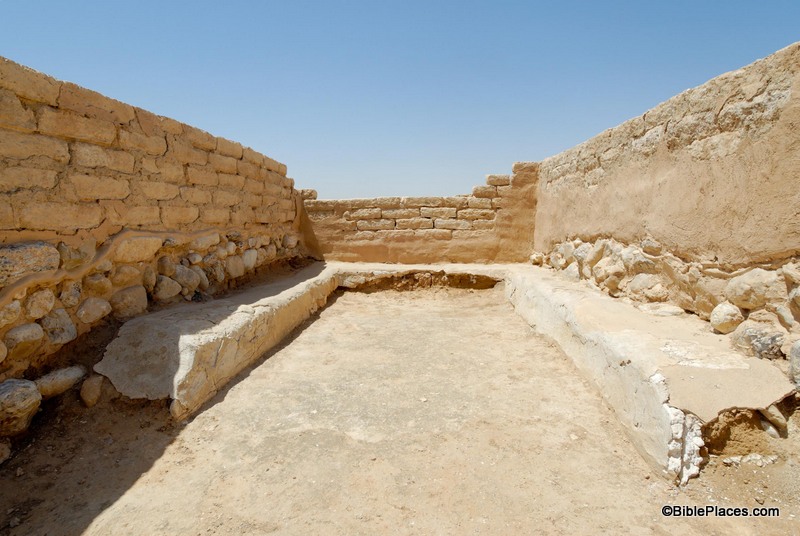
Since there was always a small number of gates in an ancient city, all the foot traffic coming in and out of the city was funneled though this one place.  Consequently it became an ideal place for people to sit and do business transactions, talk about current events, or sell their wares.  It also was a convenient place for the elders and rulers to decide legal matters or prophets to  proclaim a message from the Lord.  In times of battle, these rooms provided the soldiers of the city with space to fight an enemy that had managed to break through the door.

Oded Borowski, in his book Daily Life in Biblical Times, describes the city gate this way:

When discussing the gate, one should realize that this was more than just a door; it was a gate system. Many cities, such as Hazor, Megiddo, Gezer, Lachish, and Dan, had a series of gates, outer and inner, through which traffic found its way in and out of the city.  … The main gate was a formidable structure that had two or more stories to provide space for the activities undertaken by the civic and military administrations and by the citizenry. … The street-level floor had one to three chambers on each side …. The gate area, including the chambers and the open space around it, was used in peacetime for judicial, commercial, and social activities.  The city elders, as well as the king or the regional governor, met in the gate to hold court. At Tell Dan, the remains of a low podium for an elaborate seat and canopy were found by the gate adjacent to the open area.  The chambers in the gate at Gezer contained low benches along the walls to provide seating, possibly for the elders or for merchants.  The gate was also where certain cultic activities took place (2 Kgs 23:8), as illustrated by the standing stones discovered at Dan and other sites.

In the age of computers, automobiles, and sprawling cities, there really is no good modern equivalent of the city gate.  It was the mall, the courthouse, the army base, the television, and Facebook all rolled into one.  In many ways, it was the center of daily life in the city.

Excerpt from Oded Borowski, Daily Life in Biblical Times, Society of Biblical Literature: Archaeology and Biblical Studies, No. 5 (Atlanta: Society of Biblical Literature, 2003), pp. 47-48.

This photo and over 700 others are available in Volume 5 of the Pictorial Library of Bible Lands, and is available here for $34 with free shipping.  Additional pictures of ancient gates can be seen herehere, and here on the BiblePlaces website.

Share:

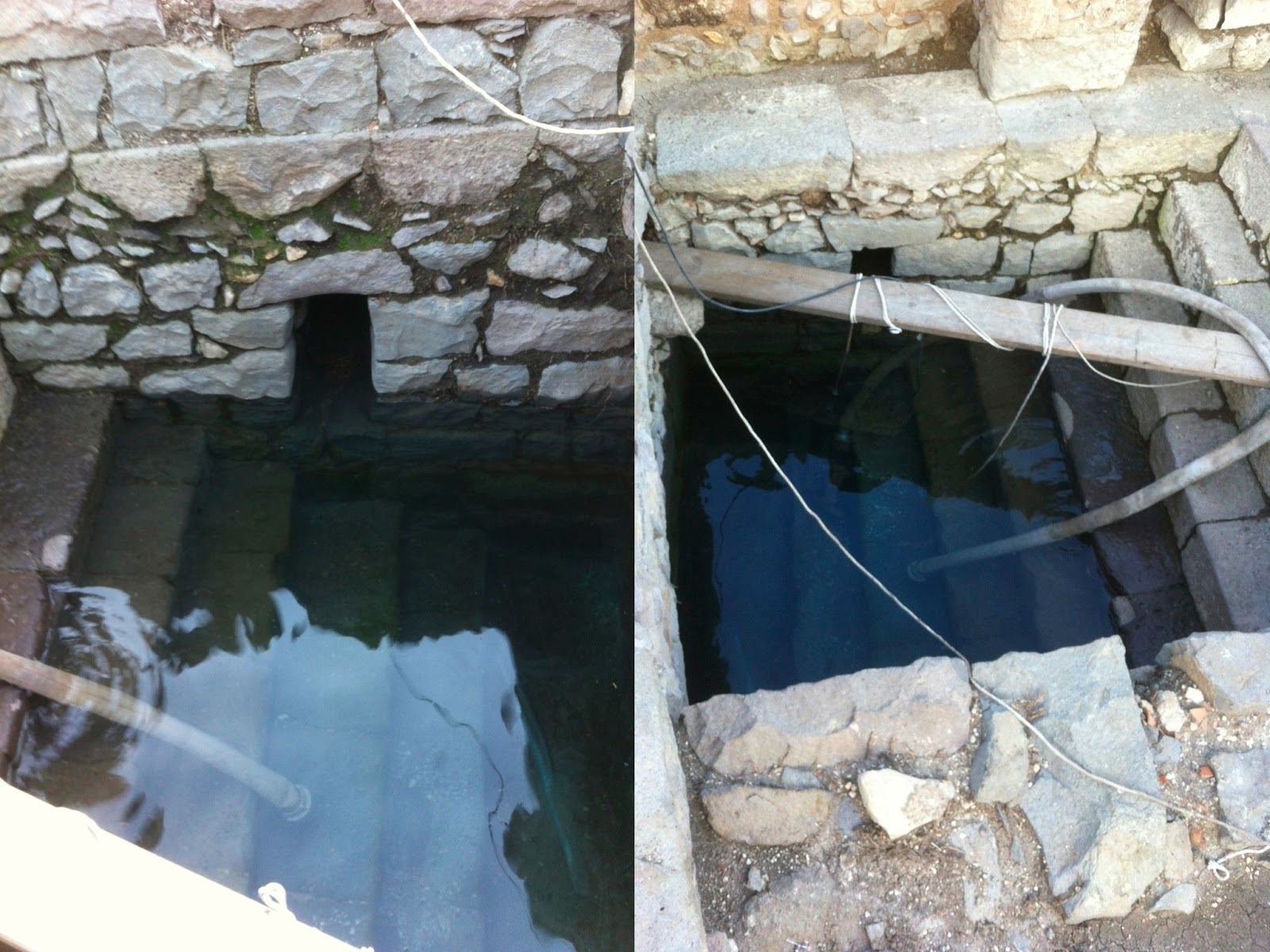
Archaeologists working for the Israel Antiquities Authority (IAA) recently excavated a unique ritual bath (mikveh) in the Kiryat Menachem neighborhood of Jerusalem (southwest of the Old City). Three separate collecting tanks (otzar) were carved into the rock in order to collect as much rainwater as possible.

The IAA press release quotes Benyamin Storchan, director of the excavation:

Numerous ritual baths have been excavated in Jerusalem in recent years, but the water supply system that we exposed in this excavation is unique and unusual. The ritual bath consists of an underground chamber entered by way of steps. The miqwe received the rainwater from three collecting basins (otzar) that were hewn on the roof of the bath, and the pure water was conveyed inside the chamber through channels.
The ritual baths known until now usually consist of a closed cavity that was supplied with rainwater conveyed from a small rock-cut pool located nearby. The complex that was exposed at this time is a more sophisticated and intricate system. The bath was apparently associated with a settlement that was situated there in the Second Temple period. Presumably, due to the rainfall regime and arid conditions of the region, the inhabitants sought special techniques that would make it possible to store every drop of water.
It is interesting to note that the bath conforms to all of the laws of kashrut, like collecting the water in it naturally without human contact, and ensuring that the water does not seep into the earth which is why the bath was treated with a special kind of plaster.

The full press release is here, and three high-res photos are available in a zip file. The story is also reported by the Jerusalem Post and Arutz-7.

mikveh-kiryat-menachem-iaa-3
Archaeologist Benyamin Storchan stands in the immersion chamber of the mikveh.
mikveh-kiryat-menachem-iaa-1
Aerial view of the excavations
mikveh-kiryat-menachem-iaa-2
Aerial view of three storage tanks and channels
All photos courtesy of the IAA. The second and third are by Skyview.
Share:

Several significant excavation reports will be published in the next couple of months and Eisenbrauns is offering major discounts on pre-orders.

Megiddo V: The 2004-2008 Seasons

Gezer VII: The Middle Bronze and Later Fortifications in Fields II, IV, and VIII

Sepphoris I: The Pottery from Ancient Sepphoris
MegiddoVcover.indd
With the ongoing debate over the chronology of the Iron Age II, the Megiddo volumes may receive the most attention from scholars.

Eisenbrauns has a number of other excavation reports on sale, including volumes on Bab edh-Dhra, Lahav (volumes I-II), Tell el-
Hesi (volumes II-V), Gezer (volumes I-III, V), and Dothan. For those interested in a popular work, the Timnah volume is now marked down 50% (to $15).

There doesn’t seem to be a direct link to the sale page, so go to the home page, read about their phenomenal new “Online/Offline
Backup Service” (announced on April 1), and follow the link to the sale from there.

A couple of recently published excavation reports are reviewed in the current issue of Biblical Archaeology Review. In the article now available online, William G. Dever reviews Ashkelon 3: The Seventh Century B.C. and Hazor: The 1990–2009 Excavations: The Iron Age.

Share:

Miriam Feinberg Vamosh has written an article on the little-known Church of St. Mark near the Armenian Quarter of the Old City of Jerusalem. According to tradition in the Syriac Orthodox church, this was the place of the Last Supper.

A Byzantine winepress has been excavated at Hamei Yo’av near Kiryat Gat. High-resolution photos are available here (zip).

If you’re traveling to the Middle East, it’s worth preparing not only for the sites, but also for the food.

Debra Kamin has four rules for eating hummus.

The LMLK Blogspot has a “modern ancient art mystery” for savvy biblical archaeology sleuths.

The AP has more about the new excavations in the city of Ur.

Scientists are studying a battering ram found in a Greek or Roman ship sunk off the coast of Libya.

The ruins of ancient Palmyra are being threatened by the fighting in Syria.

Some new maps of the ancient world are now going online at the Encyclopedia of Ancient History.

Aren Maeir will be lecturing on “The Search for Goliath” on April 18 at William Jessup University.

Yesterday’s quotation was by William Dever, long-time crusader against biblical archaeology. It’s
from page 14 of Archaeology and Biblical Studies: Retrospects and Prospects. Evanston, IL:
Seabury-Western Theological Seminary, 1974.

HT: Jack Sasson

Syrian Orthodox Church, St Mark's Convent, traditional house of Mark and Upper Room, tb010312374
Entrance to Church of St. Mark
Photo from the Pictorial Library of Bible Lands, Jerusalem volume (available at Amazon for $220 or at BiblePlaces.com for $39)
Share:
(post by Chris McKinny)


For an introduction to this series see here.


It seems only a short time ago that archaeologists were saying that there were only 3 positively identified 1st century CE synagogues in Israel – Herodion, Masada and Gamla (See “Synagogues” in Anchor Bible Dictionary, Meyers 1992: 6.255). In the case of Herodion and Masada – these are relatively late synagogues as they were both converted from Herodian structures during the first Jewish Revolt (66-73 CE). The Gamla synagogue represented the only tangible archaeological evidence of a synagogue built for the primary purpose of being a synagogue (versus later retrofitting).

The 2009 discovery of the first century CE synagogue at Magdala changed that perception. We have discussed this discovery on several occasions, including a debate regarding the function of the building and the possibility of excavating at the site with costs covered by the excavation. I asked on a recent visit and this offer still stands, according to the staff at the site. Also from what I gathered their work will continue long after 2013, as they had stated previously – see here for pictures of volunteers from fall 2012.


Directions 


View Secret Places: BiblePlaces in a larger map (toggle between different map view in top left corner – other views might provide easier driving directions)

Getting to the first century remains at Magdala is quite simple – from Tiberias it is a mere five-minute drive to the north of town – make a right at “Magdala Hawaii” and turn into the construction site – there will be a sign that says “Magdala” and two small office buildings on each side of the road in front of the excavations.

Touring Suggestions 

Upon arrival you will be met by a security guard who will ask you to donate money to the project (there is no admission fee) – he will also give you instructions on where you can and cannot go on the site. The guard might also offer a few words of insight about the site – take what he says with a grain of salt. The following instructions are tentative as visiting protocols will change as the Magdala Center project develops (for comparison note the complete absence of buildings in this area in the Google Maps view above).

Update 4/8/2013 – Entrance information: Opening time  Monday-Friday 8-1pm. Email contact (HT: Shmuel Browns)

Historical Background and Discussion

Magdala means tower (Hebrew – migdal). It is never mentioned by name in the Gospels, rather the site name only appears when identifying Mary Magdalene apart from the other Marys (e.g. Matthew 27:56). Had the other Marys been named Salome instead of the ubiquitous “Mary” it is likely that even “Magdalene” would not be part of the New Testament record.

Before the founding of Tiberias as capital of Galilee in 20 CE under Herod Antipas, Magdala (Josephus calls the site Taricheae, which means fish) was the main administrative center (toparchy) of eastern Lower Galilee beneath the authority of Sepphoris, Antipas’ Galilean capital. In 20 CE, the capital shifted from Sepphoris to Tiberias and Magdala lost its administrative significance, but remained an important site. Later on in the 50s CE the site was ceded to Herod Agripa II (son of Agrippa I, grandson of Aristobolus, great-grandson of Herod the Great) and later still in 66 CE it was the site of a  naval battle between the Romans under Vespasian the result of which was the total defeat of the Jewish forces (including the execution of thousands inside the stadium at Tiberias). This naval war also produced one of the most interesting archaeological finds of all-time – the so-called “Jesus Boat,” which probably owes its exceptionally rare preservation to the unique events that transpired during the onset of the first Jewish Revolt. (For more information regarding Magdala’s historical background see James Strange “Magdala Magdalene,” Anchor Bible Dictionary 4:463).

Magdala from the eastern side of Mt. Arbel looking east towards the Sea of Galilee

The synagogue is on the left side of the road, as of March of 2013 visitors could still not go into the synagogue itself, but you will be able to view the beautiful synagogue from a distance. As fascinating as the synagogue is – what caught my eye was the extremely well-preserved, presumably first cent. CE street ca. 30 meters south of synagogue (see picture above). Along this street one can easily make out several mikvaot (ritual baths) that seemed to be fed by means of a canalization system and remains of the foundations of buildings constructed from basalt (black volcanic rock typically used in construction in the Golan Heights).

Magdala Street – notice the slabs in the center of the street that cover the canalization/sewage system, the mikvaot are to be found on the left side of the picture (that is the south side of the street – the picture is looking west to the foot of Mt. Arbel with highway 90 in the distance)

Mikvaot? There are at least four of these along this street, notice the extremely well-preserved steps and opening for presumably filling the pool. 

While final say will go to the excavators of this important site, it seems quite clear that the remains around the synagogue, including the street with presumed mikvaot, all date to the same time period – the excavators have claimed that the synagogue is first century CE on the basis of coinage and pottery. It therefore seems likely that the connected buildings date to the same time period. Beyond the clear connection of this site to Mary Magdalene of the Gospels this Early Roman town has the potential to illuminate many details of first century, Galilean village dynamics.

In conclusion, this exciting new site should be considered a “required” stop on any trip to Israel that makes it to the Sea of Galilee. In the opinion of this author, Magdala is a more important site for folks interested in New Testament and Second Temple Judaism than say, Tabgha or Chorazin (primarily 4-5th cent. CE Byzantine remains with New Testament textual connections). Magdala has the potential of illuminating our understanding of first century daily village life (i.e. the very time of Jesus’ ministry) in the same way that Qatzrin has illuminated our understanding of everyday Jewish life in Mishnaic/Talmudic times. 

Share:
(Post by Chris McKinny) 

One of the exciting things about living in Israel is how quickly archaeology can change the landscape of our understanding of the biblical world. Our picture of the ancient Near Eastern world is constantly developing and becoming more nuanced, largely due to the work of archaeologists operating in Israel.

Israel, home to an estimated 30,000 archaeological sites (and counting), produces large quantities of archaeological architecture and materials of biblical significance that are often passed over by tourists, students and even scholars who visit the Land. While readers of this blog are considerably more well-informed regarding biblical archaeology’s rapid developments than the general public – there still remains a bit of a gap between exposure to the information and first-hand experience through visiting the various “secret places” scattered throughout the country.

With this in mind, the purpose of this upcoming series is three-fold: 1.) to expose the reader to off-the-beaten path locations, new archaeological sites and museums, and significant views and overlooks; 2.) to inform the reader on the importance of these locations by connecting the site with the historical/biblical data; and 3.) to show the reader how to get to these locations when visiting Israel.

Share: