If you plan to visit biblical sites, you will benefit from a good guidebook. For years I have recommended excellent resources such as Jerome Murphy-O’Connor, The Holy Land, Clyde E. Fant and Mitchell G. Reddish, A Guide to Biblical Sites in Greece and Turkey, and Mark Wilson, Biblical Turkey. These books share the same basic approach: organized by site, they explain a city’s principal features and its relevance to the Bible.
Jason Borges’s new work takes a different approach, and for travelers in Italy, Greece, and Turkey, it may be just as valuable. Instead of going site by site, Christian Life in the Greco-Roman City: The Civic and Architectural Contexts of Early Christianity goes feature by feature, teaching you how to understand what you encounter again and again in every Greco-Roman city: theaters, agoras, temples, baths, and more.
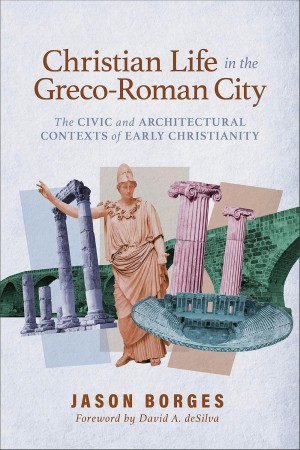
Perhaps you’ve had this experience: you visit an ancient theater, and the guide gives you the basics. At the next city, you hear the same basics. Then you arrive at a third theater, and well, here we go again. What you need is a single, in-depth exploration of what theaters were, how they functioned, how their architecture works, how they shaped society, and how they illuminate the New Testament.
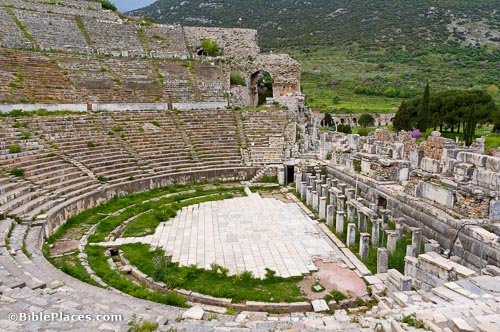
In less than an hour of your time (24 pages), Borges gives you that in-depth explanation and more. You learn that there were nearly a thousand theaters across the Roman Empire, that many could accommodate more than ten thousand spectators, that seating reflected social divisions, that Roman performances were crude and erotic, and that only one theater is explicitly mentioned in the New Testament—the theater at Ephesus in Acts 19.
You also learn the differences between theaters, amphitheaters, and circuses. Borges shows how Jesus’s teaching reveals his familiarity with public entertainment, how Paul compared the faith to athletics, and what the apostle meant when he said that he “fought with wild animals in Ephesus” (1 Cor 15:32). Borges’s mastery of early church history allows him to make various connections to Christian martyrs.
I enjoyed the chapter on the agora even more. After defining what an agora is (“the central public space … akin to a modern town square … the heart of every community”), Borges explains a number of interesting ancient words and phrases related to the agora, such as:
- “when the agora is full” – a time designation referring to midmorning (ca. 10 am)
- “breaking up of the agora” – the end of the morning (ca. 12 noon)
- being “taken to the agora” – being brought to court, especially in cases involving mob justice
- agoraios – a person who “belongs to the marketplace,” usually translated “loafer” or “idler” (Acts 17:5)
If you’ve ever wondered why some cities have two separate agoras, it’s because of those loafers. Greek elites wanted to separate the riffraff in the marketplace from the civic spaces where magistrates governed the city.
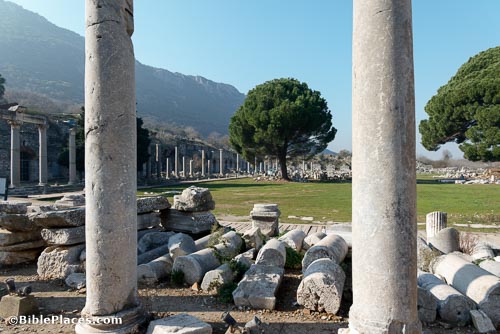
Borges explains what Jesus meant when he spoke of the “children sitting in the agora” (Luke 7:31), why Paul went to the agora in Athens (Acts 17:17), and what important feature of the agora is mentioned twelve times in the NT (the bema). He concludes the chapter with an edifying section on the verb derived from agora, agorazō, (“to buy”). Because slave markets were a common feature of agoras, the setting gives added force to the New Testament’s language of redemption: “against this sobering backdrop, the NT authors declare a divine economy with a different market transaction: Jesus purchased us for God.”
I think any one of these chapters is worth the price of the book ($25; $15 on Kindle). You’ll find much to mark and annotate in the introductory chapter on the ancient city and in the chapters that follow on agoras, temples, baths, prisons, theaters, libraries, and necropolises. I highly recommend the book to anyone who has traveled to or will travel to the Mediterranean area, along with all those just want to better understand the world so familiar to the people of the New Testament.