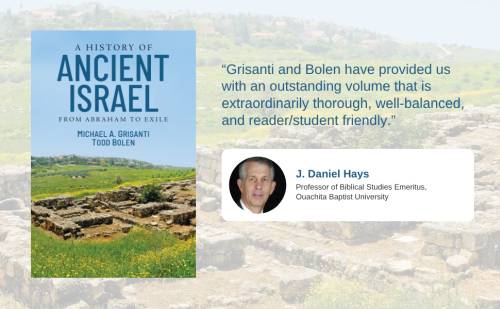
I wonder if I misnamed this series. The problem is that once a series has begun, you can’t go back and change the name. And the final post is hardly the time to try. But the reality is this: no one has said to me, “Why did you write another history of ancient Israel?” None of the scholars who reviewed pre-publication drafts nor the colleagues we’ve talked with have raised that question. I think it’s pretty obvious to those conversant with the field that a fresh history of ancient Israel is needed. There is not another such work that is current, conservative, and comprehensive.
I’ll close this series with a look at the last era of Israel’s history that I covered. Michael Grisanti wrote the final two chapters of the book, addressing Judah’s exile and return. My study ended with an investigation of the (wonderful) King Josiah and his (wretched) four successors. And here’s an interesting tidbit: no king of Judah was followed by two of his sons; every king was succeeded by his son, who was followed by his son, and so on. Except for Josiah. And he was followed not by one son but by three! Sadly, none of them were like their father. One of Josiah’s grandsons reigned for three months in the middle of these years, but otherwise this era that we could call Josiah and Sons was quite the roller coaster.
Josiah was only eight years old when his father was assassinated, and he became a father when he was about thirteen years old. It’s quite possible that his religious reforms were positively influenced by his marriage to Hamutal, who came from the priestly city of Libnah. While some believe that his religious reforms began with the discovery of the Book of the Law, his spiritual awakening came a decade earlier, and his campaign against idolatry was already underway six years before the scroll was found. As for the discovery of that scroll in the temple, I’m pretty confident that it was not Deuteronomy but the entire Torah.
Unfortunately, this era of faithfulness came to a sudden and tragic end when Josiah was killed by the pharaoh of Egypt at the age of 39. It is interesting to note a number of surprising similarities between Josiah’s death and that of the wicked King Ahab of Israel: both kings disguised themselves, disregarded divine warnings, and died after being struck by arrows. I also find it remarkable that the northern city of Megiddo figured in the deaths of two of Judah’s kings, Ahaziah and Josiah.
Extrabiblical texts shed considerable light on this turbulent era. The Babylonian Chronicle is particularly valuable for its record of Nebuchadnezzar’s campaigns, including his capture of Jerusalem in 597 BC. Jehoiachin was deported at that time to Babylon, and we even have a Babylonian administrative tablet recording provisions for him and his sons during their exile. Lachish Letter #4 is well known for corroborating Jeremiah 34’s record of Judah’s final days, and Lachish Letter #3 may shed light on Zedekiah’s attempts to secure Egyptian assistance. The hostility of the Edomites provides the context for the Judahite pleas recorded in the Arad Ostraca.
Jerusalem’s final decades are difficult to reconstruct, and scholars have long debated the precise sequence of events. One thing that is clear is how frequently Judah shifted its loyalties from Assyria to Egypt to Babylon and back again. Two of Judah’s final four kings were installed by foreign rulers, two ruled for only three months, and three were carried off into exile. The one who died in Jerusalem had the dubious distinction of being told by Jeremiah that he would receive a donkey’s burial—that is, no burial at all. Some dates can be determined precisely, such as the capture of Jerusalem on March 16, 597 BC. Others are more difficult, such as when Zedekiah began his final rebellion (589 or 588) and when Jerusalem fell (587 or 586). I argue that Jerusalem’s walls were breached on July 18, 586 BC, based on the length of Zedekiah’s reign, Ezekiel’s chronological system, Nebuchadnezzar’s nineteenth year, and the date when news of Jerusalem’s fall reached the exiles.
I love the historical details, and I’ve done my best to reconstruct the events from all the available sources. But I also know and treasure the truth that the Bible records history in service of a greater end. The fall of Judah was not a historical accident but the will of a sovereign and just God. The destruction of the temple did not bring an end to a provincial religion but was the prophesied judgment upon a long-disobedient nation. The same God who spoke of Israel’s exile also spoke of its physical and spiritual restoration through a king who would die for his people. As I wrote at the conclusion of this chapter, “The house of David would be rebuilt (Amos 9:11), the people brought back (Zeph 3:20), the twelve tribes reunited (Ezek 37:15–28), and the nations would rejoice (Isa 60:1–22), all under the peaceful reign of Israel’s righteous king (Jer 33:14–26). God’s word was certain; the only question was the matter of time.”