Archaeologists working at Omrit have revealed the discovery of an Assyrian seal from the reign of Sargon II. The story is reported at Haaretz and on Ferrell’s Travel Blog.

The remains of 50 mummies from the New Kingdom period have been discovered in the Valley of the Kings in Luxor.

Haaretz is reporting that “a team of Spanish Egyptologists may have found one of the earliest-known pictures of Jesus Christ, in a 6th-century tomb unearthed in Upper Egypt.”

The Colosseum of Rome is getting its “first top to bottom cleaning in 2 millennia. The scrub-down began in December and is slated to cost $35 million before its completion in 2016.”

Former Egyptian antiquities minister Zahi Hawass is under investigation for illegally amassing a fortune of $14 million.

National Geographic: “A study of Cold War spy-satellite photos has tripled the number of known archaeological sites across the Middle East, revealing thousands of ancient cities, roads, canals, and other ruins.”

The pillaging of Syria’s antiquities is now a full-time business for some. The Christian Science Monitor talks to some of those involved.

Is the Abba cave in Jerusalem the burial place of the last Hasmonean king? Haaretz presents the case for this identification. Joe Zias rejects it.

There’s a new open-access journal of interest: Science and Technology of Archaeological Research.
The editors are looking for submissions.

Accordance has a new series of 6 introductory Bible atlases published by Carta (OT, NT, archaeology, kingdoms, people, geography). For the first week only, the price is reduced to $79.99.

HT: Jack Sasson, Joseph Lauer, Mark Hoffman

Share:
(Posted by Michael J. Caba)

The Black Obelisk of Shalmaneser III was made in c. 827 BC in ancient Assyria. It is about six and a half feet tall and a full photo is shown to the left. It is made of fine grained black limestone and it refers to both King Jehu and King Omri. These Israelite kings are also referred to frequently in the Bible (cf. 1 & 2 Kings). The obelisk was found in 1846 in Nimrud (ancient Calah) and is now on display in the British Museum.


The obelisk has the overall shape of a ziggurat with the top being finished with narrowing stepped platforms. Each of its four sides has 5 panels that show individuals bringing tribute to Shalmaneser. The inscriptions tell of Shalmaneser’s military victories and cover 31 years of his reign.

The following photo is a close-up of one of the panels showing an Israelite (either King Jehu or an emissary) bowing to the king of Assyria. The cuneiform text reads: “Tribute of Jehu, son of Omri….” 

Of interest to Biblical studies is the fact that Jehu apparently decided not to resist the Assyrians as one of his predecessors, King Ahab, had decided to do as previously noted at this post Kurkh Monolith. Instead of resistance, he decided to bring tribute and make peace for which he likely received the protection of Assyria from his nearby foe, Hazael of Damascus. Within a few years, however, it would become abundantly clear that Jehu had made a poor choice (cf. 2 Kgs 10:32-33).

 (Photos: BiblePlaces.com. Significant resources for further study: The Context of Scripture, Volume 2, pages 269-270; Lost Treasures of the Bible by Fant & Reddish, pages 119-124.)

Share:

In my experience, the most important area of the biblical land that people know the least about is the hill country of Samaria. Its importance is reflected in the fact that it is easier for me to list biblical people who were not in this area than it is to name those who were.

Why is this region generally less known? Most tour groups avoid it. Yes, it is possible to come to Israel and not see Shechem, Samaria, Shiloh, and Ai. In fact, I would estimate that 95% of tourists never see these major sites.

I can’t recommend a tour group that will take you there (though if any tour operators would like to recommend a tour, they are free to do so in the comments below). But I can suggest you watch a short video that will help you to understand this region and its historical significance.

In just 15 minutes, you’ll learn about:

  • The capital city of Samaria
  • The Trans-Samaria Highway
  • The Wadi Fara
  • Shechem
  • Mounts Gerizim and Ebal
  • Shiloh
  • Ai

The video includes a historical review of major events, including Jacob’s dream at Bethel, Joshua’s battle at Ai, the tabernacle at Shiloh, Jeroboam’s capital, Baal worship at Samaria, the chariots of fire at Dothan, and the Samaritan woman at Jacob’s well.

Photos and on-location video bring the area to life. This video and others in the series are produced as commentaries for the Satellite Bible Atlas, but the atlas is not necessary to understand the videos. The video was created by Bill Schlegel and includes clips of some of his friends and students. It also makes good use of photos from the Pictorial Library of Bible Lands, volume 2.
15 minutes gets you a great education on this most important biblical region.


For best results, play the video in full screen and change the quality to HD.

Share:

Syria is trying to attract investment in tourism. Aleppo, Crac des Chevaliers, and Palmyra are not accessible, but other places are perfectly safe, according to the minister of tourism.

Israel’s Ministry of Tourism plans to increase the number of campgrounds around the country.

Nazareth will be the title of a new miniseries produced by Fox about the years Jesus spent growing up in this Galilean village. The Bible records nothing of this period in Jesus’ life.

Leen Ritmeyer provides some corrections to the story about the Temple Mount chisel.

Archaeologists working in southern Egypt have discovered two tombs, including one with “a trove of artifacts including reed pens and a bronze inkwell.” They date to about 600 BC.

A cave with human remains from the first century was discovered near Ein Tzurim south of Bethlehem.

Bruce Chilton revisits the issue of the authenticity of the James Ossuary.

Paleojudaica reflects on the latest developments with the Gospel of Jesus’ Wife. Bible History Daily has a much more thorough review.

Publications of the Oriental Institute, 1906-2014: Exploring the History and Civilizations of the Near East. Edited by Thomas G. Urban and Leslie Schramer, compiled by Zuhal K. Sharp. Chicago: The
Oriental Institute, 1991, 2014. Second revised edition. 28 pages (more than 750 titles). All titles published by the Oriental Institute, with active links to their web pages, alphabetically arranged.


The Final Days of Jesus is available today for Kindle for $0.99.

The weekly ASOR roundup is here.

HT: Jack Sasson

Share:
(Post by A.D. Riddle)

Two days ago, we highlighted the brand-new maps which are included in the revised Pictorial Library of Bible Lands. Today, we will illustrate some of the steps involved in creating the maps.

The key to making a map is layers. One layer contains all the dots and names of sites; another layer includes rivers and wadis; the terrain is yet another layer; and so forth. Each of these layers of data has first to be created or obtained from somewhere, and then they are compiled into a map.

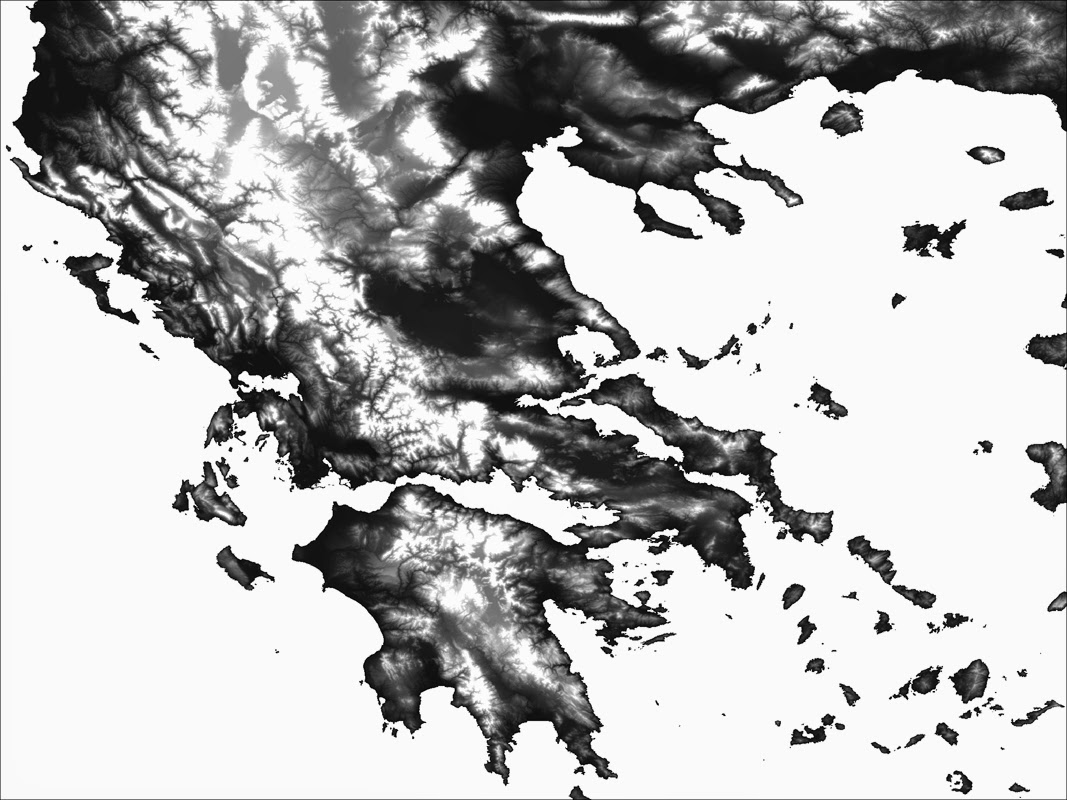
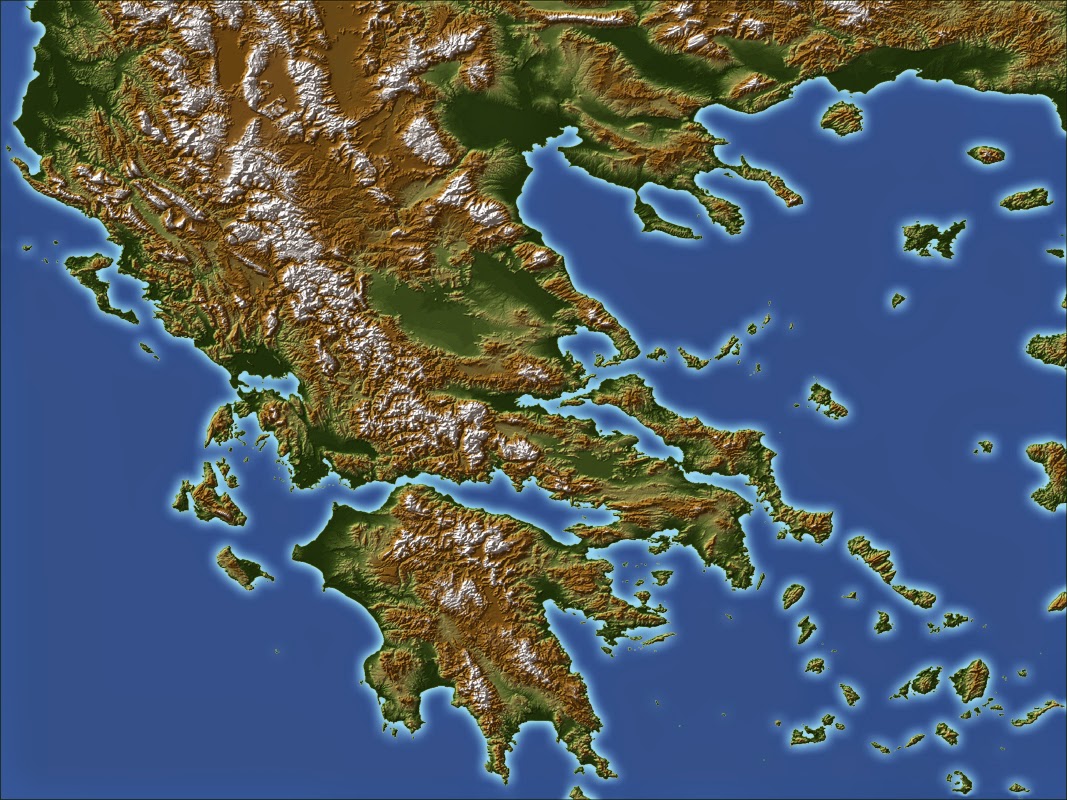
The base maps are created from a DEM, or digital elevation model. A DEM is like a digital photograph from your camera, except each pixel records an elevation. (In this case, the DEMs come from NASA.) From this one DEM, two separate images are generated: one image which shows a continuous color gradation from dark-to-light (showing elevation change), and a second image which shows “hillshading,” that is, the shadows that would be cast if the sun were in a particular position.

DEM of the Balkan Peninsula with elevation shown as
a continuous progression from dark to light colors.

Hillshading effect applied to the DEM of the Balkan Peninsula.

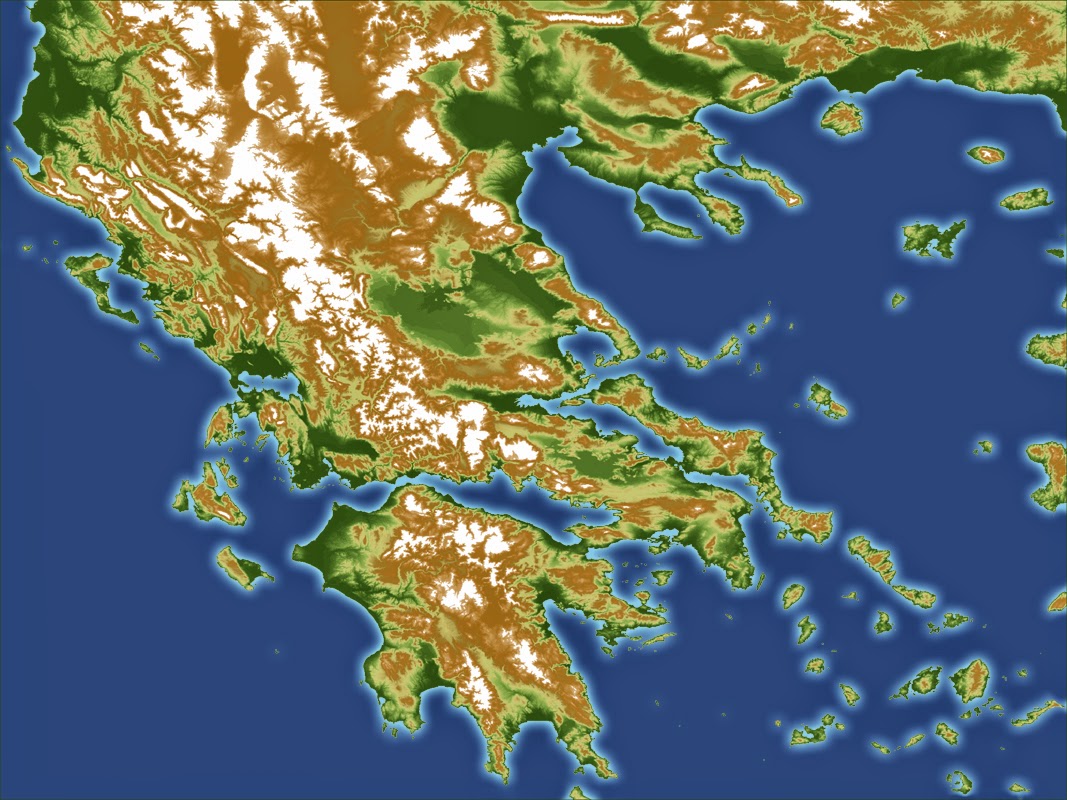
The first image was colorized according to the scheme used for the Pictorial Library maps. Then, the sea was colored blue.

Grayscale hypsometric tint replaced with color hypsometric tint.

Colorized sea with coastal “glow.”
Finally, these two images were blended into one image to complete the base map.

 Hypsometric tint and Hillshade blended.

After the base map is completed, it remains to add all the streams, lakes, sites, and other lines and dots that make up the map. The linework and dots began by looking like this.

Linework and dots to be added to the map.

Linework and dots overlaid on the base map.

The final step is to “clean up” all the lines and dots and add name labels. The linework is given the right colors, widths and sizes, and any unnecessary elements are removed. The final map comes out like this.


The Jerusalem maps are special. The base map that was used comes from the Ordnance Survey of Jerusalem, by Sir Charles Wilson. The map was scanned, and then colorized by Bill Schlegel. We added the pools, lines and labels.

The Missing Map


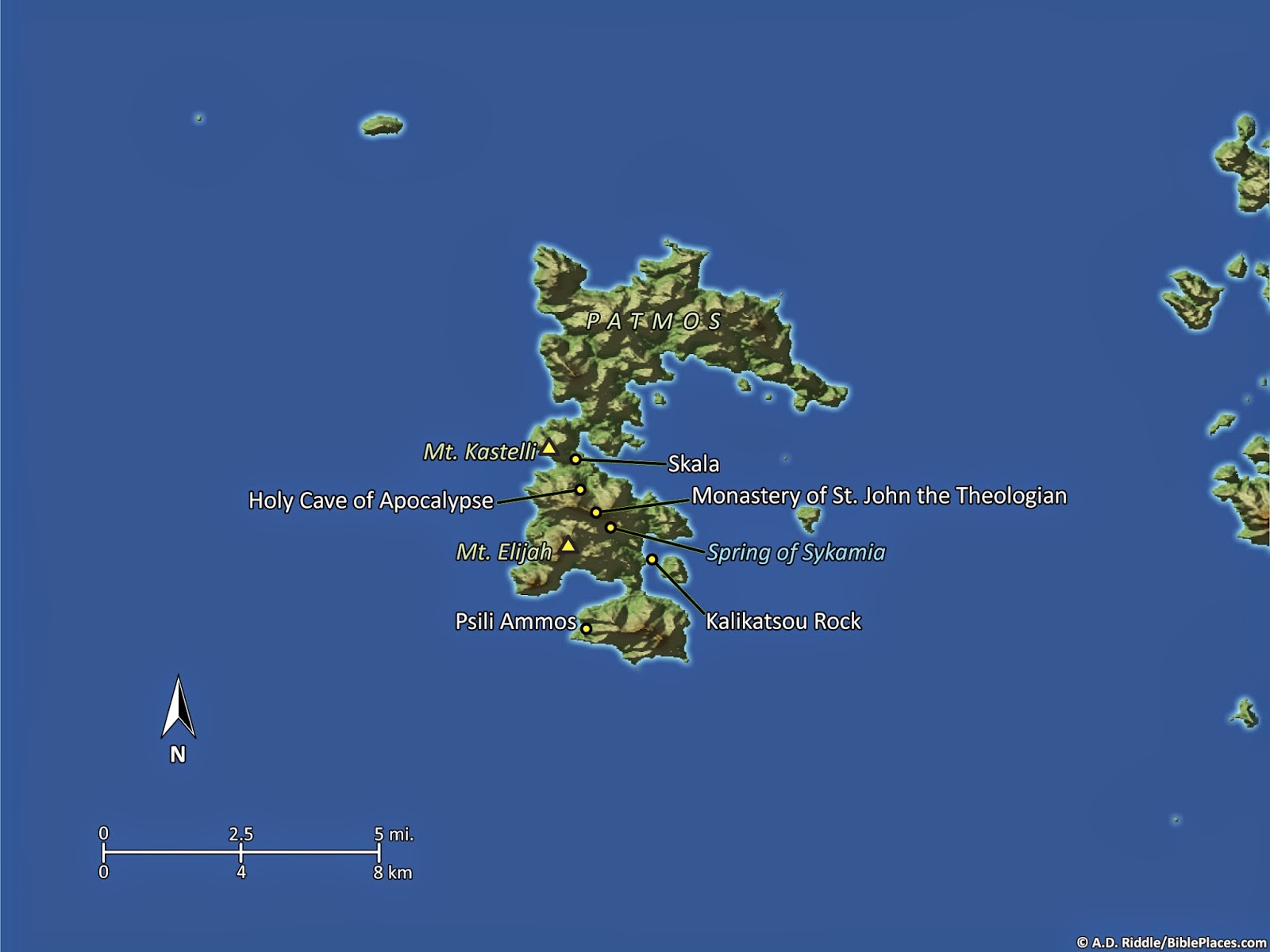
As a final note, when the revised Pictorial Library of Bible Lands was first released, we were not able to include a map of the island of Patmos, because the resolution of the NASA data was too coarse–the island is simply too small. Here is what it would have looked like.

 Ugly map of Patmos (not in PLBL) using NASA SRTM data.
Pixel resolution is 3-arc seconds, i.e. each pixel covers an area 90 meters by 90 meters.

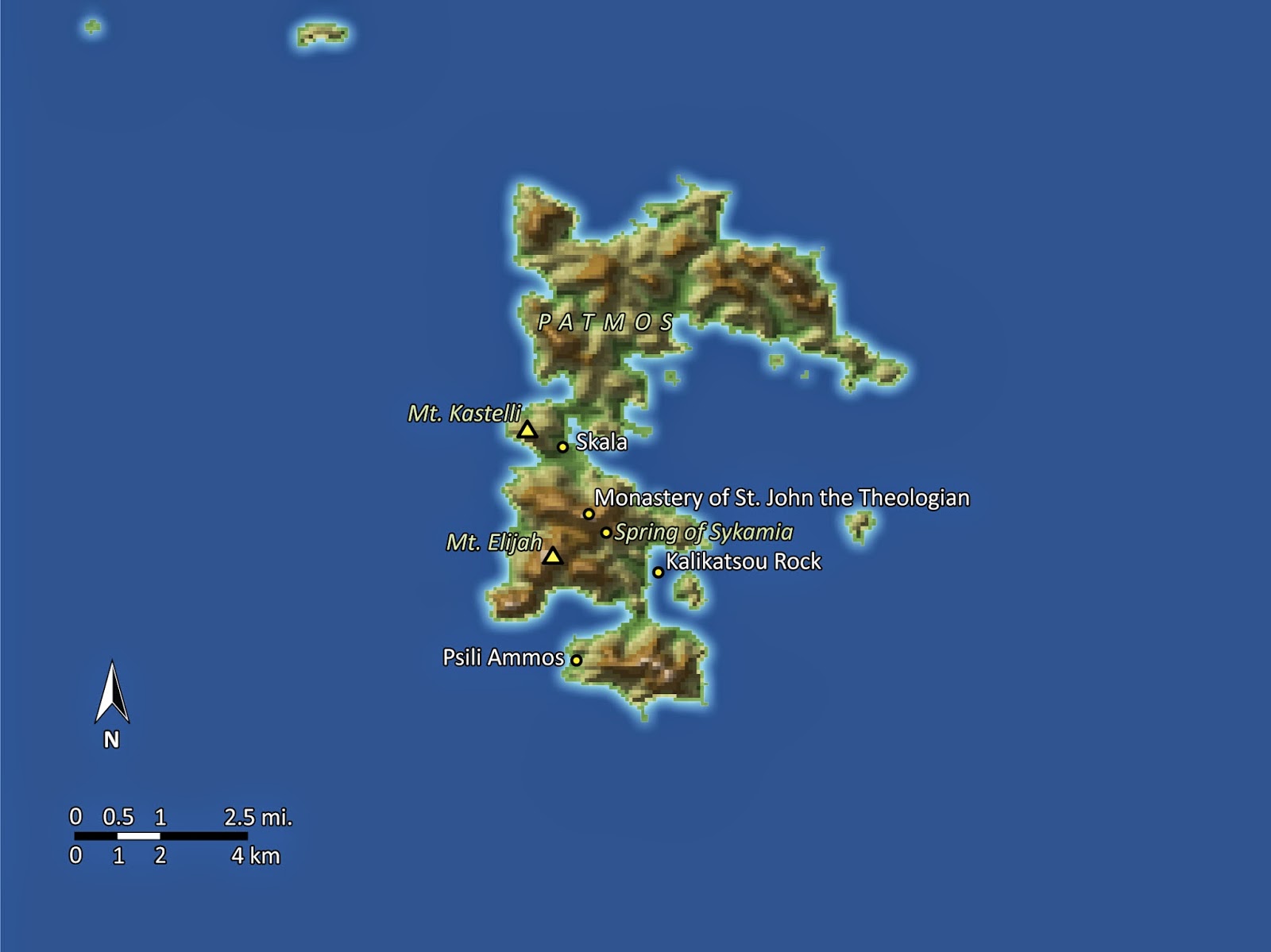
Since then, we have obtained higher resolution DEMs from NASA (via the Oriental Institute’s CAMEL Lab). The resultant map looks much better and now is fit to be included in the PowerPoint for Patmos, in Volume 12 “The Greek Islands” of the Pictorial Library.

Handsome map of Patmos using NASA ASTER GDEM data.
Pixel resolution is 30 meters.

In our next post, we will highlight another brand-new feature which was added in the revised edition of Pictorial Library of Bible Lands. As with the maps, it makes the thousands of photographs in the collection more accessible and enhances their usability.

Share:

Archaeologists excavating in the area below Robinson’s Arch along the southern end of the Western Wall of the Temple Mount have discovered a metal chisel used to shape the stones in the first century.
The Israel Antiquities Authority has not issued a press release yet, but Haaretz has learned of the discovery.

Archaeologists have found a stonemason’s chisel that they believe may have been used by the builders of the Western Wall in Jerusalem.
Actually Eli Shukron, an archaeologist working for the Israel Antiquities Authority, found the chisel last summer while digging at the lower base of the Western Wall, south of the Western Wall courtyard. However, the IAA has preferred to remain silent on the discovery, based on the need to study the tool and other evidence further before issuing any statements, it explained.
Shukron has been digging in the area of the City of David and the Western Wall together with Prof. Ronny Reich for the past 19 years, until a few months ago. In recent years Shukron had been excavating inside a tunnel found to lead from the City of David into the Old City, passing beneath its massive stone wall and ending at the Western Wall.
[…]
The chisel is just one of many archaeological treasures that Shukron and Reich reported from the area. Other finds include a Roman sword, cooking vessels from the period of the Great Rebellion, a gold bell that they think may have adorned the robe of the High Priest, and a ceramic seal apparently used to confirm the suitability of sacrifices brought to the Temple.
[…]
“People pray and kiss these holy stones every day, but somebody carved them, somebody chiseled them, somebody positioned them,” Shukron says. “They were workers, human beings, who had tools. Today for the first time we can touch a chisel that belonged to one of them.”

The full article in Haaretz (registration/subscription required) explains the basis for dating the construction of the Western Wall of the Temple Mount to one of the rulers after King Herod.

HT: Joseph Lauer

Chisel used in construction of Western Wall
Photo by Clara Amit, Israel Antiquities Authority
Temple Mount stones of western wall below street level, tb050312314
Western Wall excavations below the ancient street level near discovery location
Share: