(Post by Seth M. Rodriquez)


Our “obscure site” this week is mentioned only once in the Bible and almost in passing. However, it was the starting point of one of the most famous adventures of the apostle Paul.

In the first century, the city of Myra stood near the southern shores of western Asia Minor. It lies over two miles from the shore so it was closely associated with its port city of Andriace. In fact the harbor city was sometimes just referred to as Myra. The city and its harbor were most likely founded in the fifth century B.C. In the Roman period it was a key location along the trade route used by sailing vessels as they transported grain to Rome. The harbor of Myra was a staging ground where grain from Egypt would be transferred to boats that would carry it on to Rome. In fact, the boat that Paul boarded in Myra may very well have been one of these granary boats (see Acts 27:5-6, 38).
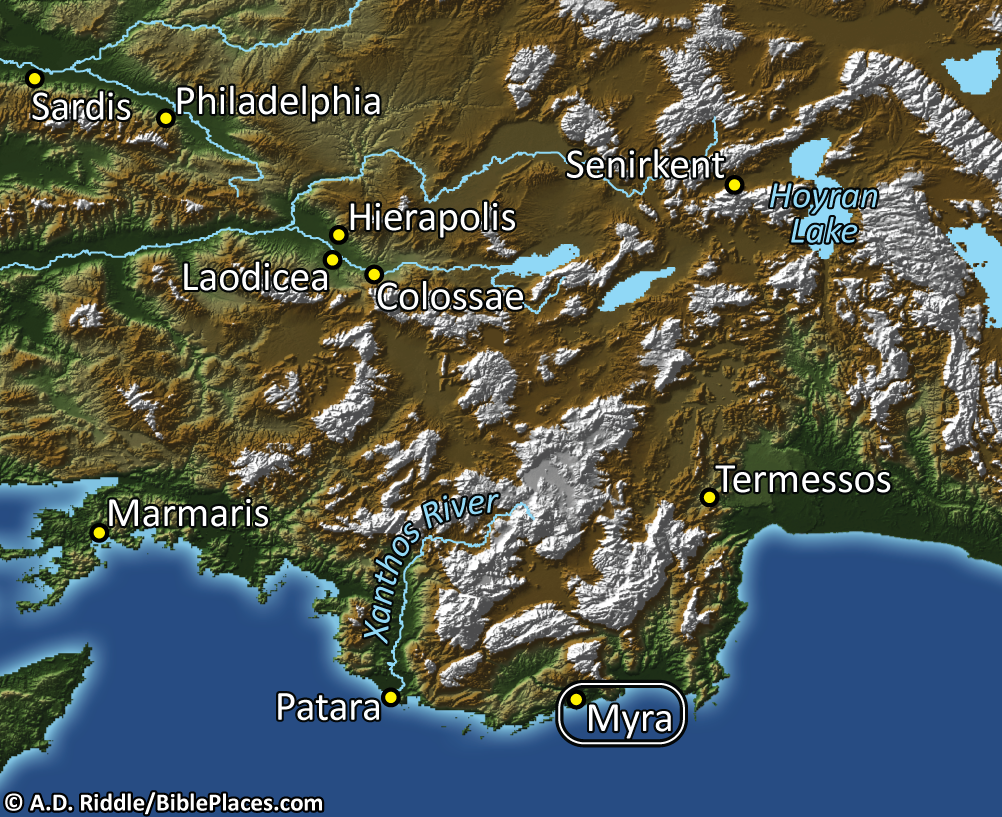
Paul visited Myra while he was a prisoner of the Romans, on his way to a trial before Caesar in Rome. The Wycliffe Historical Geography of Bible Lands, by Charles F. Pfeiffer and Howard F. Vos, provides the following description of what it would have been like to travel by boat from Caesarea to Myra like Paul did:

The westerly winds which favored the voyage from Patara or Myra to Tyre made the return voyage from Tyre to Myra an impossibility. The regular course for ships from Palestine or Phoenicia was northward past the east end of Cyprus and thence along the Asia Minor coast. Then, by means of ocean currents and land winds which blew off the coast, they made their way westward toward Myra. The voyage from Caesarea to Myra might be done in as short a time as ten days, but recorded trips over that route took as long as twenty days. Ships of the Roman grain fleet (on one of which Paul probably sailed) might take the same route if the winds required, but normally they sailed directly from Alexandria to Myra on the Lycian coast …

In the photograph below, you can see the area where the ancient harbor once existed (it has since filled up with silt):

Pfeiffer and Vos provide the following details about Myra and its significance:

In Greek times Patara surpassed Myra, but in Roman times Myra, forty miles eat of Patara, became the chief seaport of Lycia. It grew especially as a result of the Alexandrian grain trade with Italy. Though Myra was located two and one-half miles up the Andracus River from the coast, the same name was often applied to its harbor, Andriaca.

There are several “obscure sites” that Paul passed on his journey to Rome. In future posts we will explore some of them.

This photo and map are available in Volume 10 of the Pictorial Library of Bible Lands and is available here for $34 (with free shipping). This volume also includes the less obscure sites of Ephesus, Smyrna, and Pergamum. For other posts in our series on “obscure sites in the PLBL,” see here.

The excerpts are taken from Charles F. Pfeiffer and Howard F. Vos, Wycliffe Historical Geography of Bible Lands (Chicago: Moody Press, 1967), p. 376.

Share:

If you’re in the Dallas area this Friday, you might want to stop in for a free lecture on Tel Burna (possibly biblical Libnah) at Dallas Theological Seminary. The announcement gives location details but is not clear who is giving the lecture. I think it is Chris McKinny, one-time writer of our popular “Secret Places” series. (We’re hoping we see Chris back around these parts before too long!)

Ceramic mask fragment discovered at Tel Burna
Share:
(Post by A.D. Riddle)

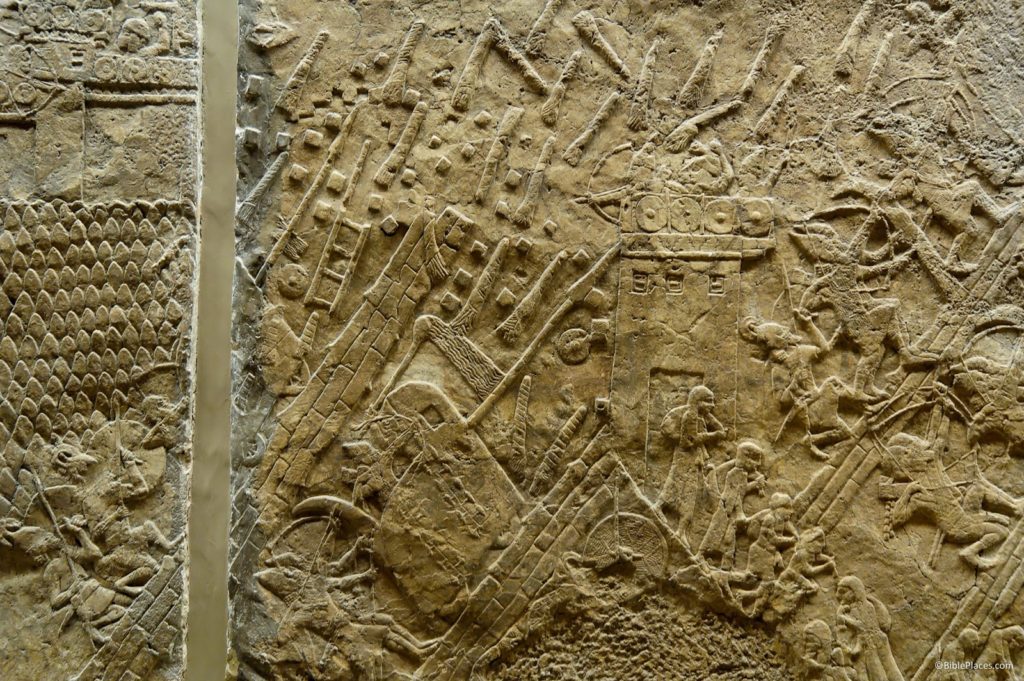
The University of Chicago’s Martin Marty Center for the Advanced Study of Religion is sponsoring a three-part lecture series on “Assyria in Israel, Judea, and the Levant.”

The first lecture presented by Irene Winter (Harvard University, emerita) is on February 11 (Tuesday). No title is yet provided for this lecture.

The second lecture by David Wright (Brandeis University) on “The Covenant Code Appendix (Exodus 23:20–33) and Assyrian Royal Inscriptions” will be given on February 26 (Wednesday).

The last lecture by Elizabeth Bloch-Smith (Saint Joseph’s University) will address “The Assyrian Military Impact on the Ground and in Biblical Texts” on March 13 (Thursday).

The series will take place in the Divinity School’s Swift Hall Common Room on the 1st floor. Lectures begin at 5:00pm and end at 6:30pm. The website for the lectures is here.

Relief from Sennacherib’s palace in Nineveh depicting
the Assyrian siege of Lachish in the reign of Hezekiah.
Share:

There is a great opportunity for older archaeology enthusiasts to have their photographs preserved in the Non-Professional Archaeological Photographs-project. The team is particularly interested in photographs taken by students and volunteers in excavations prior to 1980. If you have some of these photos, or if you know someone who does, please get in touch with NPAPH Project as soon as you can.

The official website has lots of details. You can also check out their Facebook page. The trailer below describes their vision.

Some archives are already online for viewing:

Dan P. Cole Photo Collection – Shechem and Gezer

Gordion Expedition Collection – the ancient Phrygian capital

Leo Boer Photograph Collection, 1953-1954 – travels of a student

Others cover Italy, The Netherlands, and Guatemala.

Share:

Leen Ritmeyer has photos and interpretation of the latest illegal excavations on the Temple Mount.

Ritmeyer suspects the revealed wall line may be the northern boundary of the 500-meter square pre-Herodian Temple Mount.

New excavations began at Tel Hebron this week.

Gershon Galil has translated the earliest Jerusalem alphabetic inscription be a reference to “wine part.”

Some rare fabrics dyed with extract from the murex shell have been discovered. The three colors found “represent the most prestigious colors in antiquity: indigo, purple and crimson.”

A couple of Top Discoveries of 2013 have been posted: Gordon Govier (Christianity Today) and
Noah Wiener (Biblical Archaeology Society).

In 2012, from time to time I surveyed excavation reports published by the Israel Antiquities Authority. I did not have time for that in 2013, but you can peruse the list here.

Scholars are using Google Earth to trace ancient trade routes around Antioch of Syria.

Currently on exhibition at the Israel Museum: Mapping the Holy Land II: Cartographic Treasures from the Trevor and Susan Chinn Collection.

Logos Bible Software has a pre-publication sale on Biblical Archaeologist/Near Eastern Archaeology 1992–2011 ($140).

Timothy Valentino has written an outstanding eulogy for Professor David A. Dorsey.

HT: Joseph Lauer, Jack Sasson, Charles Savelle

Share:

Some intrigue surrounded the recent discovery of a well-preserved Israelite proto-Aeolic capital when the tour guide who stumbled across it reported that the authorities told him to keep silent about it, ostensibly for political reasons. For the background and photos, see this report from last April.

This week a story in Arutz-7 claims that the secret location will be revealed next Friday. The article begins:

The location of a major archaeological find that was kept secret until now will be revealed to the public on Friday, next week. The find is being touted as a royal castle that could have belonged to Israel’s most celebrated king – the Bible’s King David.

There are several problems with this sensational report: (1) this type of architecture in Judah dates to several centuries after the time of David; (2) the impressive proto-Aeolic capital is in a water system and evidence of a palace is so far lacking; (3) the location has already been published in D. Ein-Mor and Z. Ron, “An Iron Age Royal Tunnel Spring in the Region of Nahal Rephaim,” in G. Stiebel et al., eds., New Studies in the Archaeology of Jerusalem and its Region, 2013. An abbreviated version is available online in Hadashot Arkheologiyot. (This reference comes from Zachi Dvira, via Joseph Lauer.)

It is possible that by overreaching in claims, the media may obscure the true significance of this discovery. Rather than speak of palaces and David, the comparison should rather be made with Hezekiah’s Tunnel.

(1) Both of these tunnels are water systems that bring water from a spring to a storage pool. (2) These are two of the longest underground water channels in the Judean hills, with Hezekiah’s Tunnel running 1,750 feet and the new one at ‘Ain Joweizeh running about 700 feet. (3) Both date to about the 8th century BC, with the date of the ‘Ain Joweizeh tunnel coming from a comparative analysis of other proto-Aeolic capitals found in Judah and Jordan. (4) Both seem to have royal connections, with the Siloam Inscription in Jerusalem and the royal architecture at ‘Ain Joweizeh.

What was the purpose of the ‘Ain Joweizeh tunnel? The excavators suggest that it may have been connected to “an estate or royal palace similar to Ramat Rahel here during the eighth–seventh centuries BCE; another possibility is a settlement from this period that is mostly buried beneath the farming terraces covering the ravine.” Presumably significant features are not visible on the surface and the excavators did not have the time to begin a large-scale excavation of the area. The proximity of the site to the security wall may complicate present or future attempts at excavation.

The site is located 5.5 miles (9 km) southwest of the Old City of Jerusalem, 3.5 miles (5.5 km) northwest of Bethlehem, and just down the slope to the west of Har Gilo. The map below shows the site circled in red.

Sheet_17-joweizeh
Western environs of Jerusalem
Map from the Survey of Western Palestine (1881)
google-earth-ain-joweizeh
Western environs of Jerusalem
Screenshot from Google Earth
http://www.hadashot-esi.org.il/Images//6087-1.jpg
Location map and plan of the spring based on Marcus and Ben-Yosef and Ron. Image from Hadashot Arkheologiyot
http://www.hadashot-esi.org.il/Images//6087-4.jpg
Proto-Aeolic capital in location
Image from Hadashot Arkheologiyot
http://www.hadashot-esi.org.il/Images//6087-3.jpg
Reconstruction of proto-Aeolic capital
Image from Hadashot Arkheologiyot

Another image showing the inside of the tunnel itself is posted at Maariv. (HT: Joseph Lauer)

Share: