The forgery case against Oded Golan has been concluded with the court’s rejection of the Israel Antiquities Authority’s claim of ownership of the Jehoash Inscription. Matthew Kalman has covered the case for nearly a decade and he reports on the 2-1 decision by an appeal panel of Israel’s Supreme Court.

The Supreme Court ruling caps a crushing defeat for the Israel Antiquities Authority following the sweeping 2012 acquittal of Golan and dealer Robert Deutsch on multiple charges of archaeological forgery. Israeli prosecutors advised by the Israel Antiquities Authority had argued that even though they continue to believe the inscription is a modern forgery, the reverse of the stone had been “dressed” in ancient times and was therefore classified as an antiquity that should belong to the state. But those arguments were rejected by the majority decision of the court. Oded Golan is now poised to reclaim both the tablet and the more famous item, the James ossuary, along with dozens of pieces confiscated by the Israel Antiquities Authority and the Israeli police at the time of his arrest in 2003. Golan greeted the decision as “good news.” He says he plans to put both the ossuary and the tablet on public display. The latest about-turn could be the final twist in a nail-biting finale to the decade-long pursuit of Golan. However, a sternly-worded ruling by the same court in September suggests that the battle over the future of the antiquities trade is just beginning. In an 8,000-word ruling handed down on September 29, a panel of three Supreme Court Justices rejected Golan’s appeal against his conviction and sentence on three minor charges and used the opportunity to declare war on the antiquities market. Branding the trade in antiquities “damaging” and motivated by “avarice,” the ruling authored by Supreme Court Justice Daphne Barak-Erez depicts “a world of collectors exchanging treasures teeming with trembling hands and heart – often within the law, and sometimes without,” and notes with approval that “in most countries of the world there is a general ban on the trade in antiquities, because of their recognition as a national resource.” She further observed, that this "conception also serves as the basis for the antiquities law” in Israel.

The full story is at The Bible and Interpretation and includes Golan’s response to the court’s broadside on the antiquities market. Since I believe that the tablet is likely authentic, I am happy to hear that Golan plans to put the artifact on public display.
Share:

(Post by Seth M. Rodriquez)


For the next few posts of our “Picture of the Week” series, we will be working our way back through the Pictorial Library of Bible Lands and focusing on obscure sites included in the collection. One of the great things about the PLBL is that it includes places that you would never typically go when you visit the lands of the Bible. Even if you spent a semester or a whole year in Israel, Jordan, Egypt, Turkey, or one of the other countries covered in the collection, you would probably not visit every site that Todd Bolen and his team of photographers have assembled in the PLBL. So this little sub-series can be called “Obscure Sites in the PLBL.” Or perhaps, “What You Missed on Your Trip to the Holy Land.”

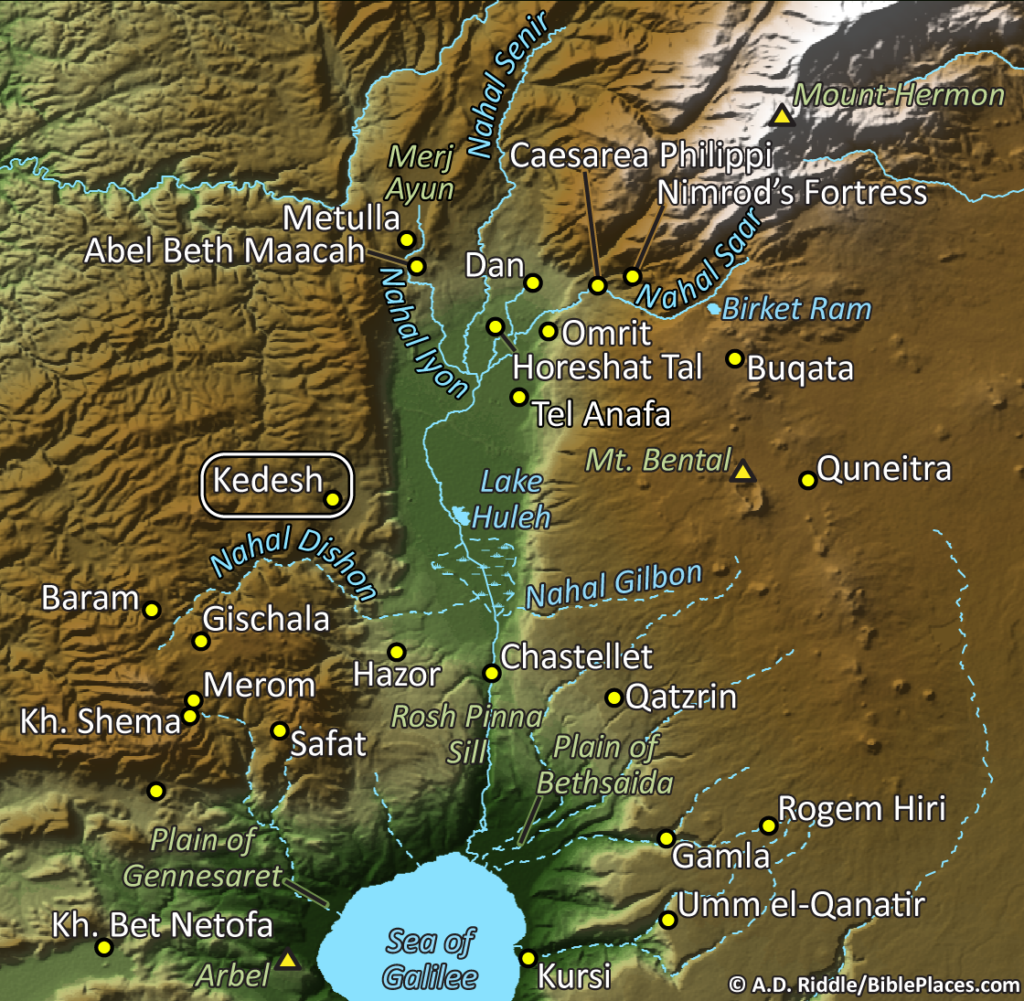
Our first stop is the ancient city of “Kedesh in Galilee in the hill country of Naphtali” (Josh. 20:7). This site is located just west of the Huleh Basin, in the region north of the Sea of Galilee. Below is a section of a map provided in Volume 1 of the PLBL which shows the location of Kedesh.

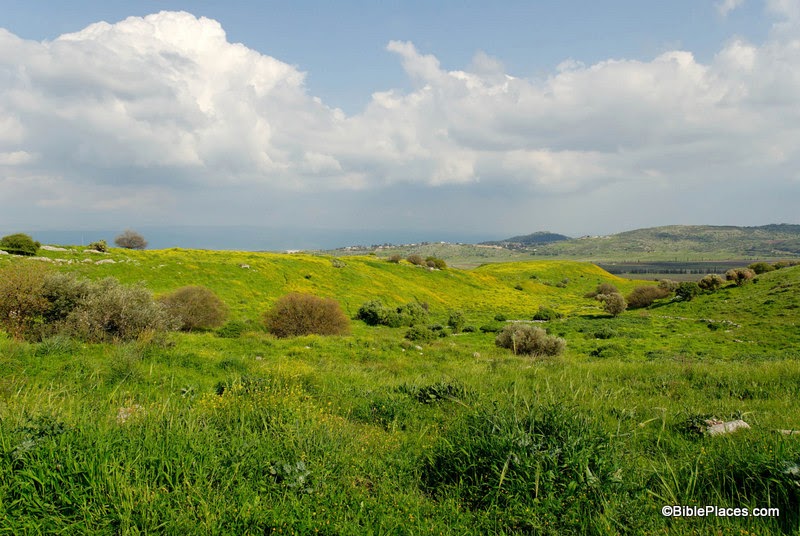
Tel Kedesh itself can be seen image below, covered with spring wildflowers. In the Old Testament period, this was one of the places designated a “city of refuge” where someone could escape from an avenger if they had accidentally killed someone (Josh. 20:1-9). There were six cities of refuge scattered throughout the Israelite territory and Kedesh was the one that was farthest to the north.

Kedesh also shows up in Judges 4. This was the where Barak lived, and it is where the Israelite army assembled before they marched out to war under the leadership of Deborah and Barak. At the time, the king of Hazor was oppressing the Israelites. Hazor is only about 8 miles southeast of Kedesh, and in the image above the camera is looking in that direction.

Lastly, Kedesh is mentioned in 2 Kings 15:29 where it was conquered by Tiglath-pileser of Assyria, along with many other cities in the region. However, the site continued to be occupied for many centuries after that. In the Roman period a temple was built here, and if you visit the site today you can see part of one wall still standing. Several pictures of the Roman temple at Kedesh are available in Volume 1 of the PLBL.

This image and over 1,100 others (along with the map) are included in Volume 1 of the Pictorial Library of Bible Lands and is available here for $39 with free shipping. Additional photographs taken in this region can be seen here, here, and here on BiblePlaces.com. Historic images of this region can be seen herehere, and here on LifeintheHolyLand.com.

Update: Another suggested location for the Kedesh of Barak is Kh. el-Kidish, southwest of the Sea of Galilee. Both of these sites were within the territory of Naphtali.

Share:

The Jerusalem Post reports on an excavation near the coast south of Haifa where thousands of teenagers are taught the value of archaeology each year.

The Tel Esur dig is the largest communal excavation in the country, [Dr. Shay] Bar said. “It’s a project of the community, for the community, for the education of the children of this community,” Bar said last week at the dig’s makeshift headquarters. He said that different skills involved in archaeology – from the meticulous digging required to unearth artifacts to careful record keeping – allow the teenagers to discover their talents. “Here they open like a flower,” he said. “They are flourishing.” On a typical day in Tel Esur, 150 children from four different schools work at different areas at the dig site, supervised by 20 staff members, volunteers and the students’ teachers. The teenagers don’t necessarily mix with students from other schools, in order to simplify the logistics, Bar said. Still, students from Arab and Jewish schools “can work five meters from each other” on a common project under the supervision of researchers from a variety of backgrounds, he said. At points throughout the day, students take a break from digging to hear short educational lessons about archaeology. Instead of discussions about who recently owned the land, the archaeologists attempt to instill an appreciation for the craft of the research. “They have to understand the value of history before they understand the relationship to different ethnicities that existed here,” said Netanel Petrushka, one of the archaeologists.

The full story is here.

Share:

Gordon Franz reports on his time at the “International Noah and Judi Mountain Symposium” in Sirnak, Turkey. He also provides a summary of a number of the presentations.

On The Book and the Spade this week: “Discovering Dalmanutha” with Ken Dark (direct link).

Norma Franklin believes the Megiddo water system was built during the Middle Bronze Age.

George Athas asks, “What’s New in Biblical Inscriptions?” and he suggests a cautious approach in announcing new discoveries.

An enormous Corinthian capital has been excavated at a temple of Hadrian in western Turkey.

A report in the Belfast Telegraph provides details about the ongoing excavations at Sidon.

Aviva and Shmuel Bar-Am provide a tour of Gezer.

Before there was writing, there were clay balls. Scholars are trying to decipher the code from objects found in Iran.

Dove Booksellers reports that the retail price is jumping up to $395 for The Oxford Encyclopedia of the Bible and Archaeology. It’s on sale for $257 until Tuesday (cheaper than Amazon).

HT: Jack Sasson, Joseph Lauer, Explorator

Mount Cudi from west, adr1005222380
Cudi (Judi) Dagh, possible location of Mount Ararat, from west
Photo from Eastern and Central Turkey
Share:

The world’s largest Ark of the Covenant has been donated to Israel.

Leen Ritmeyer discusses the little-known Jewish excavation underneath the Temple Mount.

As for the recent challenge to the identification of Herod’s tomb at the Herodium, Ritmeyer sides with Netzer.

Have you been to Joseph’s tomb at Shechem? Ferrell Jenkins gives the biblical significance and a recent photo.

The Ephraim of Jesus’ day is modern Taybeh. There are more reasons to visit than ever before.

The “most popular photo” at The Bible and Interpretation is one our sunset shots over the Sea of
Galilee.

Tomb of Joseph, Nablous, ef0131
Joseph’s Tomb in Shechem
Photo source
Share:

Two former students of Ehud Netzer are disputing their teacher’s claim that he discovered Herod’s tomb at the Herodium. Prof. Joseph Patrich and Benjamin Arubas, both of Hebrew University, presented a paper yesterday in which they argued that the hillside shrine may have served Herod’s family but not the king himself.

They argue that the newly discovered tomb could not have been built for King Herod:

  • The tomb is too modest for one who considered himself the greatest king.
  • The plaza next to the tomb was too small to accommodate the large crowd that Josephus describes.
  • The later construction of the monumental staircase does not reflect the careful planning characteristic of Herod.

Nir Hasson provides a detailed summary in Haaretz of the presentation given at the seventh annual “Innovations in Archaeology in Jerusalem and the Surrounding Area” conference. The article also includes some counter-arguments by Netzer’s successor Roi Porat. I find the latter more convincing.

HT: Joseph Lauer

Herodium model tomb of Herod, tb042512613
Replica of Herod’s mausoleum at Herodium
Share: