Have they found a “smoking gun” proving that the Gospel of Jesus’ Wife was forged?

A plan to build a water reservoir west of Jerusalem near Har Adar is being opposed because it will mean the loss of 800 pine, cypress, and oak trees.

Shahar Shilo will speak about new discoveries from Jerusalem’s Temple Mount and the City of David in Simi Valley, California next week. I know that he is speaking in Dallas and probably elsewhere, but I do not have public links for those events.

“The Metropolitan Museum of Art today launched MetPublications, a major online resource that offers unparalleled in-depth access to the Museum’s renowned print and online publications, covering art, art history, archaeology, conservation, and collecting.”

The latest issue of Biblical Archaeology Review is online (digital subscription required).

HT: Jack Sasson, Joseph Lauer

Share:

The Cura Aquarum in Israel will be held next week at Neve Ilan. Many of the lecture topics are of interest.

Monday October 15, 2012 (Neve Ilan Hotel)


Session A: 09:00 – 10:30 Ancient water systems in Israel 1
Chairperson Jim Parker

1. Is There Light at the End of the Tunnel? The Gezer Water System Project – Dan Warner, Tsvika Tsuk, Jim Parker and Dennis Cole

2. A New Assessment of the Upper Aqueduct to Jerusalem: its Date and Route – David Amit and Shimon Gibson

3. Dating and engineering of Siloam Tunnel, Jerusalem – Amos Frumkin and Aryeh Shimron


Session B: 11:00 – 12:50 Ancient water systems in Israel 2
Chairperson Dennis Cole

4. The Inverted Siphon Pipelines to Tel Bet Yerah/es-Sinnabris – Yardenna Alexandre

5. The “’Otzar” in Ancient Ritual Baths: Second Temple Period Innovation or Anachronistic Interpretation? – Yonatan Adler

6. When were the Qanat Systems introduced to the Holy Land? – Yosef Porath

7. The Early Islamic aqueducts to Ramla and Hebron – Amir Gorzalczany and David Amit


Session C: 14:15 – 15:15 Ancient and modern water systems in Israel 3
Chairperson Ronny Reich

8. Touring Israel’s ancient water systems – Tsvika Tsuk

9. Water in Israel and in the Middle East – past, present and future – Shimon Tal


Session D: 15:35 – 17:00 Turkey 1
Chairperson Werner Eck

10. Grundwassernutzung in der hethitischen Hauptstadt Hattusa um 1600 v. Chr. – Hartmut
Wittenberg

11. Ancient Water Systems of the Lamas Çayi and the surrounding hinterland – Dennis Murphy

12. Die Datierung der römischen Kaikos- und Madradag-Kanalleitungen in Pergamon – Henning Fahlbusch


Session E: 17:20 – 18:50 Turkey 2
Chairperson Henning Fahlbusch

13. Das städtische Abwassersystem von Pergamon – seine Entwicklung in hellenistischer und römischer Zeit – Kai Wellbrock

14. The aqueducts and water supply of Tralleis – Eddie Owens

15. Antike Wasserbauten von Antiochia (Tuerkei) – Mathias Döring

Tuesday October 16, 2012 (Neve Ilan hotel)


Session F: 08:30 – 09:30 The Military
Chairperson Mathias Döring

16. Das Heer und die Infrastruktur von Städten in der römischen Kaiserzeit – Werner Eck

17. Water as weapon and military target in Ancient Mesopotamian warfare – Ariel Bagg


Session G: 09:50 – 11:20 Groundwater and Roman Aqueducts
Chairperson Eli Dror

18. Ground water use and understanding in ancient times: lessons for today and tomorrow – Michael Knight

19. Sinter deposits in Roman aqueducts – Gül Sürmelihindi and Cees Passchier

20. The Atlas Project of Roman Aqueducts (ROMAQ) – Cees Passchier, and Gül Sürmelihindi
Session H: 11:50 – 13:15 Greece and Spain – Sanctuaries, Mills and Aqueducts
Chairperson Dennis Murphy

21. The role of water in ancient sanctuaries. The Sanctuary of Amphiaraos – Anna Androvitsanea

22. When Ceres commands her nymphs – An investigation of the relation between mills and aqueducts in the antique Mediterranean – Stefanie Preißler

23. The Glass kiln (Horno de Vidrio), a drop tower in the water supply to the city of Toledo (Spain) during the Roman era – Marisa Barahona

More details about the conference are available here.

HT: Jack Sasson

Hezekiah's Tunnel, tb110705559
Hezekiah’s Tunnel in Jerusalem 
Share:

(Post by Seth M. Rodriquez)

In 1 Corinthians 11:17-34, Paul describes an extremely dysfunctional church event.  When the church gathered to observe the Lord’s Supper, there were divisions and factions (v. 18-19) due to the fact that people were not sharing food with those who were hungry and were eating before the others arrived (vv. 21, 33-34).  What could have possessed them to act in such an unloving way during one of the holiest events in the life of their church?

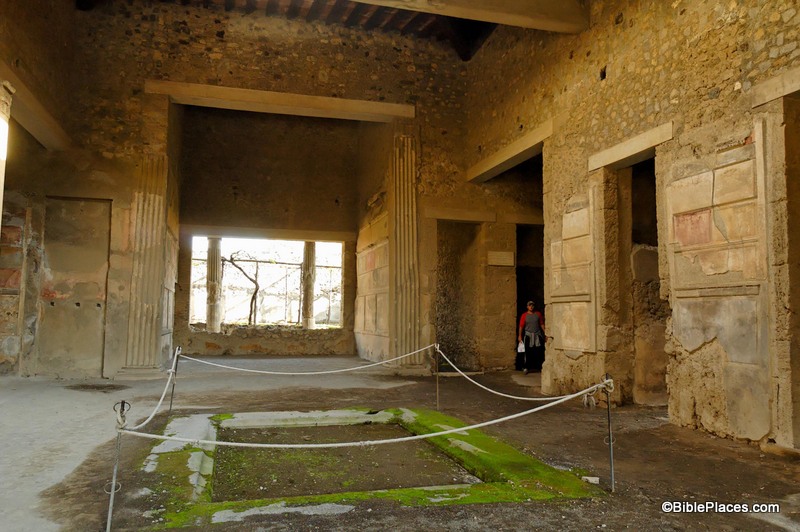
In his book St. Paul’s Corinth: Texts and Archaeology, Jerome Murphy-O’Connor suggests a historical context which could help explain this passage.  His suggestion centers around the fact that wealthy homes in that culture typically had two public areas: a room just inside the entrance called an atrium and a dining room called a triclinium.

Our picture of the week is an example of an atrium found in one of the houses at Pompeii.  This photo comes from Volume 14 of the revised and expanded version of the Pictorial Library of Bible Lands, which focuses on Italy and Malta. The photo is entitled, “Pompeii House of Sallust Atrium.”  An atrium typically had a a rectangular pool in the center of the room called an impluvium.

Murphy-O’Connor suggests that part of the problem in the Corinthian church was due to the fact that a small group of the wealthiest church members were invited to dine in the triclinium while the rest of the members had to sit in the atrium.  He explains a hypothetical historical background in the following way:

Private houses were the first centers of church life.  Christianity in the 1st cent. A.D., and for long afterwards, did not have the status of a recognized religion, so there was no question of a public meeting-place, such as the Jewish synagogue. Hence, use had to be made of the only facilities available, namely, the dwellings of families that had become Christian. …

Given the social conditions of the time, it can be assumed that any gathering which involved more than very intimate friends of the family would be limited to the public part of the house …

… [T]he average size of the atrium is 55 sq. meters and that of the triclinium 36 sq. meters.  Not all this area, however, was usable. The effective space in the triclinium was limited by the couches around the walls; the rooms surveyed would not have accommodated more than nine, and this is the usual number …. The impluvium in the center of the atrium would not only have diminished the space by one-ninth, but would also have restricted movement; circulation was possible only around the outside of the square. Thus, the maximum number that the atrium could hold was 50, but this assumes that there were no decorative urns, etc. to take up space, and that everyone stayed in the one place; the true figure would probably be between 30 and 40. …

The mere fact that all could not be accommodated in the triclinium meant that there had to be an overflow into the atrium.  It became imperative for the host to divide his guests into two categories; the first-class believers were invited into the triclinium while the rest stayed outside.  Even a slight knowledge of human nature indicates the criterion used.  The host must have been a wealthy member of the community and so he invited into the triclinium his closest friends among the believers, who would have been of the same social class.  The rest could take their places in the atrium, where conditions were greatly inferior. Those in the triclinium would have reclined, as with the custom … where as those in the atrium were forced to sit ….

The space available made such discrimination unavoidable, but this would not diminish the resentment of those provided with second-class facilities.  Here we see one possible source of the tensions that appear in Paul’s account of the eucharistic liturgy at Corinth (1 Cor 11:17-34).  However, his statement that “one is hungry while another is drunk” (v. 21) suggests that such tensions were probably exacerbated by another factor, namely, the type of food offered. …

The reconstruction is hypothetical, but no scenario has been suggested which so well explains the details of 1 Cor. 11:17-34.  The admonition “wait for one another” (v. 34) means that prolambano in v. 21 necessarily has a temporal connotation; some began to eat before others.  Since these possessed houses with plenty to eat and drink (vv. 22, 34), they came from the wealthy section of the community and might have made a contribution in kind to the community meal. This, they felt, gave them the right to think of it as ‘theirs’ (to idion deiphon).  Reinforced by the Roman custom they would then have considered it their due to appropriate the best portions for themselves. Such selfishness would necessarily include a tendency to take just a little more, so that it might happen that nothing was left for the ‘have-nots’ (v. 22), who in their hunger had to content themselves with the bread and wine provided for the Eucharist.  However, as Paul is at pains to point out, under such conditions no Eucharist is possible (v. 20). 

Excerpt is taken from Jerome Murphy-O’Connor, St. Paul’s Corinth: Texts and Archaeology, Good News Studies, vol. 6 (Wilmington, DE: Michael Glazier, Inc, 1983), 153-161, and can be purchased here. This and other photos of Pompeii are included in Volume 14 of the Pictorial Library of Bible Lands and can be purchased here.  More information on Pompeii and additional photos (including another atrium) can be found on the BiblePlaces website here.

Share:

Streams in the Desert: A 20-second clip from SourceFlix.com

New exhibit at the Oriental Institute Museum: Between Heaven and Earth: Birds in Ancient Egypt,

October 16, 2012-July 28, 2013

The Sea of Galilee is entering fall at a higher level than in six years.

Wayne Stiles: Connecting Cisterns, Rain, and Reading the Bible

Haaretz: Samson follows the sun to Galilee

The date palm growing from a 2,000-year-old seed is shown and discussed on video.

The Mazotos shipwreck is the oldest shipwreck found off Cyprus to date. The vessel sank in 350 BC
with a load of 1,000 amphorae of wine.

Elizabeth Payne, conservator of the Yale Babylonian Collection, is interviewed in the school paper.

HT: Joseph Lauer, Jack Sasson

Share:

From the Jerusalem Post:

On October 9, 1968 a thirteen-year-old girl made history, as she squeezed through a narrow hole into the underground chambers of the Cave of the Patriarchs in Hebron, which the Jews had been forbidden to enter for 700 years under Mamluk, Ottoman, British and Jordanian rule. Jews were only allowed access to the staircase at the southeast of the site, initially only up to the fifth step and later increased to the seventh.
[…]
“On October 9, 1968, my mother asked me if I would agree to climb into a narrow hole that would lead me to a cave,” Arbel wrote in her personal account of the event published on the Hebron website. “After I agreed, my mother told me that it was the Cave of the Patriarchs.”
Arbel recalls how her father later woke her and bundled her into the car “wrapped like a parcel with a blanket over her head” and they made their way to Hebron from their Jerusalem home. When they arrived they stopped at the police for a while and then continued to the cave. “I got out of the car, wrapped in the blanket, and entered the Muslim mosque. I saw the opening that I would need to fit into.” The hole measured 28 centimeters in diameter. Arbel was harnessed with ropes and equipped with a flashlight and matches in order to check the air inside the cave. “They lowered me down onto a pile of paper and money. I found myself in a square room.” She describes seeing three tombstones opposite her, “the middle one adorned and taller than the other two.” Abraham, Isaac, Jacob, Sarah, Rebecca, and Leah are all believed to be buried in the Cave of the Patriarchs.

The story continues here. For more photos and information about Hebron and the Machpelah constructed by King Herod, see here.

HT: Joseph Lauer

Hebron Machpelah, shaft to caves below, tb092204022
Hebron Machpelah. The shaft to the subterranean cave is protected by the green railings. (photo source)
Share:

The Jerusalem Post suggests six tourist attractions you might have missed:

1. Camel Riders—Mamshit

2. Alpaca Farm—Negev Highlands

3. Deer Farm—Gush Etzion

4. Robotic Cowshed—Kfar Yehezkel

5. Hai Park—Kiryat Motzkin

6. Ma’ayan Zvi Fishing Park—Sharon Plain

The full article is here.

Gazelle in Nahal Paran, tb042107595
Gazelle in Nahal Paran.
Photo from
Cultural Images of the Holy Land.
Share: