The north of Israel received a surprise August rainfall this week. Haaretz has more about the rabbi who was accused of stealing bones from an archaeological site near Beth Shemesh. Israel will return two sarcophagi lids stolen from Egypt. The BBC describes Lidar archaeology and some debate about its value. Joe Yudin recommends the view from an inactive volcano in the Golan Heights. I think that Wayne Stiles somehow managed to get all of my favorite Masada photos in this article. The ABR bookstore is now offering free shipping on all orders over $35. They offer a number of books under $10. HT: Jack Sasson, Paleojudaica
View towards Damascus from Mount Bental (photo source)
(Post by Seth M. Rodriquez)
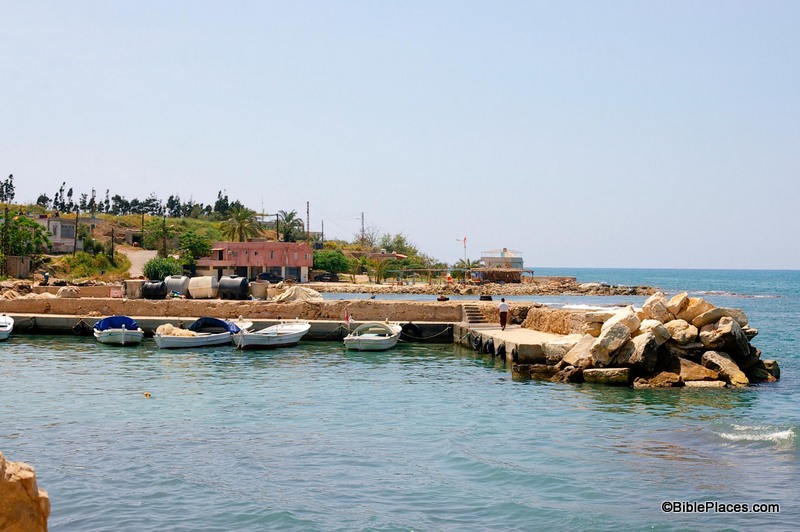
“What do you know about the biblical city of Zarephath? Where is it mentioned in the Bible? What biblical events happened there?” It is a well-known fact that while teaching or preaching, it is helpful to start your dialogue by asking questions that will gain the attention of your listeners. In addition, in today’s day and age where so much of people’s intake of information is visual, this technique can be even more effective if it is coupled with a picture, such as this one:
Although the photo and the name of Zarephath may not be familiar to most people (even people who are familiar with the Bible), the significance of the place will become evident to your listeners when you connect it with the biblical references to this place. In other words, it becomes a springboard to an important biblical story.
This week’s photo comes from Volume 8 of the revised and expanded edition of the Pictorial Library of Bible Lands, which focuses on Lebanon. The photo is entitled “Zarephath, Phoenician Harbor and Tell from East” (photo ID #: adr090508617). Volume 8 is part of the “expanded” features of the PLBL. It is a completely new volume featuring the pictures of A.D. Riddle, a frequent contributor to this blog.
So where is Zarephath and what is its biblical significance? Zarephath is an ancient city on the coast of Phoenicia, about 8 miles (13 km) south of Sidon and 14 miles (22 km) north of Tyre. In antiquity, it had a long and productive existence: it was inhabited from the Late Bronze Period (1600 BC) through the Byzantine Period (AD 600), so it was standing in both Old Testament and New Testament times. There is also a modern village about a mile from the site today. Naturally the name of the town changed over the years and as you moved from one culture to another: it was referred to as “Zarephath” by the Israelites, “Sarpu’uta” by the Egyptians, “Sariiptu” by the Assyrians, “Sarepta” by those in Hellenistic and Roman times, and “Sarafand” today.
Zarephath occurs in two chapters in the Bible: 1 Kings 17 and Luke 4. In the book of 1 Kings, Zarephath is the town where the Lord instructed Elijah to go during the last part of the three-year of drought in Israel.
Then the word of the Lord came to him, “Arise, go to Zarephath, which belongs to Sidon, and dwell there. Behold, I have commanded a widow there to feed you.” (1 Kgs. 17:8-9, ESV)
While he was there, the Lord provided for Elijah, the widow, and her son in a miraculous fashion. This was followed by another miracle when the widow’s son died and the prophet raised him back to life.
The drought ended in the next chapter, 1 Kings 18, after Elijah confronted the prophets of Baal on the top of Mount Carmel. In a way, the events in Zarephath were a subtle precursor to the dramatic confrontation in 1 Kings 18. Zarephath was in the territory of Sidon, the homeland of Queen Jezebel and a region where Baal was worshipped. In fact, Jezebel was the one responsible for making Baal worship the official state religion in Israel after she married King Ahab, as 1 King 21:25-26 makes clear. In light of all this, Elijah’s words to the widow in chapter 17 are significant:
For thus says the Lord, the God of Israel, “The jar of flour shall not be spent, and the jug of oil shall not be empty, until the day that the Lord sends rain upon the earth.” (1 Kgs. 17:14, ESV, emphasis added)
This was a bold claim in the territory of Baal-worshippers: the God of the Israelites will perform a miracle on your behalf, not the god of the Sidonians. The widow herself seems to have already had faith in the God of Israel (1 Kgs. 17:12), but when 1 Kings 17 is studied in context with 1 Kings 18 the theme seems to be that God is mightier than the false god Baal.
Finally, in Luke 4:24-26, Jesus references these events while discussing the fact that a prophet has no honor in his hometown. Jesus was almost stoned after saying this, probably because he used examples where Israelite prophets were used as a means of blessings to Gentiles … a truth that was not very palatable in 1st century Galilee.
This and other photos of the Zarephath are included in Volume 8 of the Pictorial Library of Bible Lands and can be purchased here. More information and photos about Zarephath can be found on the BiblePlaces website here.
- Tagged Lebanon, Picture of the Week
Two Neolithic figurines were discovered at Moza (biblical Emmaus?) along the Jerusalem-Tel Aviv highway. High-res photos from the IAA are available. Two men were arrested for trying to steal bones from excavations in Beth Shemesh. The Israeli government has appealed the verdict in the case of the Jehoash Inscription, but the rationale for doing so is unclear. Shmuel Browns suggests a 10-day itinerary that will take you to many places you won’t see on a typical Christian tour. Stephen Gabriel Rosenberg provides a review of the archaeological stories in July. Aaron’s tomb near Petra is a “quiet, austere holy site.” There is a lot to see in the Kidron Valley of Jerusalem. Accordance 10 has some nice new features for photographs and maps. Now shipping: Alexander to Constantine: Archaeology of the Land of the Bible, by Eric M. Meyers and Mark A. Chancey. HT: Charles Savelle
Neolithic figurine from Moza. Photo by Yael Yolovitch, courtesy of the Israel Antiquities Authority.
- Tagged Excavations, Jerusalem, Jordan, Judah, Shephelah, Tourism, Weekend Roundup
In an interview posted this morning on Justin Taylor’s blog, Leen Ritmeyer describes the “Palatial Mansion” that overlooked the Temple Mount in the first-century. This impressive structure inside today’s Wohl Museum is frequently skipped by tourists to Jerusalem, if I can judge by the private visits my groups usually enjoy at the site. Many who have been to Jerusalem may thus “see” this ancient home through the Leen Ritmeyer’s eyes, as the supervisor of the reconstruction effort provides a helpful “walk-through.” The house also provides the opportunity to clarify a difficult portion of the New Testament. How could Peter be warming himself by a fire in the courtyard on the night he denied Jesus, and yet be able to “go outside” the house of the high priest (Luke 22:54-62)? Ritmeyer explains and illustrates the concept of an open courtyard inside the palace. While I appreciate the way that Ritmeyer makes these discoveries so accessible to the average Bible reader, I am less optimistic that this particular house is the very house where Jesus stood on trial and Peter denied the Lord. In favor of making this positive identification is the fact that this is the largest house known from this time period in Jerusalem. On the other hand, most of the land in the Old City has never been excavated. If there were 100 houses in Jerusalem in the first century, how likely is it that the only complete one excavated is the same one mentioned in the Bible? See the post for the full interview, some of Ritmeyer’s famous diagrams, and links to his excellent resources. A commenter to the post also shares 63 high-resolution photos he took on a visit. These are particularly valuable because photography is not allowed unless you pay a lot of money.
- Tagged Jerusalem
I appreciate the careful work that Gordon Franz has done over the past several decades in exposing shoddy scholarship by those who make sensational claims in support of the Bible’s accuracy. Ron
Wyatt was the long-time leader of fraudulent archaeology until his death in 1999. One of those who picked up the baton was Robert Cornuke, a one-time policeman who now alleges to have discovered the location of Mount Sinai, the ark of the covenant, Noah’s ark, and Paul’s shipwrecked vessel on Malta. Indeed, he discovers more on a two-week summer trip than any trained archaeologist discovers in a lifetime! What accounts for his popularity among evangelical Christians? Two things: he tells them what they want to hear in the way they want to hear it. Bible believers want to hear of great discoveries that support their faith, and if you package that in a charismatic presentation or a well-written paperback, you need not bother yourself with truth.
Gordon Franz is serving the church by investigating Cornuke’s claims and writing critiques to help believers navigate these waters. Franz has recently created a convenient entry point for the articles he has written on Cornuke’s work over the years. Some of those articles include: Mount Sinai is NOT at Jebel al-Lawz in Saudi Arabia Part 1 Yahweh Inscription Discovered at Mount Sinai!
Does “The Lost Shipwreck of Paul” Hold Water? Was the Ark of the Covenant Taken to Ethiopia? The full list is here. You may want to bookmark this link for future reference. For critiques of other dubious “archaeology,” see Franz’s “Cracked Pot Archaeology” section.
- Tagged Analysis, Pseudo-Archaeology
The Macherus article in the newest issue of Biblical Archaeology Review is quite good, especially with its reconstruction diagrams. A particularly impressive photo is the panoramic shot from Macherus showing Masada, Herodium, and Jerusalem. I was surprised to see the entire article available online this morning. If you don’t subscribe to the print edition, you have a brief chance to read it before it goes behind the subscription wall. An annual digital subscription to BAR is now available for $20. A 21-m-long sediment sample near the Dead Sea is providing scientists with information about the area’s climate in history. According to Thomas Litt, the results “clearly show how surprisingly fast lush Mediterranean sclerophyll vegetation can morph into steppe or even desert vegetation within a few decades if it becomes drier.” The level of the Sea of Galilee dropped more than two feet this summer. Carl Rasmussen has just added photos to his site of a place in Galilee I have not seen: Domus Galilaeae is a Roman Catholic retreat center overlooking the northern side of the Sea of Galilee. And his latest travel tip suggests an alternative viewpoint now that Arbel is controlled by Park Rangers and closes way too early. Wednesday marked the 200th anniversary of John Lewis Burckhardt’s visit to Petra. He was 27 when he re-discovered the Nabatean city for the western world on August 22, 1812. Gus W. Van Beek died this week. He was Curator of Old World Archaeology in the National Museum of Natural History, Smithsonian Institution and recent author of Glorious Mud! How in the world did the ancients ever move massive stones such as the trilithons in the Jupiter Temple of Baalbek that weigh more than 1,000 tons? Paleobabble answers that question with diagrams and translation from an older French article.
Trilithon in Jupiter Temple, Baalbek (photo from the Lebanon volume of the Pictorial Library of Bible Lands)
- Tagged Dead Sea, Galilee, Jordan, Lebanon, Technology, Weekend Roundup
Search
About the BiblePlaces Blog
The BiblePlaces Blog provides updates and analysis of the latest in biblical archaeology, history, and geography. Unless otherwise noted, the posts are written by Todd Bolen, PhD, Professor of Biblical Studies at The Master’s University.
Subscribe
Tags
10th Century
American Colony Photos
Analysis
Antiquities Trade
Dead Sea
Dead Sea Scrolls
Discoveries
Egypt
Excavations
Forgery
Galilee
Greece
Holidays
Israel's Coast
Italy
Jerusalem
Jezreel Valley
Jordan
Jordan Rift
Judah
Lebanon
Lectures
Mediterranean Islands
Mesopotamia
Museums
Negev
New Exhibits
Persia
Philistines
Photo Resources
Picture of the Week
Pseudo-Archaeology
Resources
Sad News
Samaria
Shephelah
Syria
Technology
Temple Mount
Tomb of Jesus
Tourism
Travels
Turkey
Weather
Weekend Roundup
Links
Notice
As an Amazon Associate we earn from qualifying purchases. In any case, we will provide honest advice.