Archaeologists have found a collection of right hands at the Hyksos capital of Avaris in Egypt. Collecting body parts was one ancient way of counting victims (cf. 1 Sam 18:25). Israeli scientists have developed a way to predict the location of sinkholes near the Dead Sea. Clay rods from the Neolithic period found years ago are not phallic symbols but were ancient matches for starting fires. A summary of the 13th season at Hippos/Susita has been released by the University of Haifa. There are more photos here. A large olive press from the 6th-8th centuries AD has been discovered in Hod HaSharon on Israel’s coastal plain. The National Project to Document Egypt’s Heritage has begun with the tombs of Beni Hasan. The Aleppo citadel has allegedly been damaged by shelling by the Syrian army. Eilat Mazar will be excavating more of the area between the Temple Mount and the City of David later this month. Nir Hasson has more on Sir Flinders Petrie, the archaeologist who lost his head. Wayne Stiles takes a closer look at Nebi Samwil and the neighboring Gibeon and concludes that they reveal similar spiritual lessons. Gordon Franz has obtained a copy of pseudo-archaeologist Robert Cornuke’s doctoral dissertation and finds that it’s a sham. Paul V. M. Flesher writes about the latest finds in the Galilean town of Huqoq. Leon Mauldin shares a photo of Mount Ararat with a rainbow. Haaretz has some tips for finding wifi in Israel. HT: Joseph Lauer, Jack Sasson Medinet Habu, pile of hands for counting dead, tb011105878 A pile of hands used for counting the dead, depicted at mortuary temple of Ramses III in Medinet Habu (photo source)

Share:

Nir Hasson of Haaretz reports on the study of ancient plants at the Philistine city of Gath.

Until a few years ago most archaeologists would not even have considered these to be archaeological finds. The focus on them could symbolize the new road the discipline has taken in general, and Israeli archaeology in particular. Known as microarchaeology, this new field use precise scientific instruments to interpret more elements of the ancient record, making it more complex and at times, more human. Instead of great kings vanquishing cities, pillaging, murdering and being murdered, it also tells the story of cultural transformation and of simple urban dwellers. Called phytoliths, the white spots are what remains after most of a plant has decayed, as a kind of skeleton made of minerals. [Yotam] Asher is doing his Ph.D. on what phytoliths can teach us. Those at Tel Tzafit are what is left of plants that lived 3,300 years ago. A preliminary look under the microscope shows that one spot is what remains from a pile of domesticated wheat while another is of unidentified wild plants. "It’s possible that in one place was a sack of hay and in another, a sack of wild plants, or that these are plants that were on a roof that collapsed," Asher says.

The full story is here. The head archaeologist of the Gath project calls the article “great.” Joseph Lauer observes that the “four-horned altar” mentioned only had two horns.

Share:

(Post by Seth M. Rodriquez)


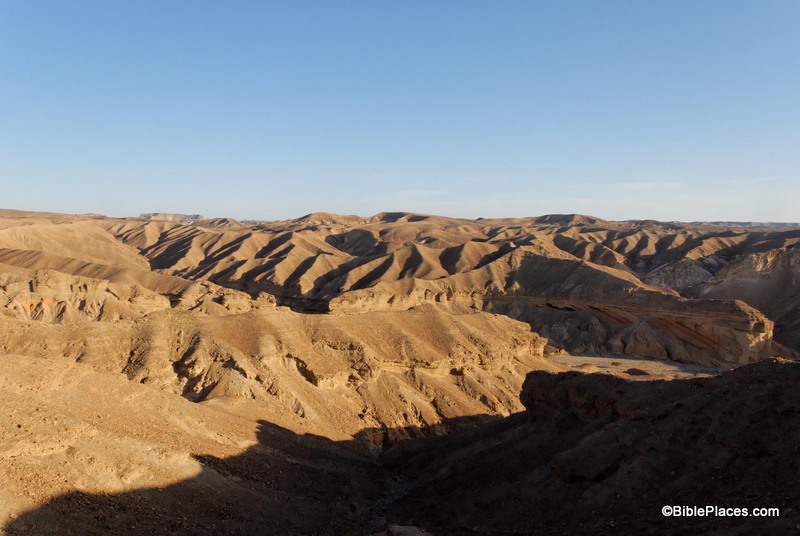
This week’s photo comes from Volume 5 of the revised and expanded edition of the Pictorial Library of Bible Lands and is entitled “Wilderness of Paran” (photo ID #: tb042007570).

The Wilderness of Paran is a desert region northwest of the Gulf of Aqaba that today straddles the southern end of the State of Israel and the eastern edge of Egypt.  It appears in the Biblical text as a lonely place outside the Promised Land.  This region is the place where Ishmael and Hagar lived after Abraham sent them away (Gen. 21:20-21).  It is also a place where David sojourned to escape from Saul (1 Sam 25:1), and a place that Hadad the Edomite passed through while he and some other Edomites were fleeing from David and Joab (1 Kgs. 11:14-19).  It is apparent from these passages that this region often served as a safe haven for people who were cast out or were fleeing from danger.

The Wilderness of Paran is also where Israel spent part of their time during the Wilderness Wanderings (Num. 10:12; 12:16).  In fact, this is the fateful area where God’s judgment fell on the people.  While they were encamped here, they sent the twelve spies into the land of Canaan and when ten of the spies brought back a bad report, the people rebelled against the Lord and refused to go into the land (Num. 13:2-3, 26).  Consequently, that generation was doomed to die in the wilderness because they failed to trust in God and obey him.  A photo such as this can enhance the retelling of that key chapter in Israel’s history.

This photo is included in Volume 5 of the Pictorial Library of Bible Lands and can be purchased here.  More information about the Wilderness of Paran can be found on the BiblePlaces website here.

Share:

From Heritage Daily:

One of the complex sites contains a distinct, four-sided, truncated, pyramidal shape that is approximately 140 feet in width. This site contains three smaller mounds in a very clear formation, similar to the diagonal alignment of the Giza Plateau pyramids. The second possible site contains four mounds with a larger, triangular-shaped plateau. The two larger mounds at this site are approximately 250 feet in width, with two smaller mounds approximately 100 feet in width. This site complex is arranged in a very clear formation with the large plateau, or butte, nearby in a triangular shape with a width of approximately 600 feet. The sites have been documented and discovered by satellite archaeology researcher Angela Micol of Maiden, North Carolina. Angela has been conducting satellite archaeology research for over ten years, searching for ancient sites from space using Google Earth. Angela is a UNC Charlotte alumnus and has studied archaeology since childhood. Google Earth has allowed her to document many possible archaeological sites, including a potential underwater city off the coast of the Yucatan peninsula that has sparked the interest of scientists, researchers and archaeologists. Angela is also a board member of the APEX Institute, founded by archaeologist William Donato, who is pioneering underwater archaeological research in the Bahamas. Angela has been assisted by Don J. Long, fellow APEX researcher and colleague.

The full story includes photos and a link to more of Micol’s discoveries. HT: Jack Sasson

Share:

From the Jerusalem Post:

The Jerusalem Biblical Zoo and the Jerusalem Municipality announced on Sunday a NIS 80 million initiative to create Israel’s largest aquarium at the zoo. The aquarium, expected to open in 2015, will hold 2 million cubic meters of seawater in a number of large tanks. The highlight of the exhibit will be an underwater tunnel where visitors can walk underneath the aquarium and see a 180-degree view of the sharks, sea turtles, coral reefs and exotic fishes. The two largest tanks will focus on life in the Red Sea and the Mediterranean, while 30 smaller tanks will feature small habitats…. “Jerusalem will be the first city where there will be both the Red Sea and the Mediterranean Sea, and people won’t be able to say anymore that Jerusalem doesn’t have the sea,” Mayor Nir Barkat said.

The full story is here.

Share: