Yediot Ahronot has an article which was summarized in the Caspari Center Media Review about a subject that I have not read about elsewhere.  Nor have I heard of a “Judaean valley,” but from the context I believe this refers to what geographers sometimes call the “Chalk Moat” on the eastern side of the Shephelah, near biblical Adullam.

In an article entitled "Bible Now," Eldar Beck looked at the background to the opening of a new "Bible valley" in the Judaean valley. The person responsible for the idea, Amos Rolnick, grew up on a Shomer HaTza’ir kibbutz which cancelled its Purim festivities due to Stalin’s death…. Rolnick, a kibbutznik who broke away to become a ‘capitalist,’ understood that Israel possessed the greatest financial potential in the world: lovers of the Bible. ‘I understood the power of the Bible in the world,’ he acknowledges. This understanding led him to conceive one of the most daring of tourist ventures now being planned in Israel: the creation of a ‘Bible valley’ park – a reconstruction of the biblical experience in a journey for Jewish history buffs, to be spread out over 100 dunams [25 acres] of land located in one of the central foci of the biblical story, in the Addulam strip in the Judaean valley, south of Jerusalem, not far from Beit Shemesh. ‘The Bible valley’ is defined as an interfaith project – Jewish and Christian – so that it will be possible to use it to link the hundreds of millions of those who also believe in the New Testament to the Land. It will be comprised of features devoted to the different biblical periods: it will contain a ‘Forest of legends,’ a ‘Forest of the land of milk and honey,’ a ‘Forest of the prophets,’ a ‘Forest of kings,’ and, of course, a ‘Forest of the Song of Songs.’ Via various technologies, visitors will be able to pass from our own time to the days of the Bible and to experience the course of history and faith … The heart of the park is intended to be the ‘Bible house,’ which will serve as permanent accommodation for the children’s paintings … as well as help in raising the funds for the next monumental project: ‘The people of the world write the Bible,’ in which framework the books of the Bible will be written by hand by people across the world, in their native language. The intention, explains Rolnick, is to get to at least 100 books, in 100 languages." The first books have already been written – in Taiwanese, Tamil, Finnish, Mandarin, Bengali – and are currently on exhibit at the Bible Lands Museum in Jerusalem…. The project, supported by various individuals including academics and literary figures, is due to be built within the next five years, the Bible house being first on the list.

More information about the project is given in the article.
Share:

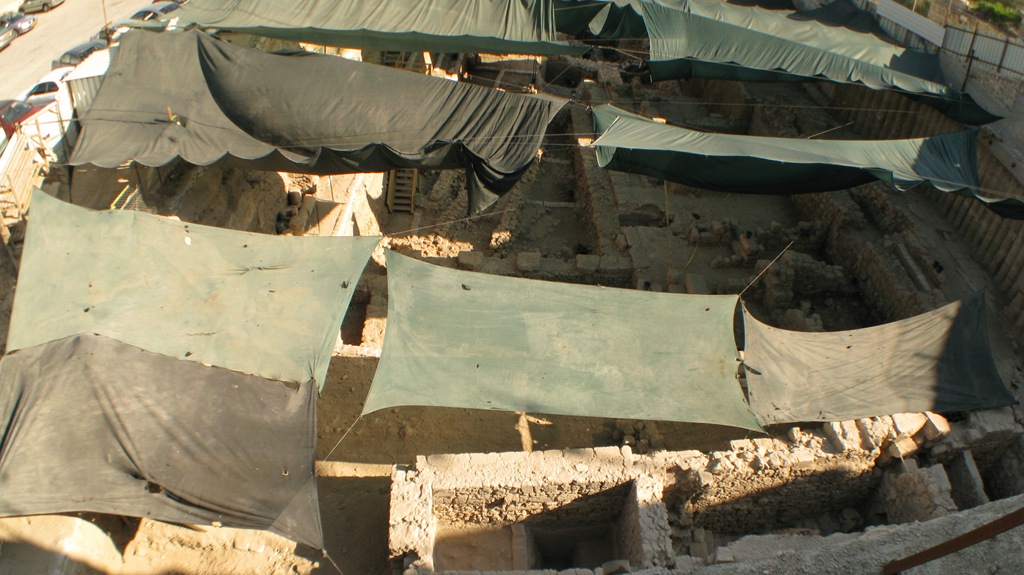
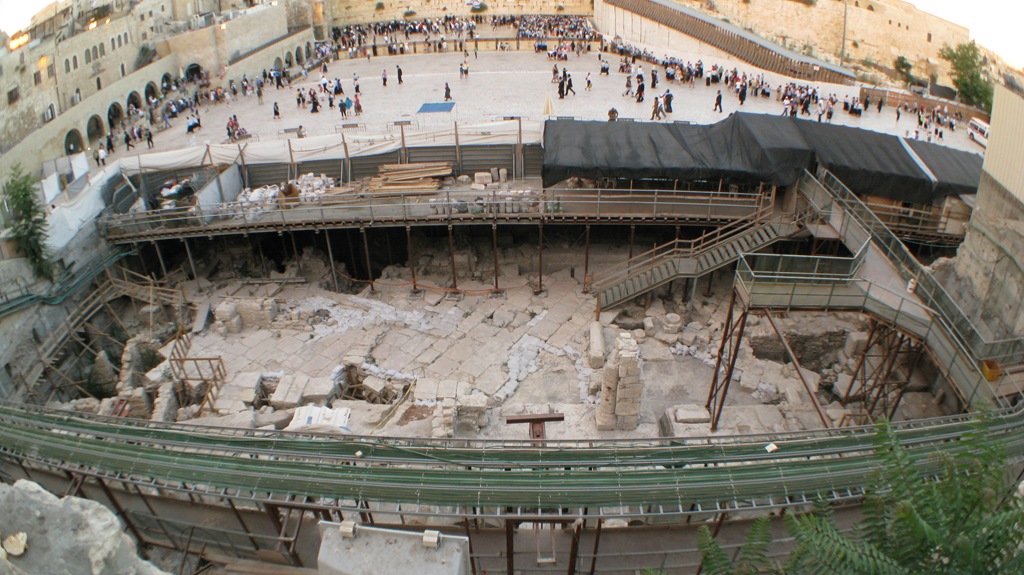
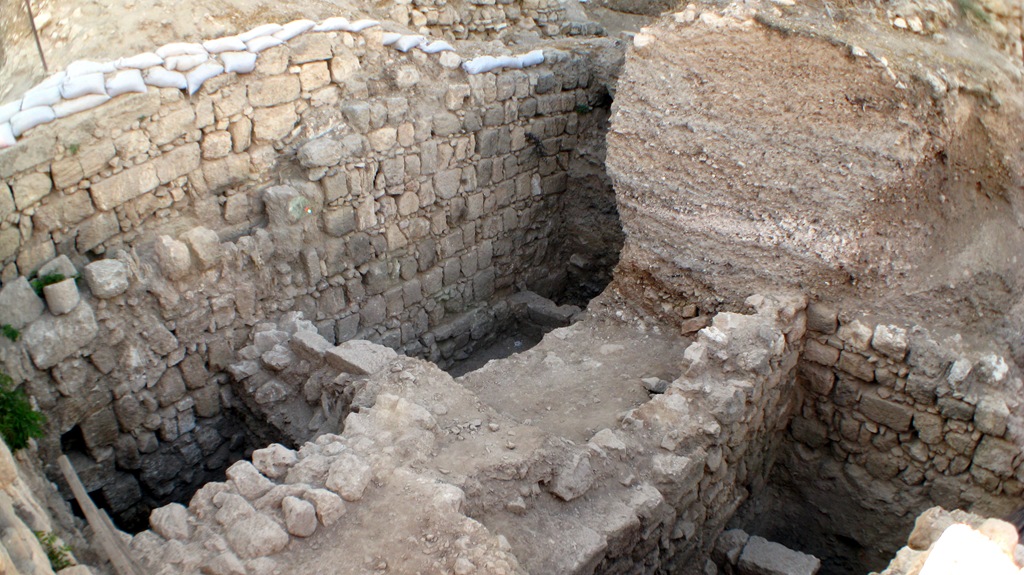
Years ago I would say that no city had been excavated more than Jerusalem.  Today I think it’s also true to say that no city is currently being excavated more than Jerusalem.  Peter Wong has shared a few photos that he took last week.

Mount Zion excavations, by Peter Wong 7014

Excavations on Mount Zion. See here for more information about the summer’s discoveries.
Tyropoean Valley excavations, by Peter Wong 6524
Excavations in the Central (Tyropoean) Valley. See here for the report of the discovery of Queen Helene’s palace in this area.

Western Wall excavations, by Peter Wong 6097

Excavations in the Western Wall plaza.  See here and here for earlier photos.
Share:

New Scientist has a popular version of an article in the Journal of Archaeological Science about recording the locations of archaeological artifacts using acoustic signals.

Every object unearthed by an archaeological dig must have its exact position recorded. This is normally a painstaking process involving measuring rods and string, but a device that uses technology originally developed to guide robots could speed up the process.
Gran Dolina in central Spain is a Palaeolithic site that contains important hominin remains which date from between 780,000 and 300,000 years ago. Thousands of fossils are discovered there every year, but registering them all by hand makes progress frustratingly slow. So archaeologists working on the site contacted Angélica de Antonio Jiménez and Fernando Seco at the Institute of Industrial Automation in Madrid, to see if they could come up with a better way.
Antonio Jiménez and Seco were working on an ultrasound system to help blind people and robots navigate, in which a mobile transmitter sends signals to a network of fixed nodes. The time taken for the signal to arrive at each node determines the precise location of the transmitter. To adapt the system for archaeological sites, Antonio Jiménez developed a 2-metre-long pointer, like a big pencil, to act as the transmitter. To prevent the user’s body blocking the signals, it has two transmitters, one at the top and one 70 centimetres below it.
When a researcher finds an object, they trace its outline with the pointer, transmitting ultrasound data to a network of nodes above the site.
Software then reconstructs not only the position of the object, but also its size, shape and orientation, to an accuracy of about 5 millimetres (Journal of Archaeological Science, DOI: 10.1016/j.jas.2009.06.027).

The New Scientist article continues here.

HT: Joe Lauer

Share:

Ferrell Jenkins has posted a few photos from the current excavation of Khirbet Qeiyafa.  If that name sounds vaguely familiar, it may be because I wrote a number of posts about this site last summer (start here), suggesting that it may have been the location of the Philistine encampment at Ephes-dammim.  The excavator believes that the site is biblical Shaaraim.  I am pretty confident that it is not Shaaraim and look forward to the time when I can articulate my reasons more carefully.  In the meantime, you can see an impressive photo of a gatehouse as well as a glass bottle discovered at the site this season.

Share:

I’m a day late on this article, but some will undoubtedly be interested anyway.  From Arutz-7:

The Temple Institute will begin building the sacrificial altar on Thursday, Tisha B’av, a fast day when Jews mourn the destruction of the Temple some 2,000 years ago. The sacrificial altar was located in the center of the Temple, and upon it the Kohanim (priests) offered the numerous voluntary and obligatory sacrifices commanded in the Bible. The Temple Institute, which has already built many of the vessels for the Holy Temple, such as the ark and the menorah, has now embarked on a project to build the altar. Construction begins Thursday in Mitzpe Yericho (east of Jerusalem) at 5:30 p.m. “Unfortunately, we cannot currently build the altar in its proper place, on the Temple Mount,” Temple Institute director Yehudah Glick said. “We are building an altar of the minimum possible size so that we will be able to transport it to the Temple when it is rebuilt." Even a minimum size altar will work out to be approximately 2 meters tall, 3 meters long, and 3 meters wide. Workers have collected around 10 cubic meters of rocks weighing several tons already. The rocks were gathered from the Dead Sea area and wrapped individually to assure they remain whole and are not touched by metal, as the Bible requires. “The Torah says that no iron tools should be used on the altar’s stones,” Glick explained. “The altar represents a connection to life and to the creation of the world. Iron is the opposite – it is used to build tools of war, death, and destruction.”

The story continues here and includes a photo, a video, and an illustration.

Share:

On the traditional anniversary of destruction of Jerusalem’s two temples, Stephen Rosenberg writes an article in the Jerusalem Post on the evidence for the existence of the temples in light of the Muslim denials.

There is a persistent narrative by the Islamists to deny any past Jewish presence on what they call Haram al-Sharif. Like the cult centers of Mecca and Medina, they call it the Noble Sanctuary rather than the Temple Mount. The propaganda is spreading throughout the Arab world, and would deny any legitimacy to our claim to have experienced the destruction of two Temples on the site. All the evidence, the propaganda goes, is written by Jews and is therefore suspect. The claim for the building of the First Temple comes from the Book of Kings. It is a detailed description, but nothing of the structure has been found. The inscription on a little pomegranate showing it to have been part of a priestly scepter from the First Temple has recently been denounced as a later forgery. The parallels with temples in Syria are fine, but no proof that one existed in Jerusalem. What evidence is there that a Jewish Temple was destroyed by the Babylonians? There is a tablet in the British Museum that Nebuchadnezzar came to Jerusalem in his seventh year (597 BCE) and captured the city, but he destroyed no temple and only set up a "king of his own heart" (Zedekiah). The tablet goes up to the year 594 and then stops. The following years are missing and the next tablet restarts in 556 BCE. The crucial year 586 is lost.

The article continues here.

Share: