As you might have guessed, one afternoon is all the time they need to discuss the contributions of Robert Alexander Stewart Macalister. From the Agade list:


R.A.S. Macalister’s Contributions to the Archaeology of Palestine 100 Years Later: An Evaluation

Workshop to be held at the W.F. Albright Institute of Archaeology, 26 Salah ed-Din Street, Jerusalem on Thursday, December 13, 2012

1:15 Light refreshments

1:30 Welcome and Introduction, Sam Wolff, Israel Antiquities Authority and Albright Institute


Tel Gezer

1:40 Jonathan Tubb, Keeper, Middle East, The British Museum, R.A.S. Macalister: Villain or Visionary?

2:10 William H. Dever, Professor Emeritus, University of Arizona, A Response to Jonathan Tubb (to be read by S. Gitin)

2:25 Baruch Brandl, Israel Antiquities Authority, Are the Finds from Macalister’s Gezer I-III Still Relevant for Current Research a Century Later?

2:40 Tsvika Tsuk, National Parks Authority, Digging in Macalister’s Footsteps: The Gezer Water System

3:00 Eric Mitchell, Southwestern Baptist Theological Seminary, The Gezer Survey: An Assessment of Macalister’s Work (to be read by S. Wolff)

3:15 Discussion

3:30 Break


Jerusalem and Judean Shephelah Sites

3:45 Shimon Gibson, University of the Holy Land R.A.S. Macalister: with Bliss at Tell el-Judeideh
and with Duncan at Jerusalem

4:15 Oded Lipschits and Yuval Gadot, Tel Aviv University “Kabdehu veChasdehu” (“Respect Him but Suspect Him”): Digging Azekah after 113 Years

4:30 Amos Kloner, Professor Emeritus, Bar-Ilan University Subterranean Complexes at Mareshah and Additional Notes on the Judean Shephelah Hiding Complexes

4:45 Aren Maeir, Bar-Ilan University and Rona Avissar, Albright Institute, Bliss and Macalister’s Work at Tell es-Safi: A Reappraisal in Light of Recent Excavations

5:00 David Ussishkin, Professor Emeritus, Tel Aviv University and Ronny Reich, University of Haifa, concluding remarks, followed by discussion

The workshop is open to all interested scholars. Please RSVP your intention to attend to Sam Wolff (sam at israntique.org.il).

Gezer Calendar large replica, tb070506092
A replica of the Gezer Calendar, found in the Macalister’s excavation dump
Share:

A press release from the American Friends of Tel Aviv University announces the recent discovery of a holy place that was not always a holy place.

Tel Aviv University researchers have uncovered a unique 11th-century BCE sacred compound at the site of Tel Beth-Shemesh, an ancient village that resisted the aggressive expansion of neighboring Philistines. The newly discovered sacred complex is comprised of an elevated, massive circular stone structure and an intricately constructed building characterized by a row of three flat, large round stones. Co-directors of the dig Prof. Shlomo Bunimovitz and Dr. Zvi Lederman of TAU’s Sonia and Marco Nadler Institute of Archaeology say that this temple complex is unparalleled, possibly connected to an early Israelite cult — and provides remarkable new evidence of the deliberate desecration of a sacred site.
[…]
After ruling out the use of the site as a domestic structure, the researchers knew that they had found something unique. Excavations revealed almost only shards of painted chalices and goblets found spread on the floor but no traces of domestic use. One of the three flat stones was surrounded by animal bone remnants, and the two other stones were seemingly designed to direct liquids. These clues convinced Prof. Bunimovitz and Dr. Lederman that they had uncovered a likely place of sacred worship.
But the temple didn’t remain sacred. Samples of earth taken from layers above the destroyed temple and analyzed at the Weizmann Institute of Science revealed astonishing results. Directly above the temple was a packed-in layer containing phytoliths (remains of weeds that are commonly eaten by livestock) and spherulites (microscopic remnants of manure produced by grass-eating animals), indicating the presence of animal pens directly on top of the sacred site, explains Prof. Bunimovitz. Intermittent burning in order to clean the pens likely resulted in the concentrated state of the layer.
This desecration was no accident or coincidence, the researchers believe. Instead, it represents the see-saw of political might between the Philistines and the local population. Presumably the Philistines gained temporary control of Beth-Shemesh, and brought in livestock to live on what they knew had been a sacred site to their enemies.

The article does not mention Samson, but this is roughly the period when he lived in the town across the valley.

HT: David Coppedge

Zorah and Eshtaol from Beth Shemesh, tb062300343
View from the excavations of Beth Shemesh towards Samson’s place of birth and burial
Share:
Jerusalem Old City western wall, tb051908285

The title of this article at the Jerusalem Post will get your attention, but it’s a bit misleading. If you think of it primarily as ways to leave Jerusalem, it’s more accurate. The top 5 are:

  • Segway
  • ATV
  • Bike Tours
  • Jeep Tours
  • Horse-riding
The article gives more details and includes phone numbers. If you want to see Jerusalem, you really need to walk.

HT: Charles Savelle

Share:

The Associated Press reports on the Carchemish excavations. Six photos are featured. (A version with photos embedded is here.)

NT Blog: The Jesus’ Wife Fragment: How the Forgery Was Done

Logos Bible Software, my Bible study program of choice for more than 15 years now, has released version 5. The Biblical Studies and Technological Tools blog is reviewing it. In Part 1, Mark Hoffman provides excuses for upgrading, and in Part 2, he gives reasons, with plenty of illustrated examples.

Eisenbrauns’ Deal of the Weekend is Exploring the Longue Duree: Essays in Honor of Lawrence E. Stager. Don’t let the title fool you: there are many interesting articles in this book. (Click on the Table of Contents link for a full list.)

Share:

(Post by Seth M. Rodriquez)

Perhaps the most curious volume in the revised and expanded Pictorial Library of Bible Lands is the last one: Volume 18, “Signs of the Holy Land.” If you have never visited the Holy Land, then you don’t know what you’re missing! If you have been there, then you can imagine what humorous (and not-so-humorous) signs you can find in this collection.

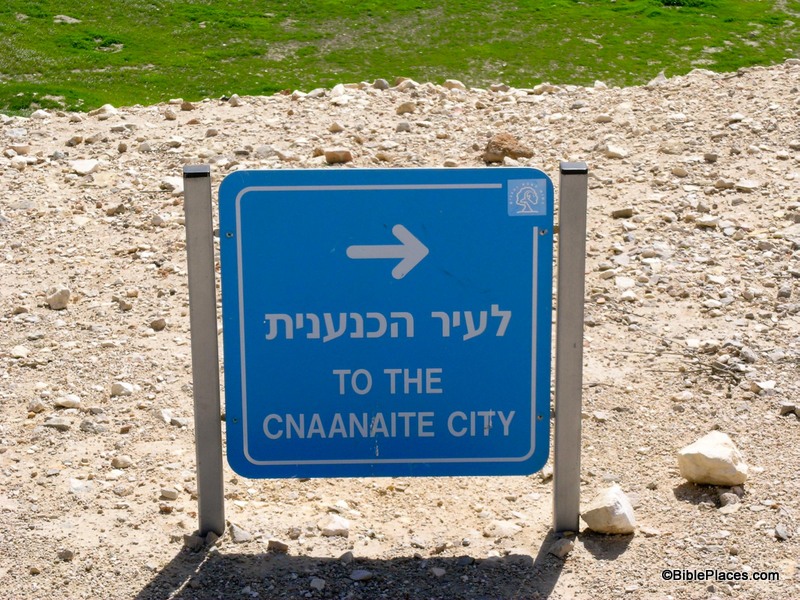
It goes without saying that English is not the primary language of any of the biblical regions today, so the charm of many of these signs lies in the fact that the grammar, spelling, and choice of words are frequently not the most eloquent. “This Holly Church,” “Danger of Death,” “You Are Hear,” and “Bewar of Loose Rocks” are just some of what you will find when you visit the Holly Land … I mean, Holy Land.  Or perhaps you will run across this one:

With directions like these, it’s no wonder the Israelites had to wander in the wilderness for 40 years. (How do you even pronounce that?!)

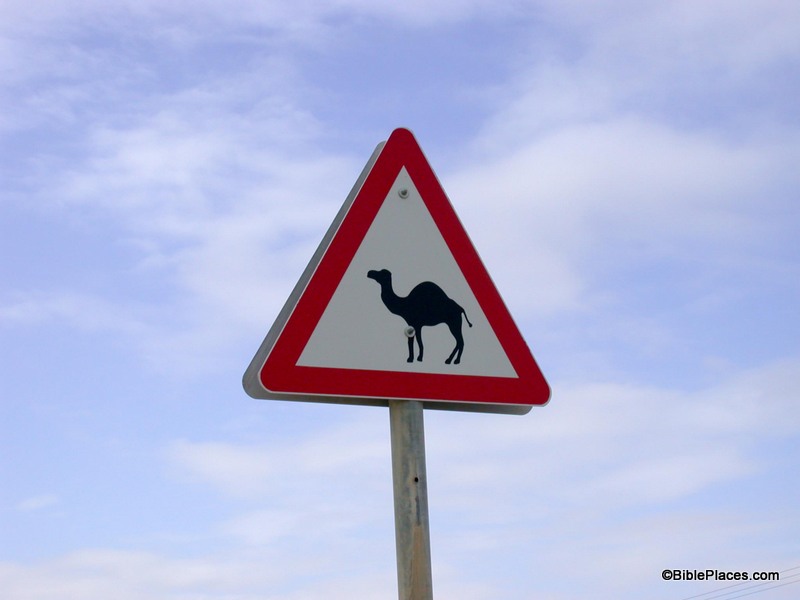
Another source of their charm is in the cultural differences that they reveal. Some of these differences are rather serious: such as signs requiring modest clothing in certain areas, signs warning you of a mine field, or signs of Jews denouncing Arabs or of Arabs denouncing Jews. But some of these are quite humorous, such as “Temptation Restaurant” in Jericho (near the traditional Mount of Temptation), signs forbidding honking, an advertisement for windsurfing on the Sea of Galilee, and “Do not play soccer on the grass!” (You can just hear the municipality’s frustration with the local youth in that last one.) Or, one of my personal favorites, this sign for a camel crossing taken by Daniel Frese:

Perhaps we are not as far removed from the time of Abraham as we think we are.

Yet much of their charm comes from the fact that these are modern signs that often reference biblical people, places, and events. One of the values of visiting the Holy Land is that it helps you connect with the Bible in a unique way because you are there. You are in the same place where the drama of the Bible unfolded. Seeing road signs that reference the cities of Jerusalem, Bethlehem, Jericho, Nazareth, Tarsus, or Corinth drives home the point that you are in the land of the Bible. You also will see streets and shops named after biblical events or people. 

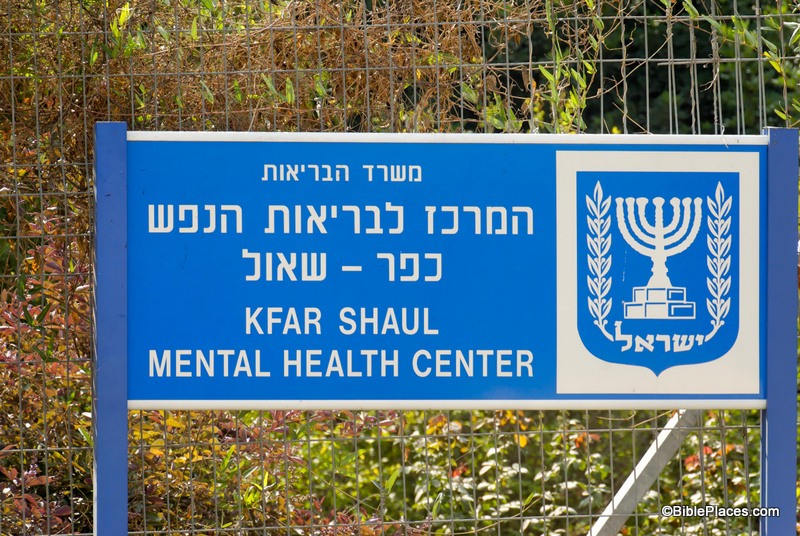
Much of this volume of the PLBL is devoted to such signs. Biblical people, places, and events are part of the lifeblood of these cultures and this is evident in how they name things. Most of the time, these references are intentional and add dignity to a place. However, I’m not sure that the people who named the “Kfar Shaul (Village of Saul) Mental Health Center” really thought through all the biblical associations:

If only this place had existed in Saul’s day then maybe he wouldn’t have needed to hire David to play music for him (1 Sam. 16:14-16).

There are so many interesting signs in this collection that I couldn’t narrow it down to just one for this post, so once again I broke tradition by giving you three. And although this volume may be one of my personal favorites, you may be wondering, “What in the world would I use these pictures for?” So here are some ideas for you …

  • Ice Breakers for a Lesson or Sermon
  • Teaching Illustrations
  • Humor
  • Attention Grabbers
  • Demonstrating the Relative Geographical Location of One Site to Another (using highway signs)
  • Hebrew or Arabic Vocab Lessons and Tests (gleaned from real-life examples)
  • Lessons in Jewish and Arab Culture
  • Decorative Art for a Bulletin or Brochure

I’m sure the readers of this blog can think of more uses than that, and you are welcome to leave your ideas in the comment section. Until next time … drive safely, watch out for passing camels, and (as one sign in Cyprus puts it) remember that “Driving in the lake is forbidden.”

These and other photos of “Signs of the Holy Land” are included in Volume 18 of the Pictorial Library of Bible Lands and can be purchased here.

Share: