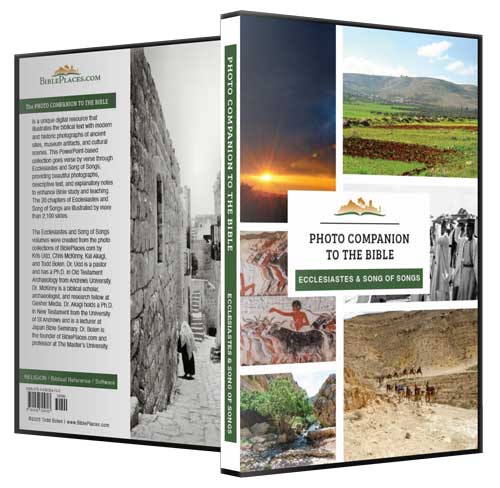
This week we released new photo collections for Ecclesiastes and Song of Songs. If you like to stay up-to-date on our latest resources, the BiblePlaces Newsletter is the place to do that. (Subscribe here.)

If you click over to this week’s newsletter, you’ll see some of the beautiful photos, read three kind endorsements, and learn about a 2-for-1 deal ending soon. For less than $40, you can get more than 2,000 photos, all organized and ready for learning and teaching. Do you think that Solomon might have liked something like this? I hope he wouldn’t say that it’s all just vanity. 🙂 In any case, take a look here. And if you know someone who might enjoy such a resource, let ‘em know. Thanks!
Share:

Archaeologists uncovered portions of a monumental relief of the Assyrian king Ashurbanipal in the throne room of his palace in Nineveh.

Christopher Jones explores questions related to Sennacherib’s assassination.

Scientists have discovered the evidence for leprosy that dates to the third millennium BC.

In a new study on Pompeii, “scientists documented events at one home in the doomed city where a family sought refuge inside a back room by pushing a wooden bed against a door in a vain attempt to stop a flood of volcanic rocks from the sky.”

Turkish authorities arrested four individuals who had discovered a Roman mosaic during illegal excavations at their house.

“Gojko Barjamovic, a lecturer at Yale University, along with a team from Harvard, deciphered and even attempted to recreate some of the dishes detailed on Babylonian clay tablets dating back nearly 4,000 years.”

David M. Pritchard explains why “sport in ancient Athens was much more than the Olympics.”

Aish.com has published a primer on the Cairo Geniza.

“The ancient bilingual inscriptions of Karatepe Aslantas Open-Air Museum in Osmaniye, Türkiye, have been officially inscribed into the UNESCO Memory of the World International Register.”

“Friends of ASOR is pleased to announce its first tour of some of Chicago’s greatest museums on September 18 and 19 for an exclusive behind-the-scenes experience.”

Live Science explains how archaeologists can determine the sex of a skeleton.

HT: Agade, Gordon Franz, Ted Weis, Arne Halbakken

Share:

An Israeli team began excavations of Samaria-Sebaste this week. Some consider the excavation of ancient Israel’s capital to be a hostile takeover of Palestinian heritage.

Archaeologists working at the Roman cemetery at Legio near Megiddo have uncovered the jaws of thirteen pigs in what they believe was remains of a funerary banquet.

Jewish veterans from the Roman army — and not Shimon Bar Kochba — may have initially led the 2nd-century Jewish rebellion against the Romans commonly known as the ‘Bar Kochba Revolt.’”

“Two enigmatic 1,500-year-old human figurines carved in rare ebony wood from India or Sri Lanka and likely made in Africa have been uncovered in the Negev.” The underlying journal article is here.

A new study has found that “the Kingdom of Israel had much greater name variety than the southern kingdom, hinting at deeper social differences.” The underlying journal article is here.

“Police arrested nine Jewish men who tried to smuggle a sacrificial goat onto the Temple Mount in Jerusalem Monday afternoon.”

The Jerusalem Post runs a short article about the road between the Pool of Siloam and the Temple Mount.

New release: Readers of the Lost Ark: Imagining the Ark of the Covenant from Ancient Times to the Present, by Kevin M. McGeough (Oxford University Press, $35; Amazon). Free chapter here.

Bible Mapper Atlas has created a (free) poster map of the tribe of Manasseh (west of the Jordan) and its surroundings, circa 1200 BC.

HT: Agade, Gordon Franz, Ted Weis, Arne Halbakken

Share:

(Post by A.D. Riddle)

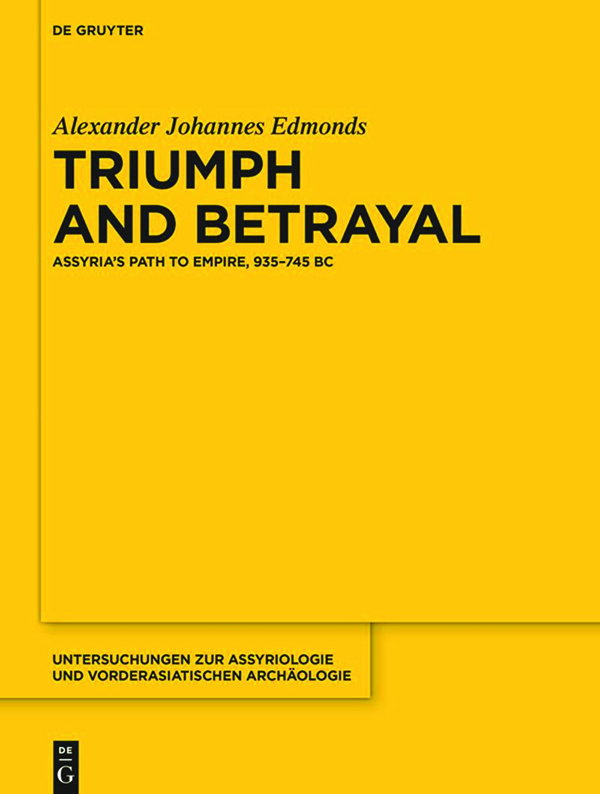
In the previous weekend’s Roundup, Todd mentioned a new book entitled Triumph and Betrayal: Assyria’s Path to Empire, 935–745 BC, by Alexander Johannes Edmonds (2025). It is available as a free download (pdf or epub) from the publisher, De Gruyter.

I began reading Edmonds this past week, and learned quite early in the book that the author makes the astonishing claim that three previously-unknown kings from the Neo-Assyrian period have been identified—two by Edmonds and one by Eckart Frahm. (I say “previously unknown,” but that is to say unknown to scholarship of the past few centuries—obviously Assyrians from the 8th–10th centuries BC would have known about them.) Edmonds states that the presence of these “new” kings “serves to explain previously enigmatic periods within Assyrian history.” It will be interesting to see what kind of response Edmonds’ work receives. Time will tell.

For comparison, here are the two lists of kings compared side-by-side. The names in pink are the newly-identified kings. If there is a new Tiglath-pileser and a new Shalmaneser, that will make quite a mess out of all my notes and teaching materials.

Share:

Archaeologists working at Knossos, Crete, have discovered the longest known inscription in Linear A script.

Archaeologists have discovered defensive structures and military housing at Tell Abu Saifi in northern Sinai.

Scholars have confirmed that one of the Herculaneum papyri as a work written by the Greek philosopher Philodemus.

A scholar claims that he has discovered previously unidentified hieroglyphics on an Egyptian obelisk located in Paris.

A treasure hunter claims to have discovered the actual location of the Council of Nicaea and is willing to disclose it for payment of $50 million.

“The painstaking restoration of glass and ceramic artifacts from the Hatay Museum damaged during the devastating earthquakes in February 2023 earthquake in Turkey is underway.”

“Starry paintings found on ancient Egyptian coffins and tombs indicate that the sky goddess Nut was closely associated with the Milky Way galaxy, according to a new study by an astronomer.”

“Jordanian authorities evacuated hundreds of tourists from the ancient city of Petra on Sunday after heavy rains caused flash floods.” Here’s another video.

“A National Endowment for the Humanities grant to create the first scholarly edition of one of the great classics of biblical literature, the Psalms” has been cancelled.

Turkish Archaeological News surveys major stories from the month of April, including:

HT: Agade, Gordon Franz, Explorator

Share:

“Israel on Monday began long-delayed renovation and maintenance work at the Little Western Wall, a lesser-known section of the Western Wall located in the Muslim Quarter of Jerusalem’s Old City.”

A flash flood on Sunday caused severe damage to the Ein Gedi Nature Reserve. The park is now closed for restoration.

Also on Sunday, a brushfire broke out at Tell es-Safi/Gath.

Ruth Schuster has written a lengthy article about the excavations at Chorazin, including the “pay to dig” opportunity that’s been running there for more than a decade now.

Newly released: Bet Shean V: Hellenistic Nysa-Scythopolis Part 1: Stratigraphy and Architectureand Part 2: The Finds and Conclusion (IAA Reports; free download)

Hybrid lecture at the Albright on July 2: “Amorites, Their Origins, and Their Legacy,” by Aaron A. Burke

“A leading archaeology journal [Palestine Exploration Quarterly] has effectively barred submissions by Israelis on Judea and Samaria unless they ‘have cooperated with the relevant Palestinian authorities.’”

Bryan Windle interviews Joan Taylor in the latest installment of the “Scholar’s Chair” series. Among other things, she discusses her new book, Boy Jesus.

The Biblical Museum of Natural History sells archaeology-themed board games and a kosher box of locusts.

HT: Agade, Gordon Franz, Explorator

Share: