There is an Israeli police station today just inside Jaffa Gate to the right. The Israelis took it over from the Jordanians who used it for the same purpose. The Jordanians inherited it from the British Mandate authorities. One of the buildings of this complex is known as the Kishle. The Kishle served as the prison during British Mandate times. Before the British, the building served the Ottoman police force. And before them, this was the location of the Roman legion charged with keeping the peace in the centuries following the Jewish Revolt. And below that archaeologists have discovered foundations of King Herod’s palace.

There’s clearly a pattern here, and it’s likely related to the geography. This area is the high ground on the Western Hill, and it provides a commanding position of the surrounding area. Unfortunately all of this construction has made uncovering earlier remains difficult. In fact, in the conclusion of the article being summarized here, the archaeologist soberly notes that all that left of Herod’s great palace are scattered remnants of its podium.
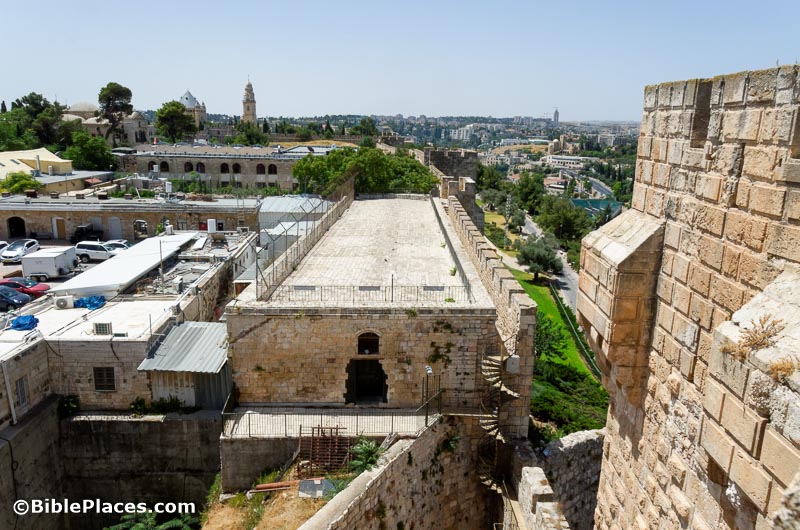
Kishle building from the north

Amit Re’em excavated the Kishle in 2000 and 2001, and his report in Ancient Jerusalem Revealed provides a summary of his discoveries. The article is succinct and well-illustrated, moving from the earlier periods to the later ones. My focus here will be the same as that named in the title of the article, “First and Second Temple Period Fortifications and Herod’s Palace in the Jerusalem Compound.”
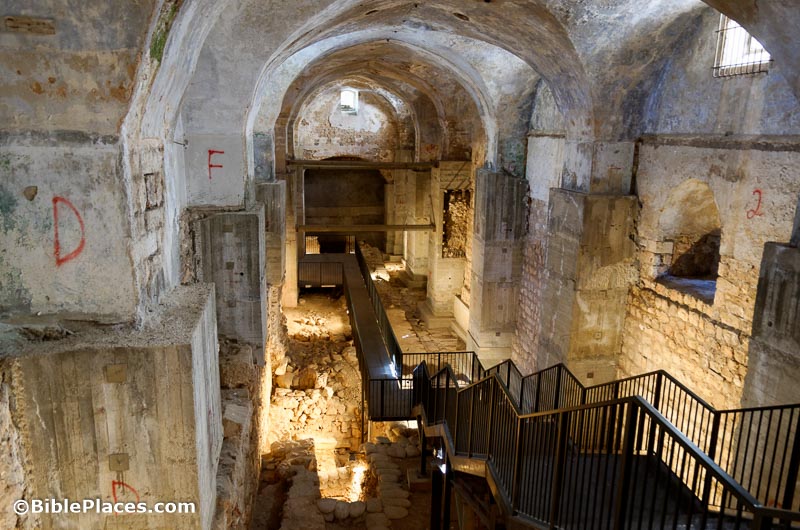
Kishle interior

What gets me most excited about this excavation is not the foundations of Herod’s palace but a large section of wall constructed by Hezekiah. If you have studied Jerusalem’s history, you know of the “Broad Wall,” a 25-foot-wide fortification located today in the middle of the Jewish Quarter. What Re’em revealed is more of this same wall, but on the western side of the Western Hill. This is valuable because this is now only the second portion of this wall discovered to date. (This point is a useful illustration of how relatively little is either preserved or accessible in Jerusalem today.)

A length of about 50 feet was exposed, preserved to a height of 8 to 9 feet. That’s not as big as the “Broad Wall” portion, but it’s quite substantial. The construction was also impressive, as the wall was made of “large, well-trimmed stones (90×35 cm.) laid in header/stretcher fashion in the best tradition of First Temple period fortification construction.”
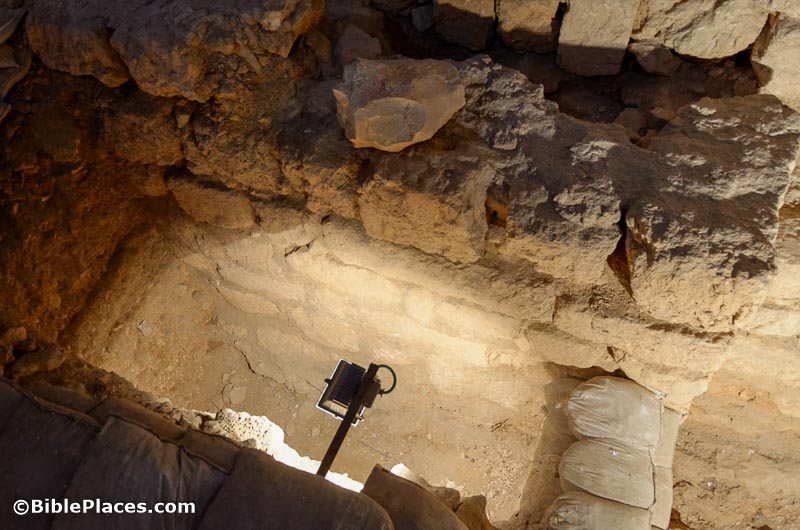
City wall from time of King Hezekiah

But then Re’em goes a step further, claiming that the common view that Jerusalem’s Western Hill was quickly populated with exiles from Samaria is wrong. I think it’s best to hear his claim in his own words:

The new finds from the Kishle contradict [previous] researchers’ conclusion that Jerusalem, limited to the area [of] the City of David and the Temple Mount, rapidly developed to occupy the Western Hill as a result of a mass influx of refugees to Judah and Jerusalem following the Assyrian destruction of the northern Kingdom of Israel at the end of the 8th century BCE. The settlement process on the Western Hill appears to have been gradual, beginning during the first half of the 8th century BCE.

Unfortunately he moves straight on to the next subject without giving a scrap of evidence for his conclusion. I would say that there is evidence in the Bible, usually ignored, that indicates that Jerusalem’s Western Hill was not only settled earlier in the 8th century, but it was also fortified! I think I’ll follow Re’em’s example by throwing that out there and then just moving on.

The Kishle excavations also revealed some of the “First Wall,” built by the Hasmoneans in the 2nd century. Re’em uncovered remains of this wall that were 16 feet wide and exposed for a length of 75 feet. It may be noted that all of these excavations are constrained by the walls of the elongated structure of the Kishle.

From Herod’s palace we have some walls, and the article gives the dimensions, the most interesting of which is one that was preserved to a height of 22 feet. The discussion here is not much more than a page long, and the bottom line is that when you combine results from this dig with others in the area, it is clear that Herod’s palace was massive in size, covering the area of the Citadel, the Kishle, the Armenian Garden, and most of today’s Armenian Quarter.
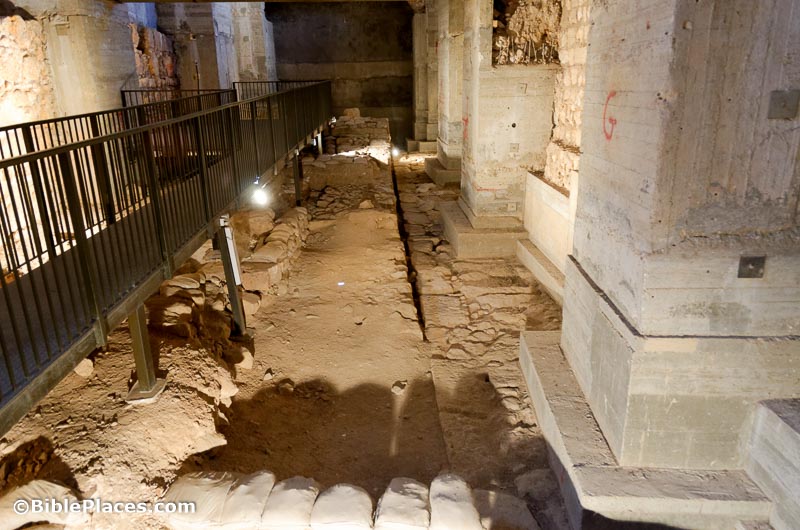
Foundation wall of Herod’s palace

The final section of this article surveys discoveries from later periods, including a Late Roman channel, medieval dyeing vats, a wall that is probably Ayyubid, and graffiti inscribed by prisoners held by the British Mandate authorities.

Share:

Archaeologists have uncovered the largest Early Bronze city in Israel. The site of En Esur is 160 acres in size and is located 7 miles (11 km) east of Caesarea.

A lengthy inscription discovered at Pompeii in 2017 has been translated. It describes a “massive coming-of-age party for a wealthy young man.”

In the ruins of the ancient Hittite capital, there is a large, beautiful green rock that is a mystery to archaeologists and visitors.

Christopher Rollston is using multispectral imagery to study ostraca discovered at Macherus in 1968.

“The British Library, the largest national library in the world by number of items cataloged, has for the first time ever put some of its rarest and most ancient religious texts online for the general public to be able to access them from around the world.”

In a 2015 article for a special edition of the BBC History Magazine now published online, Aren Maeir identifies 10 key discoveries from the Holy Land. (It seems to me to be cheating for one of those to be “the discoveries of Jerusalem.”)

A portion of the Istanbul Archaeology Museums has reopened after years of renovations.

250,000 objects from the Louvre will be moved over the next four years to a non-public storage facility in northern France.

A student volunteer describes her experiences at Hazor in the last three years.

Wayne Stiles recently led a tour to Rome, and he shares some of his observations and reflections here.

JJ Routley argues that there is such a thing as Christian archaeology.

Bryan Windle has begun a new series of archaeological biographies, and the first subject is King Hezekiah.

The Getty Trust is devoting $100 million over the next 10 years to protect endangered historical sites around the world through dialogue and conservation.

If you would like to volunteer for a winter excavation in Israel, registration is now open for the February season at Timna.

A new survey is aiming to shed light on the Nabateans who lived in what is now Saudi Arabia.

The Wadi Shuʿaib Archaeological Survey Project (WSAS) is a new project in the area northwest of Amman, Jordan.

Bryan Windle has posted a resource review of the Photo Companion to the Gospels, with a focus on how he has used the Luke volume in his preaching.

HT: Agade, Joseph Lauer, Ted Weis, Keith Keyser, Explorator

Share:

Tourism:
National Geographic has a beautifully illustrated article on the history of Jerash (ancient Gerasa).

Saudi Arabia is now giving visas to foreign tourists.

A $6 million, 9-year project has made much of Jerusalem’s Old City accessible to wheelchairs. And now you can rent a golf cart at Jaffa Gate (for $100/hour).

The entry fee for Rome’s Colosseum is jumping to €16.

Ferrell Jenkins shares a number of photos from his visit to the Brook Besor.

The first photograph of the Acropolis of Athens was taken in 1842.

I enjoyed talking about my visit to Susa on The Book and the Spade. Part 2 is now posted.


Lectures:
Peter Machinist will be lecturing on “Assyria and the Hebrew Bible: A Reassessment” at NYU on Nov 14. Registration required.

Felix Höflmayer, Katharina Streit, & Lyndelle Webster will be lecturing at the Albright Institute on Oct 31 at 4:00. Their topic:  The Austrian-Israeli Expedition to Lachish After Three Years of Excavation.


Videos:
New series on YouTube: “The Holy Land: Connecting the Land with Its Stories is a nine-episode series hosted by Dr. John (Jack) Beck that takes you to regions throughout Israel to experience the land, the culture, and the customs that surround the sacred stories of the Bible.” The first two episodes have been released, and you can see a 2-minute special feature about Jerusalem here.

The latest video from Biblical Israel Ministries and Tours: “It Happened Here” – Life Lessons from Israel: Beth Shemesh (6 min).

Appian Media is posting regularly to their YouTube channel, including some behind-the-scenes videos.

We’ll have more in part 3 tomorrow.

HT: Agade, Joseph Lauer, Ted Weis, Keith Keyser, Explorator

Share:

Discoveries:
Tablets excavated at Gezer and the nearby Tel Hadid indicate that Israelites were not living in the area following the Assyrian invasions in the late 8th century BC (Haaretz premium).

A new study by Tel Aviv University has determined that the kingdom of Edom was flourishing in the 12th and 11th centuries BC, led in part by a high-tech copper network. The underlying journal article is available here.

Tin ingots from the 13th-12th centuries BC discovered near Haifa were apparently mined in Cornwall, England.

“Egyptian authorities have unintentionally discovered several historical monuments dating back to the Greco-Roman and Ptolemaic era in roughly 20 archaeological sites in the east and middle of Alexandria.”

A temple of Ptolemy IV was discovered in northern Sohag, Egypt, while drilling for a sewage drainage project.

An archaeologist in Aphrodisias, Turkey, discovered a Roman milestone that had long been used as a table base in a coffee shop.

Excavators continue to work to expose the forum area in ancient Alexandria Troas.

Nadav Shragai reports on the Adonijah seal impression and other discoveries that have come as a result of the excavations at the foundations of the western wall of the Temple Mount.


Museums and Exhibits:
The Bank of Israel in Jerusalem has opened an archaeological exhibit featuring “several spectacular ancient coin caches,” one of which includes more than 10,000 large coins.

Two Roman statues discovered last year near Beth Shean are joining the permanent collections of the Gan Hashlosha–Sahne Museum.

The largest-ever exhibition of treasure from King Tut’s tomb will be on display at the Saatchi Gallery from November 2, 2019 to May 3, 2020.

The Palestinian Museum in Bir Zeit recently won the Aga Khan Award for Architecture. The museum does not have a permanent collection.

New York’s Metropolitan Museum is returning a beautiful gold coffin of a high-ranking priest to Egypt after learning the item was stolen and its import papers forged.


Books:
Available at a pre-pub discount on Logos: Zondervan Handbook of Biblical Archaeology, by Randall Price and Wayne House.

Two new books from the Oriental Institute:

  • Discovering New Pasts: The OI at 100, edited by Theo van den Hout. Purchase ($134). Free download.
  • 100 Highlights of the Collections of the Oriental Institute Museum, edited by Jean M. Evans, Jack Green, and Emily Teeter. Purchase ($80). Free download.

The Times of Israel reviews Jodi Magness’s new book, Masada.

The German Protestant Institute of Archaeology in the Holy Land (GPIA) has produced a catalogue of the exhibition “Tall Zirā’a—Mirror of Jordan’s History.”

In tomorrow’s roundup, we’ll cover tourism, lectures, and videos.

HT: Agade, Joseph Lauer, Ted Weis, Keith Keyser, Explorator, Jared Clark

Share:

I mentioned in my introduction to this book that Ancient Jerusalem Revealed really provides a “who’s who” in modern Jerusalem archaeology. Dan Bahat is another well-known name, having served as district archaeologist of Jerusalem for some years and having written the Illustrated Atlas of Jerusalem. Bahat is also known for his excavations of the Western Wall Tunnel, and this article provides information from more recent work.

The main point that Bahat wants to make in this article is that Amos Kloner is wrong about the dating of the arched bridge that begins with Wilson’s Arch and runs west. All agree it originally dates to the Herodian period and was destroyed by the Romans. Kloner challenged Bahat’s dating to the Umayyad period, proposing instead that was rebuilt in the Late Roman period (AD 70-330). Bahat is back to prove that he was right all along. This debate does not interest me much, so I’m going to move along.

Unlike the Triple Gate article from last week, this chapter has more illustrations. I especially like the one showing the two-story vault structure supporting the bridge, built over a couple of ritual baths with a four-sided mikveh used for the purification of vessels in the foreground. The reconstruction of the Temple Mount in the Crusader era is strange, however: I don’t think that the Dome of the Rock used to be on the northern end of the Temple Mount.

A few other discoveries round out the article:

  • A three-story Crusader building
  • A Roman-era latrine beneath the three-story Crusader building
  • A Hasmonean ritual bath beneath the latrine beneath the three-story Crusader building

Every article concludes with a selected bibliography. This one has six entries, including one by Bahat, two by R. W. Hamilton, and one by Charles Warren.

Share:

From 1997 to 1999, Yuval Baruch and Ronny Reich excavated along the southern wall of the Temple Mount. More specifically, they unearthed material in front of the Triple Gate and along the wall to the southeastern corner of the Temple Mount. Their work is summarized in a chapter they wrote in Ancient Jerusalem Revealed.

The first interesting discovery they made was of a ritual bath (mikveh) underneath the wall of the Temple Mount. Since this predates the Herodian construction, it dates to the Hasmonean period. The mikveh has a double entrance divided by a quarried pilaster. Those are my favorite kind.

A second find is more briefly described: they discovered the fragment of a Herodian doorpost that matches the western doorpost of the Triple Gate. I am sad that there was not a photo.

They also found fragments they believe belonged to the Royal Stoa on the Temple Mount above.

These were thrown down when the Romans destroyed the city. The authors don’t mention, but I will add, that it is absolutely amazing just how little is preserved of this structure that Josephus described as “more noteworthy than any other under the sun” (Ant. 15.412). BTW, if you’re looking for a handy description of the “magnificent stones and wonderful buildings” of the Temple Mount, I wrote an essay on this for the Lexham Geographic Commentary on the Gospels.

Here’s another remarkable fact: the excavators revealed some 80 meters of the Temple Mount wall east of the Triple Gate, and they determined that a sloped street ran along the top of a series of 18 vaulted shops, yet they found no actual evidence for the street itself. It is amazing to me how much of antiquity has just vanished.

I love the photo of the arches burned into the Temple Mount wall. While it was a sad day for Jerusalem shopkeepers, it provides a poignant scene of the city’s destruction in AD 70. (I have a less dramatic photo here.)

Ronny Reich is the mikveh expert, so I was interested to read his suggestion that ritual baths near the Temple Mount can be dated based upon which direction they pointed. Those quarried along a southeast-northwest axis are pre-Herodian, while those oriented north-south are Herodian. The change in orientation is owing to the dominant feature in the area: the earlier ritual baths follow the natural topography of Mount Moriah, while the later ones are aligned according to Herod’s Temple Mount.

Baruch and Reich save the best for last. They propose that the sloped street that ran from the Triple Gate eastward was used for bringing sheep into the Temple Mount for slaughter. It also was periodically used for the removal of the red heifer. In support of this is the fact that the street is sloped, not stepped, and they contend that the third gate of the Triple Gate was used for animals, not people. This, they believe, makes better sense than a 200-foot high bridge spanning the Kidron Valley.

I enjoyed reading this article, but it would have been better with more illustrations.

Share: