by Chris McKinny

Yesterday, Huffington Post released a story that re-hashed the equation that Tall el-Hammam may be identified with biblical Sodom proposed by S. Collins. While there is nothing new to report from the story and Todd and Bill Schlegel have clearly illustrated many of the difficulties with this identification, I would like to take it a step further and point out an additional geographical/toponymic problem with the Tall el-Hammam = Sodom viewpoint.
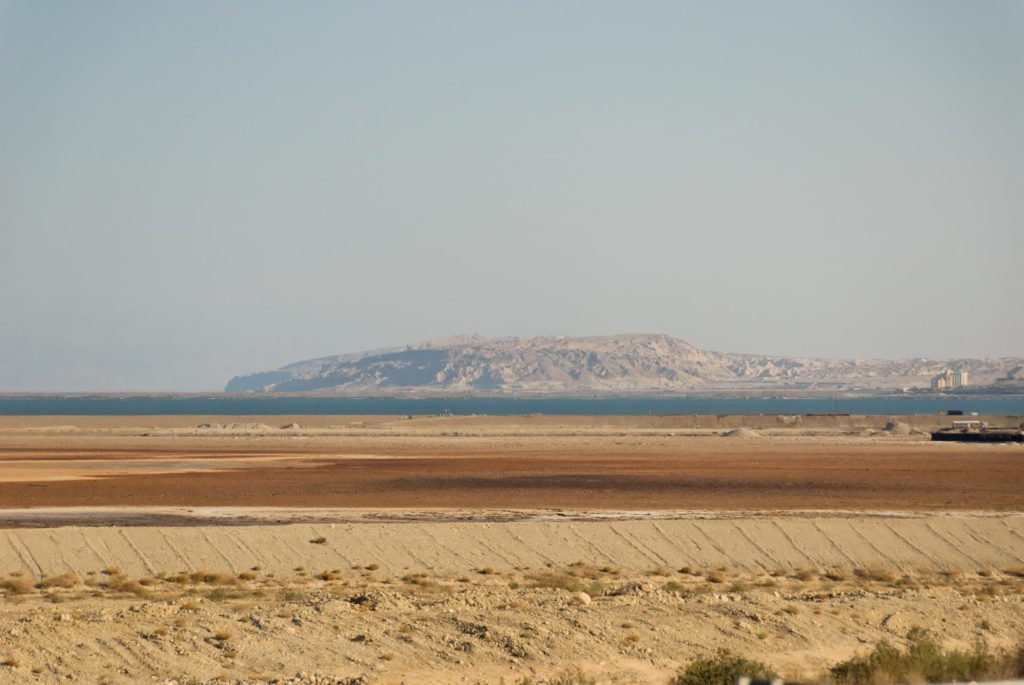
Mount Sodom (Jebel Usdum) from north – copyright BiblePlaces.com

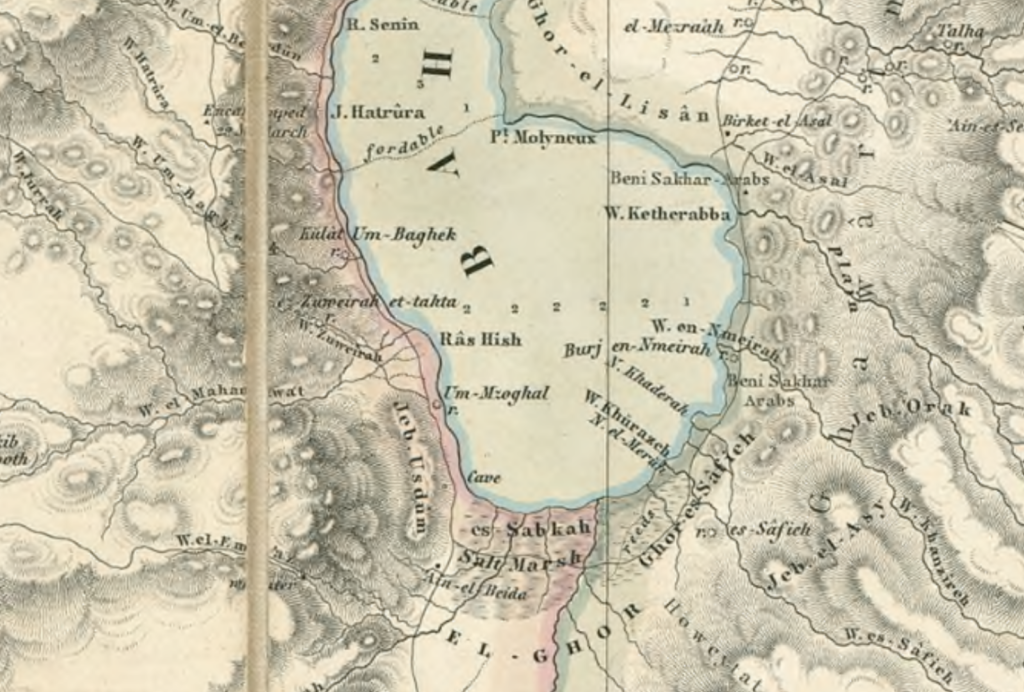
Simply put, there appears to be good toponymic evidence for the traditional references to “Mt. Sodom” that is located on the southwestern side of the Dead Sea. Researchers may be unfamiliar with this evidence, because it is absent from both the well-known Survey of Western Palestine Maps (which did not survey this part of Palestine) and the later British Mandate Map of the Negev prepared by S.F. Newcombe. In fact and somewhat ironically, this area is a bit of a black hole in the early cartographic sources of 19th and early 20th century Palestine. However, at least two sources clearly show the name “J. Usdum” in the area that is commonly referred to as Mt. Sodom. One of these sources is the lesser known map of Arabia and Petrea prepared by Alois Musil in 1900, which can be found online in three parts here. The other is a very important map prepared by Charles Van de Velde that includes the mid-19th century explorations of Edward Robinson and Charles Van de Velde and also shows the name “Jeb. Usdum” on the rocky scarp above the western shore of the Dead Sea.
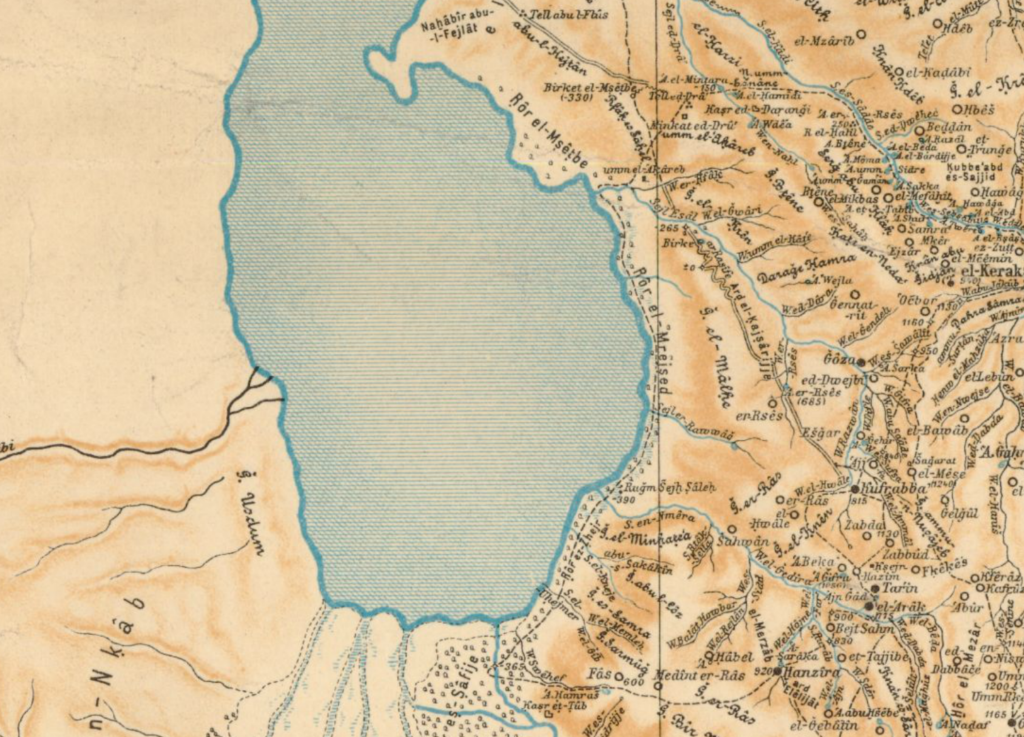
Section of Musil 1900 – Karte von Arabia Petraea – see “J. Usdum” on left side near Dead Sea
Section of Van de Velde 1865 – Map of the Holy Land – see “Jeb. Usdum” on left side near Dead Sea

To those unfamiliar with Arabic toponymy and its relation to biblical place names – Jebel Usdum would seem to clearly preserve the name “Sodom.” The toponym’s proximity to the southern candidates (e.g., Bab edh-drah, Numeirah, etc.) would at least plausibly connect them to the cities of the plain or perhaps to destroyed and then submerged cities within the Dead Sea (as originally suggested by Albright 1924:2-12). This connection finds further support in Eusebius’ description of the “Lasan” (Hebrew = Lisan [tongue]) that he describes as being “near Sodom” (Onom. 120.3). The Lisan is the boundary of the promised land below the Dead Sea (Josh. 15:2). In light of this evidence and regardless of one’s opinion regarding the historicity or chronology of the patriarchal narratives that mention Sodom, the occurrence of Jebel Usdum on the southwestern shore of the Dead Sea together with the early Christian witness to Sodom near the “Lisan” would seem to be (more) compelling evidence that Sodom and the cities of the plain should be located on the southern end of the Dead Sea.


Bibliography
Albright, W. F. 1924. The Archaeological Results of an Expedition to Moab and the Dead Sea. BASOR 14: 2–12.
Share:

ISIS has destroyed the Arch of Triumph in Palmyra.

The destruction of ancient monuments will now be considered a war crime in trials at The Hague.

An interdisciplinary team of scientists want to dig beneath the popular version of Pompeii to discover what life was really like.

Here’s more on the new lines discovered from the Gilgamesh Epic.

“Persepolis: Images of an Empire” is a special exhibit that opens next week at the Oriental Institute Museum.

Mordechai Aviam critiques Eldad Keynan’s recent article on the
“miqveh” in Upper Galilee.

The Jewish Chronicle catches up with Ron Tappy four years after he concluded excavations at Tel Zayit.

Howard R. Feldman shares a personal recollection about the Jehoash Affair on the ASOR Blog.

The Amphipolis tomb may have been the funeral shrine for Hephaestion, the closest friend of
Alexander the Great.

The Oxford Archaeology Image Database currently has 700 photos from nearly 30 sites in Iraq and it is seeking more contributions.

The first rainfall this season in Israel led to flash flood warnings in the Judean wilderness.

Netanyahu has suspended approval for the building of a museum in the Western Wall plaza.

Was the star of Bethlehem a comet? A new book makes a strong case.

A German team will repair a botched epoxy job on King Tut’s beard.

Leen Ritmeyer takes the New York Times to task for shoddy research on the Temple Mount.

Rachel Hallotte has dug up some interesting items from the attic of the Albright Institute.

HT: Agade, Ted Weis

Share:
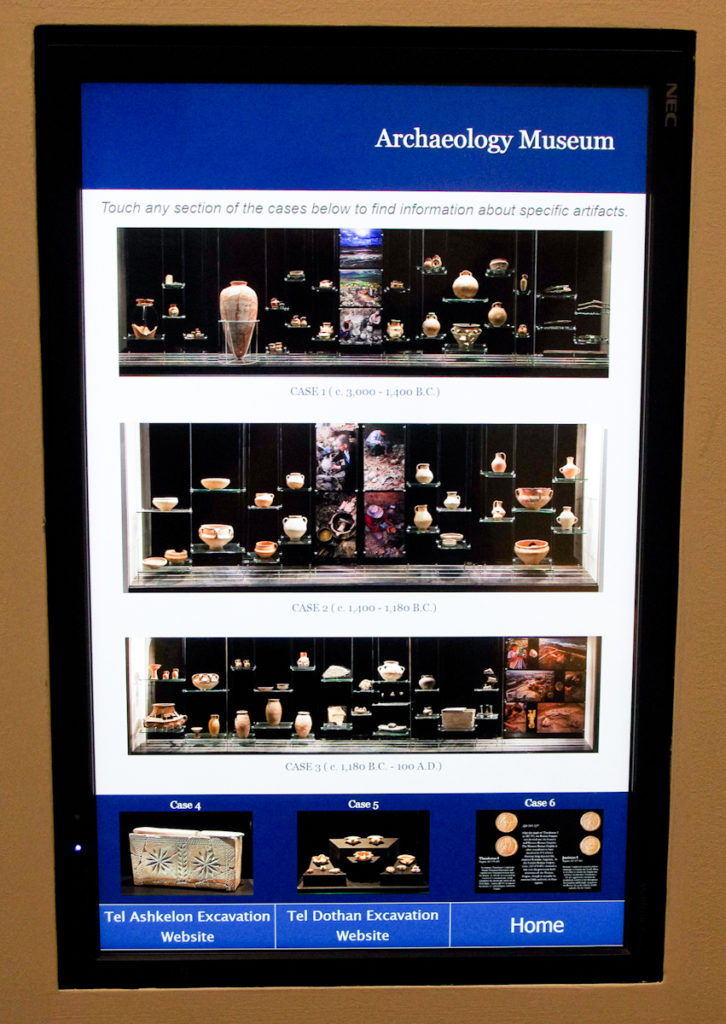
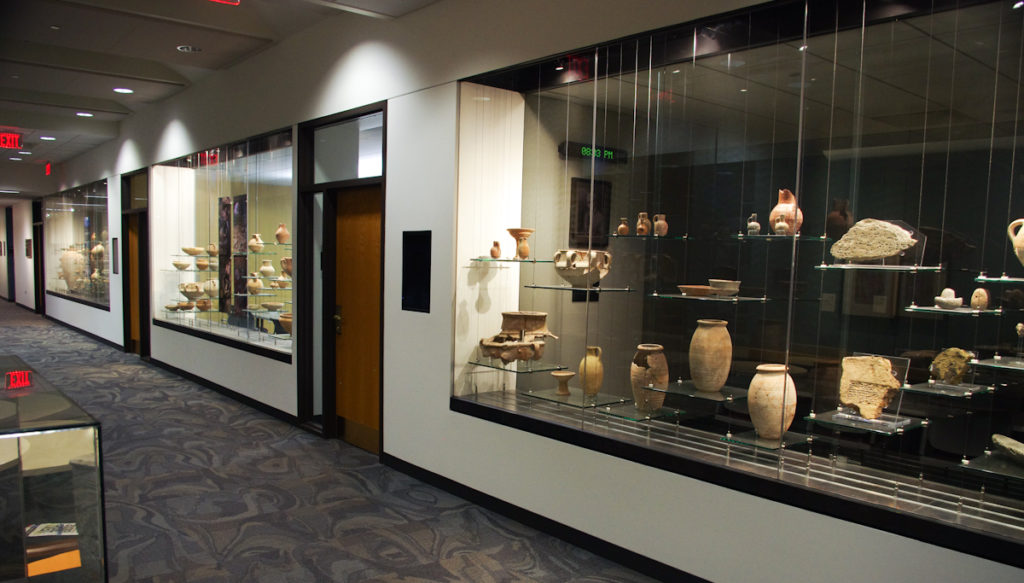
The other evening, I had the opportunity to visit the newly relocated and renovated Wheaton Archaeology Museum. For those who can make a stop, the museum is located on the fifth floor of the Billy Graham Center at Wheaton College. Many of the objects are finds from Tel Dothan, where Wheaton’s Joseph Free conducted excavations between 1953 and 1964.

The main displays consist of three glass cases built into the hallway wall. If there are no classes occupying the rooms, you can view the cases from the other side too. To read descriptions about the objects, there are two touch-screen panels. You tap on the object, and a description appears on the screen. Pretty fancy. Be sure not to miss the three smaller displays with ancient lamps, coins of Roman emperors, and an elaborately carved ossuary.

Share:

A church mosaic floor dating to AD 500 and depicting a map of Egypt has been discovered in Kiryat Gat.

There’s a growing consensus among archaeologists that the tomb of King Tut has two previously undiscovered rooms, one of which could hold the remains of Nefertiti.

A site in Gush Etzion inhabited during the Bar-Kochba era has been destroyed by vandals.

Some Arab scholars are claiming that a Jewish mafia is behind the destruction of antiquities in Palmyra and elsewhere in the Middle East.

Wayne Stiles shares some footage from his helicopter ride over Israel.

Thomas L. Thompson claims that Israel Finkelstein and William Dever are more similar to William F. Albright than they think.

Excavations at Tel Tayinat in southern Turkey suggest that the site was an ancient Philistine capital.

Leon Mauldin takes a look at the high place of Dan.

The California Museum of Ancient Art is hosting a four-part lecture series on Ancient Shipwrecks and Harbors: Great Discoveries in Underwater Archaeology.

The Biblical Archaeology Society has posted a video clip of a lecture by Robert Deutsch entitled “To Publish or Not to Publish.” Aren Maeir’s segment looks at “Archaeology During Times of Trouble.”

The November/December issue of Biblical Archaeology Review includes articles on Cana, Hippos, and manuscripts of the Hebrew Bible not quite as old as the Dead Sea Scrolls.

Please consider participating in this Survey on Field Safety.

A student shares his experience in volunteering at the Palestine Exploration Fund this summer.

This week on The Land and the Book, Charlie Dyer covers “everything you want to know about the Temple Mount.”

HT: Joseph Lauer, Ted Weis, Agade, G. M. Grena, Jared Clark, Paleojudaica

2

Mosaic in Kiryat Gat
Photo courtesy of the Israel Antiquities Authority
Share:

In Pompeii, a pre-Roman tomb dating to 4 B.C. has been found in perfect condition by French archaeologists.

A newly discovered tablet of the Epic of Gilgamesh preserves nearly twenty lines previously unknown.

The UNC Charlotte magazine features a story on the Mount Zion excavation.

Eldad Keynan examines a unique mikveh in Upper Galilee—one with a cross inscribed on the wall.

Dr. Ben Witherington paid a visit to the Greco-Roman Collection at the Art Institute of Chicago and demonstrates how artifacts illuminate our understanding of the New Testament.

Why study biblical geography? Barry Britnell suggests one, two, and three reasons.

Bryant Wood reexamines the blockage of the Jordan River.

Ferrell Jenkins explains the significance of Adullam and shares several photos of the cave.

The Virtual World Project presents interactive virtual tours of archaeological sites in Israel and Jordan. The project is designed to aid in the teaching and study of antiquity.” There’s some background here.

“Koç University’s Research Center for Anatolian Civilizations (RCAC) in Istanbul has begun an exhibition celebrating the immense contribution of John Garstang, a British scholar, on archaeology in Turkey.”

With only 2,000 gazelle remaining in Israel, the species will probably be classified as endangered.

Logos has pre-publication pricing on a new video course, AR101 Archaeology in Action: Biblical Archaeology in the Field ($50).

The early bird discount for Wayne Stiles’s Holy Land Tour ends on Monday.

HT: Agade, Ted Weis, Chris McKinny, David Bivin

Share:

Archaeologists have been sifting debris discarded from illegal excavations on the Temple Mount for more than a decade now. Yesterday they announced the discovery of a seal dating to the 10th century BC. From a press release from the Temple Mount Sifting Project:

“The seal is the first of its kind to be found in Jerusalem,” stated Dr. Gabriel Barkay, the co-founder and director of the Temple Mount Sifting Project. “The dating of the seal corresponds to the historical period of the Jebusites and the conquest of Jerusalem by King David, as well as the construction of the Temple and the royal official compound by his son, King Solomon… What makes this discovery particularly significant is that it originated from upon the Temple Mount itself.”
The seal was discovered by Matvei Tcepliaev, a ten year old boy, visiting the Temple Mount Sifting Project from Russia, and was only recently deciphered by archeologists. Since the project’s inception in 2004, more than 170,000 volunteers from Israel and around the world have taken part in the sifting, representing an unprecedented phenomenon in the realm of archaeological research.
[…]
“The discovery of the seal testifies to the administrative activity which took place upon the Temple Mount during those times,” said Barkay. “All the parallel seals with similar stylistic designs have been found at sites in Israel, among them Tel Beit Shemesh, Tel Gezer, and Tel Rehov, and were dated to the 11th – 10th centuries BCE,” asserted Barkay.
“Upon the base of the seal appear the images of two animals, one on top of the other, perhaps representing a predator and its prey. Additionally, the seal is perforated, thus enabling one to hang it from a string,” said Barkay.
Aside from the seal, which was likely used to seal documents, hundreds of pottery sherds dating to the 10th century BCE have been discovered within the soil removed from the Temple Mount. Additionally, a rare arrowhead made of bronze and ascribed to the same period by its features, has been discovered.

The press release includes photos of the seal and other finds from the same period. The organization recently released a video which documents the success of the project in a bid to raise additional funds.

HT: Joseph Lauer

Sifting Temple Mount debris, tb110906723
The Temple Mount Sifting Project in 2006
Share: