The new excavations at the Citadel of David are described by Seth J. Frantzman in an article at the Jerusalem Post. The excerpt below begins with a quotation from Amit Re’em, the Jerusalem District Archaeologist.

“He spoke of a lot of water; baths, ritual baths, pools. Herod loved water and this is proof,” says the archeologist pointing to the drainage system that goes under the Old City walls and ends at Sultan’s Pool. Re’em, energetic and constantly on the move during the tour, is fluent in all the historical geography, shifting from the story of the High Priest Annas to the tale of how Jesus was brought to the palace of Herod, according to the New Testament.
Re’em envisions tourists being greeted one day by holograms in which they will see virtually the different walls from the various periods. “In this beautiful place we can see all the archeological and historical sequence of the history of Jerusalem.”
Eilat Lieber, the general director and chief curator of the museum, has a vision for the Kishle that involves opening it to the public for tours as well as making it a center of culture.
“We want to put an exhibition about the finds with a floating glass floor [at the upper level]. What is important to us is to know about the history and create a new cultural space for activities like lectures, music and modern art, bring the past and future together.”

The full story gives more of the modern history and plans for the museum’s future.

Citadel of David with snow from west, tb012800201
Citadel of David in Jerusalem
Photo from the Jerusalem photo collection
Share:

Gordon Govier has selected the top ten discoveries for Christianity Today, putting at the head of the list: (1) Herod’s Gate at Herodium; (2) Khirbet Summeily bullae; (3) Sheshonq’s scarab.
Robin Ngo has compiled an unranked list of the top ten for the Biblical Archaeology Society.

Looking the lists over, I would conclude that if you’re into spectacular discoveries, this wasn’t your year. If you include the broader world of archaeology, you fare better with the excavation of the Amphipolis tomb.

Share:

(Posted by Michael J. Caba)

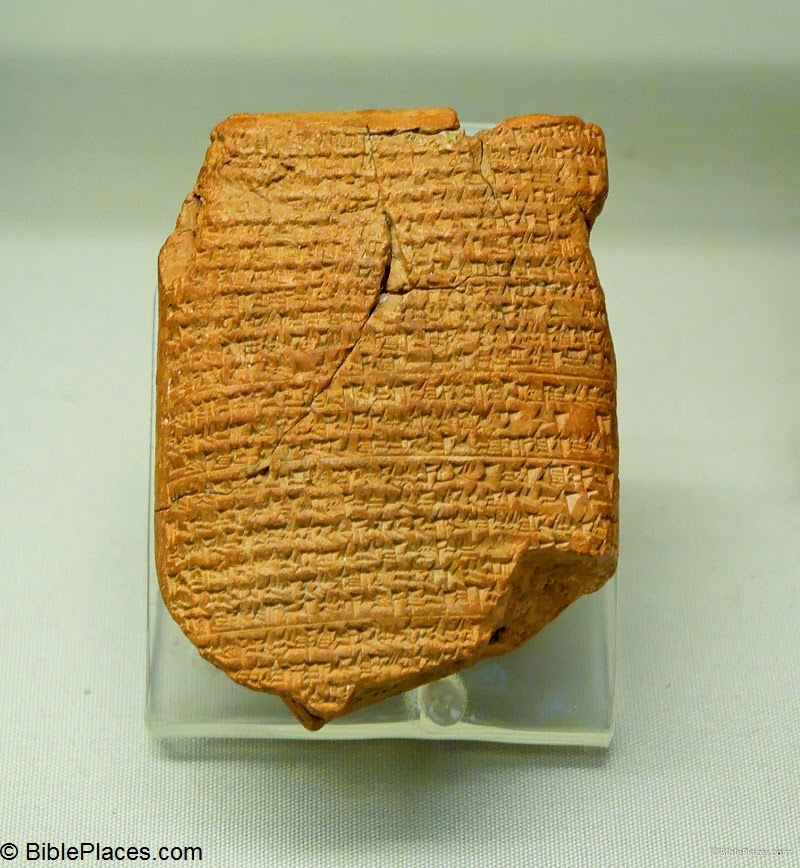
This ancient Babylonian tablet is part of the Babylonian Chronicles, which, among other events, mention the capture of Jerusalem by the Babylonians in 597 BC. The event is also recorded in the Bible in 2 Kings 24. The tablet was written in the 6th century BC and is made of baked clay. It is a little over three inches in height and the writing is in the Akkadian language using cuneiform script. It was discovered in the late 1800s in Babylon and is now located in the British Museum.

For those interested in Biblical studies, this Chronicle, which is also known as the “Jerusalem Chronicle,” covers the time frame of 605–595 BC and provides the specific date of the first capture of Jerusalem in 597 BC as recorded in 2 Kings 24.


For information on similar artifacts related to the Bible, see Bible and Archaeology – Online Museum.

(Photo: BiblePlaces.com. Significant resource for further study: Lost Treasures of the Bible, by Fant and Reddish, pages 208–11.)


Personal Note: Other duties call, so this will be the last post for a while in the “Artifact of the Month” category. Todd, thanks for this opportunity. MC

Share:

From the Jerusalem Post:

A fragment of a glass bracelet inscribed with a seven-branched menorah from the Second Temple was discovered during Hanukka at an excavation in the Mount Carmel National Park, the Israel Antiquities Authority announced Tuesday.
According to a statement from the IAA, excavations were carried out there in recent weeks prior to the construction of a water reservoir for the city of Yokne’am, at the initiative of the Mekorot Company.
During the excavation, an industrial region and refuse pits were exposed which were part of a large settlement that existed in the late Roman and early Byzantine periods, during the end of the fourth Century and beginning of the fifth Century CE, the IAA said.
The excavation’s co-directors Limor Talmi and Dan Kirzne said in the statement that last Thursday they made the findings at the end of the dig.
“While examining the contents of one of the boxes, which contained hundreds of glass fragments that had been discarded in the refuse pit, we found to our surprise a small fragment of a bracelet,” they said in a joint statement.
“Naturally it was extremely dirty, but still, you could see it was decorated. After cleaning, we were excited to discover that the bracelet, which is made of turquoise colored glass, is decorated with symbols of the seven-branched menorah – the same menorah which according to tradition was kept alight in the Temple for eight days by means of a single cruse of oil.”

The full article considers various theories of the item’s significance and includes four photos.

UPDATE: Joseph Lauer has sent along a link to seven high-res photos.

1
Bracelet inscribed with menorah
Photo courtesy of the Israel Antiquities Authority
Share:

Miriam Feinberg Vamosh has written a number of popular books  over the last couple of decades, including Daily Life at the Time of Jesus, Women at the Time of the Bible, Food at the Time of the Bible, and How Kids Lived in Bible Days. Her books are well-researched and beautifully illustrated, and I frequently recommend them to students.

Miriam has recently created a new website where you can find her latest articles and blog posts. The website also tells more about her latest book, The Scroll. This work of historical fiction describes the journey of a young woman who survived Masada.

I am happy to see Miriam make her insights more available to students of the Bible around the world.

Share:

Michael Eisenberg tells the story of trying to discover the synagogue of Sussita (Hippos).

An Egyptian cemetery may contain more than a million mummies, say BYU archaeologists. No, it doesn’t, and you’re not working here again, says Egypt’s Ministry of Antiquities.

The colossi of Amenhotep III have been re-erected at the site of his funerary temple in Luxor.

The Harvard Semitic Museum is honoring its founder with a special exhibition.

A new discovery in Galilee suggests that olive use was already in use in the Early Chalcolithic period.

The Book and the Spade features Mike Molnar explaining the star of Bethlehem mystery.

Leen Ritmeyer: Where on the Temple Mount was Jesus during Hanukkah?

How close is the new movie Exodus to the Bible? Ellen White answers: “Their story was so different
that if they didn’t use the Biblical names and released the same movie with a different title, I might not have even recognized it.”

Don McNeeley reports on the 2014 NEAS Conference in San Diego.

Our Rabbi Jesus notes a couple of free books on Greek and Hebraic thought.

Heritage Daily lists its Top 10 Archaeological Discoveries of 2014.

This will be the final roundup of 2014. We’ll try to note major stories as they break. Thanks for joining us this year!

HT: Charles Savelle, Ted Weis

Share: