A family member asked me for a brief list of major regions in the biblical world that are mentioned in the news today by other names. Since most Bible dictionaries do not have entries for the modern names, this list is intended to bridge that gap. With the ancient names in hand, you can consult a Bible dictionary for more details.
Iraq – ancient Assyria (northern Iraq) and Babylon (southern Iraq). Assyria conquered the ten tribes of the north, and Babylon conquered Judah and Jerusalem.
Iran – ancient Persia. Setting of familiar stories of Daniel in the lions’ den and Esther.
Syria – ancient Aram. Rarely united in ancient times, leading to multiple Aramean countries. The prominent one in the Bible was centered in Damascus.
Lebanon – home of the biblical cities of Tyre and Sidon and the ancient Phoenicians.
Jordan – settled in biblical times, from north to south, by Israel (tribes of Manasseh, Reuben, and Gad), Ammon, Moab, and Edom.
West Bank – the modern name for the biblical lands of Judah (Judea), Ephraim, and Manasseh (Samaria). Strangely enough, the Israelis today do not live in most of the land that was the heartland of ancient Israel.
Gaza Strip – once was part of the land of the Philistines (no relation to the Palestinians of today except in name). Most of the Philistine territory is inhabited by Jewish Israelis today, including the coastal cities of Ashdod and Ashkelon.
Golan Heights – biblical Bashan. Known for its cattle and oaks, but sparsely settled in the biblical period.
Turkey – in the Old Testament period this was home to a variety of people that are less directly related to the Bible (including the Hittites). In the New Testament times, Paul founded and worked with many churches, including those in Galatia, Ephesus, and Colossae.
Greece – Paul’s second missionary journey focused on Macedonia (northern Greece) and Achaia (southern Greece). Macedonia includes the cities of Philippi and Thessalonica, whereas Achaia includes Athens and Corinth.
Russia – this region is never named in the Bible. Some believe that references to the enemy in “the north” pertain to Russia, but I think this is unlikely. Because Israel was sandwiched between the Mediterranean Sea to the west and the Arabian desert to the east, invaders came from the south (Egypt) or the north (Assyria and Babylon).
From the Jerusalem Post:
University of Haifa archaeologists announced Monday that they have recently discovered items which have shed light on an earthquake that occurred in 363 CE in the ancient city of Hippos which overlooks the Sea of Galilee.
Hippos, near modern-day Kibbutz Ein Gev, was the site of a Greco-Roman city-state. Archaeologists digging at the Hippos excavation site, known as Susita in Hebrew, uncovered a woman’s skeleton and a gold dove-shaped pendant under the tiles of a collapsed roof. In addition, they found the marble leg of a statue and artillery from some 2,000 years ago.
“Finally the findings are coming together to form a clear historical-archaeological picture,” Dr. Michael Eisenberg, the head of the excavation said.
The excavation at the site has been ongoing for the past fifteen years. Hippos, which was founded in the second century BCE, was the site of two major, well-documented earthquakes, the first of which took place in 363 CE. The earthquake caused major damage but the city recovered. The second earthquake, in 749 CE, destroyed the city which was then abandoned, never to recover.
The full article includes photos. I don’t believe there is much dramatic archaeological evidence for the earthquake of 363, though according to fifth-century church historians, this earthquake ended efforts to build a third temple in Jerusalem. Wikipedia provides a few references. David B. Levenson recently published a more technical article in the Journal of Late Antiquity: “The Palestinian Earthquake of May 363 in Philostorgius, the Syriac Chronicon miscellaneum, and the Letter Attributed to Cyril on the Rebuilding of the Jerusalem Temple.”

South Church of Hippos, destroyed by later earthquake
Photo from Galilee and the North
Photo from Galilee and the North
An Egyptian scarab with the name of Pharaoh Shishak has been discovered in the copper mines of Feinan in southern Jordan.
Has evidence of human sacrifice been uncovered near Amman, Jordan? Hershel Shanks presents the evidence and the debate.
Also in the current issue of Biblical Archaeology Review: a survey of readers’ views of the Bible. The poll has one question and does not require registration.
ASOR is working with the State Department to identify and document destruction of ancient sites in Syria.
Dura Europos is reportedly suffering severe looting under the control of ISIS and archaeologists fear for the world’s oldest synagogue located there.
The new director of the Louvre plans to give the museum a makeover that may take decades.
Charles Savelle shares a chart comparing the crossing of the Red Sea with that of the Jordan River. I would add one more contrast: Enemies behind vs. Enemies ahead. (One of those requires more faith!)
Gordon Franz’s article on Ancient Harbors of the Sea of Galilee is now online.
Ferrell Jenkins notes that Daniel I. Block’s book, Israel: Ancient Kingdom or Late Invention? is deeply discounted for Kindle for a short time.
Martin Klingbeil will be lecturing at Southern Adventist University on “Excavating War and Destruction in Ancient Judah” on Oct. 6 at 7 p.m.
Nyack College in partnership with the Center for the Study of Ancient Judaism and Christian Origins is hosting a conference on “Unearthing Magdala” on October 20.
David Eitam will be lecturing at Yeshiva University on Monday, September 29 on “The Oil Enterprise at 7th Century BCE City-Kingdom of Ekron, Philistia: A Window into an Ancient
Levantine Economy.”
HT: Joseph Lauer, Agade

Remains of the harbor of Hippos on the Sea of Galilee
Photo from Galilee and the North
Photo from Galilee and the North
 (Posted by Michael J. Caba)
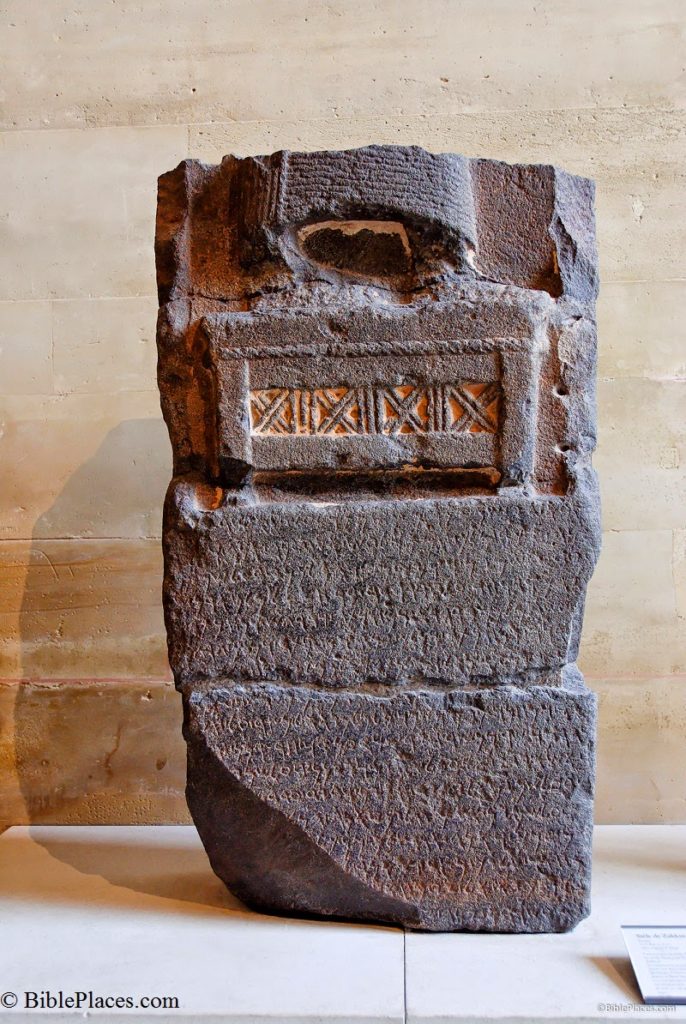
This inscribed basalt slab is known as the Stela of Zakkur. It refers to the Aramaic king Hazael who is also referred to in the Bible in such passages as 1 Kings 19:15. The item was discovered in 1903 at Tel Afis in Syria and dates to approximately 800 BC. The artifact is about 24 inches tall and the language is Aramaic. It is now located in the Louvre.
Of interest to historical studies is the interplay of the biblical text and this stela. To begin with, 1 Kings 19:15 says, “The Lord said to him [Elijah], ‘Go back the way you came and go to the Desert of Damascus. When you get there, anoint Hazael king over Aram . . .'” (NIV). In comparison to this, the text on the stela reads, “I am Kakkur, king of Hamath and Luash . . Bar-Hadad, son of Hazael, king of Aram, united against me seventeen kings . . .”
In effect, we have a web of connections linking Yahweh, Elijah, the Bible, Hazael, and this stela.
For information on similar artifacts related to the Bible, see Bible and Archaeology – Online Museum.
(Photo: BiblePlaces.com. Significant resource for further study: The Context of Scripture, volume 2, page 155.)
At the time when Jesus was born in Bethlehem, Emperor Augustus was enjoying a luxurious life on the Palatine Hill in Rome. Restorations of some of his rooms have been completed and are now being opened to the public. From ArtDaily:
Lavishly frescoed rooms in the houses of the Roman Emperor Augustus and his wife Livia are opening for the first time to the public Thursday, after years of painstaking restoration.
The houses on Rome’s Palatine hill where the emperor lived with his family are re-opening after a 2.5 million euro ($3.22 million) restoration to mark the 2,000 anniversary of Augustus’s death — with previously off-limit chambers on show for the first time.
From garlands of flowers on Pompeian red backgrounds to majestic temples and scenes of rural bliss, the rooms are adorned with vividly coloured frescoes, many in an exceptional condition.
[…]
The complex was intended to symbolise not only his power but that of his wife and advisor Livia, who is said to have wielded great influence over him and went on to play an important role in Roman politics after his death.
“Looking at the houses, the buildings he had built, we understand he was a man of power, of great strength, who knew what went into making a political man at the head of such a big empire,” Conti said.
The frescoes in Livia’s house in particular are one of the most important examples of the period’s style, according to Barbera.
The full story is here.
HT: Ted Weis

Palatine Hill in Rome
Joseph Patrich and Benny Arubas offer four reasons against identifying the mausoleum discovered at the Herodium with the tomb of Herod. Unfortunately, they do not suggest an alternative identification.
Some IAA photos of the Byzantine monastery uncovered near Beth Shemesh are available for download. [link has expired]
The oldest known Jewish prayer book just went on display at the Bible Lands Museum in Jerusalem.
3 Sea of Galilee Sites You’ll Pass But May Not See. Before you click, see if you can guess the three.
Ferrell Jenkins looks at two outstanding architectural remains in the Pergamum Museum in Berlin: the Miletus Market Gate and the Altar of Zeus.
Leon Mauldin has two illustrated posts about the two Temple boundary inscriptions: the complete one on display in Istanbul and the fragment in the Israel Museum.
The Baptist Press runs a story on the Bronze Age water system of Gezer.
Wheaton’s Archaeology Lecture Series 2014-2015 has two lectures remaining.
An electronic edition of supplementary volume of The New Encyclopedia of Archaeological
Excavations in the Holy Land is now available to all members of the BAS Library.
Subscriptions are now available to the Loeb Classical Library, but the prices aren’t cheap and you must inquire by email.
In stock on Monday: the first volume of the Dictionary of Daily Life in Biblical and Post-Biblical Antiquity, edited by Edwin M. Yamauchi and Marvin R. Wilson ($20).
HT: Joseph Lauer

Byzantine monastery near Beth Shemesh
Photo by Griffin Aerial Photography Company, courtesy of the Israel Antiquities Authority.
Photo by Griffin Aerial Photography Company, courtesy of the Israel Antiquities Authority.