How do recent archaeological discoveries relate to the Bible? Michael Grisanti addresses this issue in a detailed article published last year in the Journal of the Evangelical Theological Society and now available online. He begins with a statement from a critical scholar and then explains his own approach.

The archaeological evidence cited below and in any similar study never provides certifiable proof that a given individual lived or that a certain event took place. Our confidence in the accuracy and historicity of the people and events referred to in God’s Word draws on other evidence, primarily theological statements the Bible makes about itself. Regardless, one should recognize that the archaeological evidence does not rule out the people or events described in the Bible. As a matter of fact, archaeology provides a “picture” that points to the feasibility or plausibility that the people and events described in the Bible lived and occurred just as they are described.
[…]
Out of all the areas that could have received attention, I have narrowed my focus on two chronological periods: the Conquest of Canaan and the United Monarchy. For both I summarize the consensus of critical scholars and then consider the evidence that has been found. With regard to the Conquest of Canaan, the paper considers the recent discussion of an Egyptian pedestal with three name rings on it as well as the destruction of Jericho and the location and destruction of Ai. After surveying the heated debated concerning the United Monarchy with a focus on David and Solomon, the paper considers key archaeological discoveries found at Jerusalem, Khirbet Qeiyafa and the copper mines in southern Jordan. With each example I argue that the discoveries made at least allow for the historicity and accuracy of the biblical narratives describing those people and events.

Read it all here.

Jericho, Tell es-Sultan from west panorama, tb05110685p
Jericho from the west
Photo from Samaria and the Center
Share:

Last week we noted an article about the Temple Mount Sifting Project by Ilan Ben Zion in The Times of Israel. If you have any interest in the subject, you’ll want to read today’s response by the director of the project, Zachi Dvira. He counters charges made by three critics interviewed by Ben Zion.
Israel Finkelstein has never even visited the excavation. Yonathan Mizrachi said that the sifting project “doesn’t have any archaeological value” after he failed to get a job at the worthless project!

The only interviewee that spoke to-the-point and  is worthy of a response is Professor Marwan Abu-Khalaf, who claimed that the area from which the earth was removed was an Ottoman dump, and questioned our ability to glean information from soil without clear stratification. In our published articles we’ve already addressed these issues, including the well-known fact that the Ottoman finds come from a local dump – this being a good thing, since dumps provide the richest archaeological data from periods with no destruction phases.

And then there’s this:

Ben Zion gives an account of the contents of the introductory presentation given to visitors at the Sifting Project, and reports that there was no mention of the “Islam or Arabs, and solely emphasized the Jewish connection to the Temple Mount”. This is completely false. The reporter listened only to the beginning of the presentation, and then left due to a phone call.

I suspect that the problem, besides a certain amount of journalistic incompetence, is the desire for a story that generates lots of clicks, and for that you need controversy, not truth. I’ll keep that in mind before I recommend articles by this author in the future.

Read Dvira’s full response here.

HT: Joseph Lauer

Share:

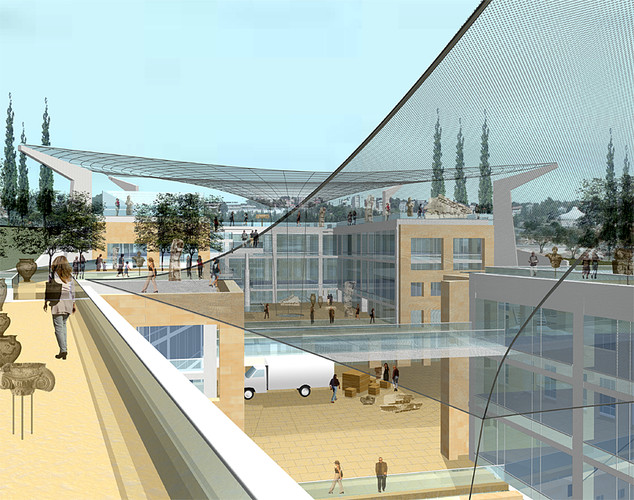
Now under construction, Israel’s new archaeology center is profiled in the Architectural Record.

We’ve mentioned this project before, but today’s story includes some new information, such as the design of the complex (like a layered tell) and its open access to the public.

In Jerusalem, the capital of a modern country enthralled by its past, a unique national archaeology campus is being built. The project—commissioned by the Israel Antiquities Authority (IAA) and officially named The Jay and Jeanie Schottenstein National Campus for the Archaeology of Israel—combines three major components: storage of the national archaeological treasures (some two million items); restoration labs for objects made of various materials, including the Dead Sea Scrolls, mosaics, and glass, textile, and clay finds; and a national archaeology library and archive.
[…]
The guiding principle in the design of the new complex, which Safdie proposed during the competition phase, was that the project be a metaphor for an archaeological excavation. The floors will be numbered from the top down, like the numbering of strata in an excavation. And some mosaic preservation work will take place in the courtyards, which will be shaded by a canopy much like the tent-like canopies used in actual digs. The most striking design feature is this giant, square, concave canopy, held in place by cables and made of a brown, woven fiberglass-and-polymer fabric that allows 40 percent light transmission while keeping rain out. “Because of the shape, [water] drains toward the center, forming a kind of fountain into a pool,” Safdie said.
[…]
The new campus “is not a museum,” although there will be displays of finds from recent excavations before they are shown permanently elsewhere. Most important, it will give people a chance to see the process of archaeology and have “a glimpse of the accumulation by allowing [them] into the vaults and to see 1,000 mosaics, 10,000 pots,” Safdie said. “It will have more meaning, that you can [come here] and then see … displays in the other museums.”

Read it all here.

Since most tourists to Israel don’t even make it to the Israel Museum (sadly!), it is unlikely that this specialized archaeological complex will be added to tourist itineraries. But repeat visitors and those fascinated by archaeology will surely want to make time for it. The center is scheduled to open in April 2016.

Digging for The Past and Future
The Jay and Jeanie Schottenstein National Campus for the Archaeology of Israel
Image courtesy Safdie Architects and the Israel Antiquities Authority
Share:

Wayne Stiles recommends 3 Sites To See Along the Mediterranean and 3 High Points to Visit in the Golan. As always, he has lots of photos.

Lois Tverberg has a new e-book out: 5 Hebrew Words That Every Christian Should Know. Only $3.99 and a free sample is available.

After Israel, the next country Bible students should visit is Turkey. Why? Ferrell Jenkins explains.

Tom Powers provides the history of “the bridge that never was.” His post includes illustrations of Robinson’s arch and inaccurate reconstructions.

The Bible and Interpretation features a well-illustrated summary of crucifixion in the ancient Mediterranean world based on a recent monograph by John Granger Cook.

This article explains why museums hate ancient coins.

The “endless archaeological park” also known as Greece is now on Google Street View after overcoming five years of government resistance.

Bible History Daily has a new post on Map Quests: Geography, Digital Humanities and the Ancient World.

Satellite imagery is helping officials monitor looting of sites in Egypt. The New York Times reports on other actions the Egyptian government is taking against antiquities theft.

Work continues in the effort to establish an archaeology park at Carchemish.

For more, see the ASOR Archaeology Weekly Roundup.

HT: Explorator, Joseph Lauer, Jack Sasson

Termessos Hadrian propylon and Artemis temple, tb062506813

Temple of Artemis in Termessos, Turkey
Photo from Western Turkey
Share:

Leon Mauldin has photos of a restored pagan temple at Laodicea.

Luke Chandler: Canaan was not a big desert. (Someone tell the media!)

Where is the ark of the covenant? This article surveys some of the most popular views in history.

And now Ferrell Jenkins has seen Jerusalem in IMAX. Read his review here.

Leen Ritmeyer has a brief note on his recent work at Khirbet el-Maqatir, concluding that the first-century village was actually a walled city.

The Associates for Biblical Research have just released a new booklet entitled Khirbet el-Maqatir: History of a Biblical Site.

BibleX reports that all of SBL’s Ancient Near Eastern Monographs are now available as free pdfs.

A museum for the History of Medicine in the Holy Land has opened in the Old City of Jerusalem.

Hershel Shanks ponders a remaining mystery about the Dead Sea Scrolls.

We’ll have more stories in part 3 of the roundup tomorrow.

Judean hills near Debir, Khirbet Rabud, tb030407777
The “desert of Canaan”
Photo from Judah and the Dead Sea
Share:

SourceFlix has just released a great new film short on “The Potter.” The 3-minute video features a craftsman in Hebron.

Recent excavations in Hebron are briefly described in the Jewish Press.

Might el-Araj be the real Bethsaida? A five-day “shovel survey” this week suggests that it might be.

An intact burial chamber was discovered in Aswan, Egypt, with nine mummies. Luxor Times has photos.

Israel’s Ministry of Tourism is looking to boost budget tourism by providing grants for the construction of hostels in Jerusalem and around the country.

The note that Pope Francis placed in a crack of the Western Wall had the text of the Lord’s Prayer written in Spanish.

“The Western Wall Heritage Foundation unveiled on Sunday a fully excavated grand hall from the 14th century in the Western Wall Tunnels that took 10 years to restore.” (JPost) An older video shows the hall under renovation. (HT: Joseph Lauer)

Jerusalem has been chosen as the “Islamic Tourism Capital” for 2016.

Is a mosque being constructed in the Golden Gate? The Israel Antiquities Authority says no.

Exploring Bible Lands is leading a tour of Israel and just finished a visit to Northern Galilee.

What language did Jesus speak? The dispute between the pope and the prime minister has scholars weighing in.

I’m on the Book and the Spade this week, talking with Gordon Govier about Magdala and a Jerusalem inscription (direct link here). I missed noting last week’s broadcast on the latest developments in the City of David. Details on The Book & The Spade 2015 Archaeological Adventure Study Tour are now available.

Golden Gate from west, tb091306226
The Golden Gate of the Temple Mount
Photo from Jerusalem
Share: