The Temple Mount Sifting Project is profiled at length by Ilan Ben Zion in The Times of Israel. If you’ve been following the work for the last decade, much of the report will sound familiar. But Ben Zion provides some detractors with the opportunity to showcase their ignorance.


Israel Finkelstein: “the debris could also have been brought from other locations” besides the Temple Mount.


Marwan Abu-Khalaf: whatever was in that soil may have come from the surrounding Kidron Valley.


Yonathan Mizrachi: the sifting project “doesn’t have any archaeological value.”

First, they tried to prevent archaeologists from studying the material illegally removed from the
Temple Mount. When that failed, they try to deny it has any significance. Unfortunately, news reports like this one allow them to say whatever they want, without any evidence whatsoever.

Ben Zion describes some of the discoveries made since the project began in 2004.

Most of the tens of thousands of items found in the pans by volunteers are small — an abundance of coins, innumerable fragments of clay, figurines, brightly colored mosaic tiles and beads, arrowheads, inscribed stones and bits of bone. In explaining the trove of tiny artifacts found, Barkay made regular reference to biblical and post-biblical characters in corresponding the items to time periods: clay figurines smashed during the time of the just kings of Judah, seal impressions with the names of priests mentioned in the book of Jeremiah and coins minted during the rein of King Antiochus IV Epiphanes, who fought the Maccabees. The relics catalog the history of Jerusalem from antiquity through the modern era.

The full story, with many photos, is published here.

HT: Joseph Lauer

UPDATE (6/12): The director of the sifting project has responded.

temple-mount-sifting-project-gold-mosaic-dome-of-rock
Gold mosaic pieces from the Dome of the Rock
Photo courtesy of The Temple Mount Sifting Project
Share:

From the Jerusalem Post:

The Antiquities Authority announced Tuesday that it unearthed a rare 800-year-old lead seal from the Monastery of St. Sabas in Jerusalem.
[…]
The seal shows a bearded bust of a saint wearing a himation, while holding a cross in his right hand and the Gospel in his left. Surrounding it is a Greek inscription naming him “Saint Sabas.”
On the back of the seal there is a longer Greek inscription, reading: “This is the seal of the Laura of the Holy Sabas.”

Photo by Clara Amit, courtesy Israel Antiquities Authority

During the summer of 2012, the Antiquities Authority conducted two archaeological salvage excavations at the Horbat Mizmil antiquities site in Bayit Vagan, which revealed the remains of a farmstead constructed during the Byzantine period (5th-6th centuries CE).
The archeologists said the excavated farmstead may refer to a farming settlement sold to the monastery in 1163–1164.
[…]
St. Sabas, or according to his Syriac name, “Mar Saba,” was one of the most important and influential leaders of the Christian monastic movement developing in the Judean Desert during the Byzantine period.
Sabas established several monasteries, but his crowning achievement was the construction of the Monastery of St. Sabas, referred to as the “Great Laura” in the Byzantine period.
The monastery, situated on a cliff overlooking Nahal Kidron, was home to several hundred monks.
“This is the only monastery in the Judean Desert continuously inhabited since its foundation, and even today there are circa 10 Greek monks who reside in the monastery belonging to the Greek Orthodox Church,” the Antiquities Authority said.

The full story is here. The IAA press release is here.

HT: Bill Soper

Mar Saba, Valley of the Kedron, pp1148a

Mar Saba monastery
Image from Picturesque Palestine, volume 1
Share:

Today is Jerusalem Day and in honor of that Accordance Bible Software has a sale on some outstanding Jerusalem resources.

The photo collections should be mentioned first:

  • Accordance Photo Guide – save $25
  • The American Colony Collection – save $50
  • Views That Have Vanished (Photos of David Bivin) – save $13

Five Jerusalem “atlases” published by Carta are also discounted (with my favorite at the top):

  • The Quest: Revealing the Temple Mount in Jerusalem, by Leen Ritmeyer
  • Jerusalem in the Year 30 A.D., by Leen and Kathleen Ritmeyer
  • Jerusalem in the Time of Nehemiah, by Leen and Kathleen Ritmeyer
  • The Illustrated Atlas of Jerusalem, by Dan Bahat
  • Carta’s Historical Atlas of Jerusalem, by Dan Bahat

The sale page gives two examples of the dramatic changes visible in recent history at the Western Wall prayer plaza.

Check out these great resources before the sale ends on June 2!

Share:

(Posted by Michael J. Caba)

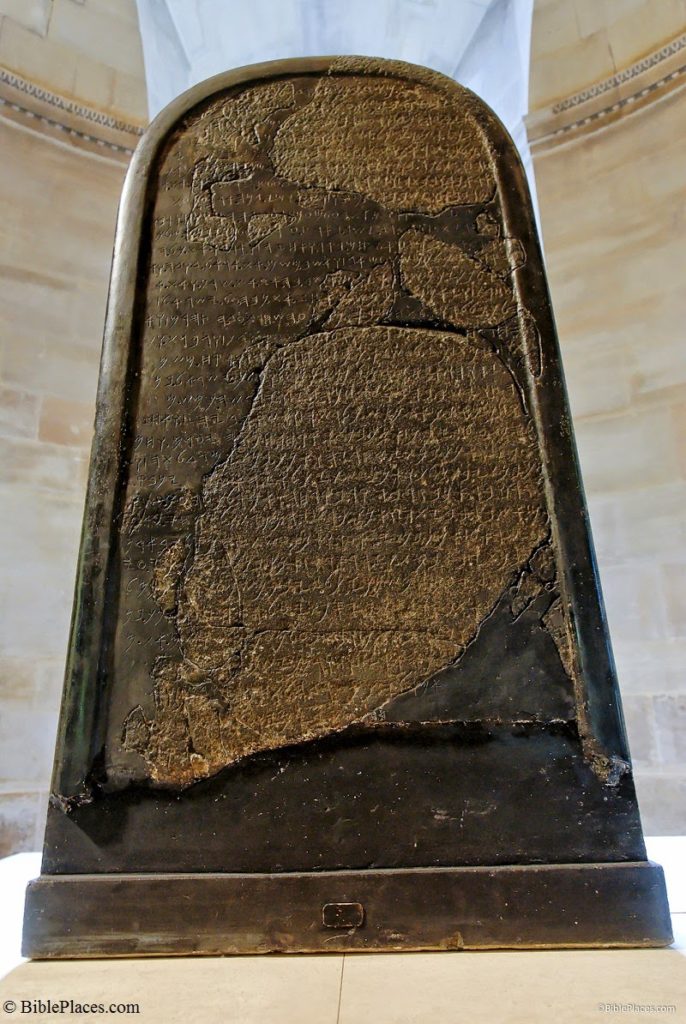
The Moabite Stone, also called the Mesha Stela, is an inscribed black basalt monument written in the Moabite language in c. 835 BC. It stands nearly four feet tall and was found in 1868 in the land of ancient Moab, now modern Jordan. It contains references to biblical figures such as Israelite King Omri and Moabite King Mesha (cf. 1 and 2 Kings), as well as the covenant name of God, YHWH (cf. Exodus 3). It is now located in the Louvre.

The story of the discovery and eventual movement of the stone to the Louvre is quite interesting in itself. Originally discovered by a missionary, it was subsequently broken apart by the local population who heated it with fire and then poured cold water on it. Following this, they used the various pieces as amulets in their granaries. Eventually, after much wrangling among European powers and local tribes, 57 pieces (representing about 2/3 of the original) coupled with replacement parts were used to reconstruct the original. The reassembly was undertaken with the help of a paper squeeze of the surface that was made before it was broken apart.

Future post(s) will comment on some controversial aspects of this important artifact.

(Photo: BiblePlaces.com. Significant resources for further study: The Context of Scripture, Volume 2, pages 137-138; Lost Treasures of the Bible, by Fant and Reddish, pages 97-103.)  

Share:

The first half of the season is finished at a site that may be Ai of the Bible. This year’s team is the largest ever, and most of the work is focused on remains from the first century. Gary Byers reports on some of the discoveries:

From one of these squares a second scarab at KeM was found. Last year’s scarab was considered to be the top find of Biblical archaeology in 2013 by Christianity Today Magazine (off-site link). This year’s scarab, from soil 15 feet from the first, has already been taken to an expert at Hebrew University for cleaning, restoration and analysis. Last season at KeM, we found a record total of 205 coins (See the report from 2013). This week, we found 112 coins – from every square but mine! Our numbers are impressive to archaeologists because they’re being found individually all over the site and not together in hordes. Squares led by Dr. Gene Merrill, dig Administrative Director Henry Smith, Abigail Leavitt and Dr. Brian Peterson all have cisterns (plastered and holding water) or silos (not plastered and holding storage jars). Many of our coins come from soil in these subterranean structures.

A full report with photos is here.

Share:

Aren Maeir reports on the highlights of the 2013 excavation season at Gath (Tell es-Safi).

A statue of a Phoenician priest dating to the 6th century BC has been discovered in Sidon.

The Pope has arrived in Jordan and heads to Israel soon.

Some religious Jews are afraid that if Catholic mass is permitted in the Upper Room that they will be unable to pray at the Tomb of David downstairs.

A new study suggests that some of Petra’s structures were intended to align with the solstices and equinoxes.

Archaeological work in Jerusalem indicates that it was the Roman construction of Aelia Capitolina that triggered the Bar Kochba Revolt (and not the other way around).

Have you ever wondered how Jonathan defeated the Philistines by climbing the cliff of Michmash?

Wayne Stiles explains it all with maps and photos.

Ferrell Jenkins and Leon Mauldin are traveling in eastern Turkey. They have recently visited Haran
and the Zeugma Mosaic Museum.

Muslims in eastern Syria have apparently destroyed a statue from the Neo-Assyrian period looted from Tell Ajaja.

The 2014 excavation season has begun at Tel Jezreel.

The PACE (Project on Ancient Cultural Engagement) online database has moved.

Judith McKenzie’s black and white photographs taken in 1982-1986 for The Architecture of Petra
(1990) are now all available online at the Petra Digital Archive. Other collections are also online, in high-resolution and free for use in educational and academic publications and research.

HT: Joseph Lauer, Jack Sasson

Share: