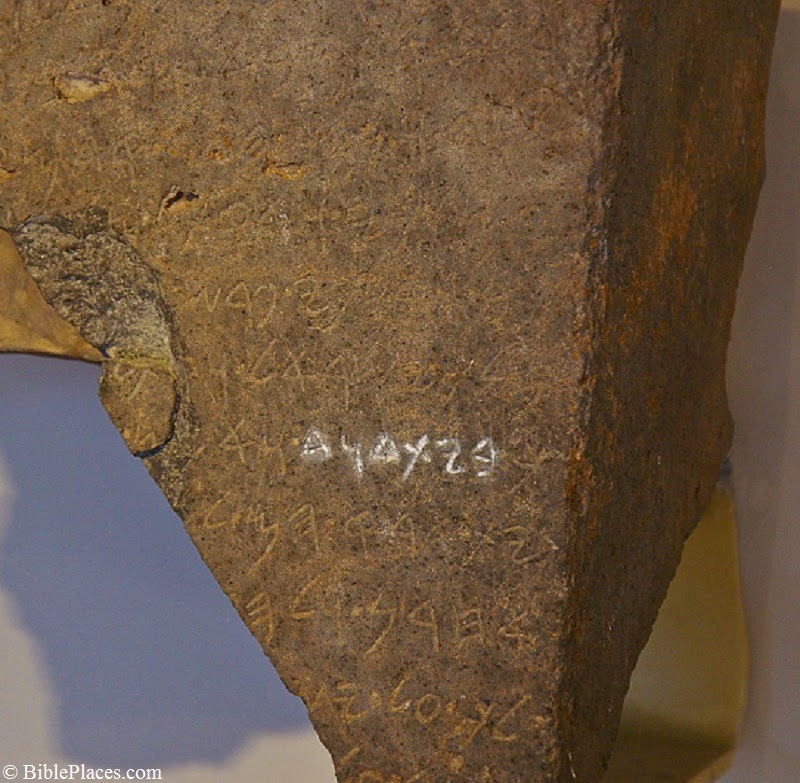
Excavations in Hebron have already revealed an Iron Age house, artifacts from the 10th century, and Second Temple period items.

Nadav Shragai writes in Israel HaYom on recent Temple Mount discoveries that have not been publicized.

Plans are underway for a new museum at Petra.

The Rapid City Journal recounts how a collection of cuneiform tablets came to be in the collection of Black Hills State University in South Dakota.

National Geographic presents “Indiana Jones and the Adventure of Archaeology,” a new exhibition coming to the Fort Worth Museum of Science and History.

Ferrell Jenkins has posted several entries recently in his Visualizing Isaiah series: a skirt of sackcloth, trusting in horses and chariots, and a booth in a vineyard.

Jerusalem’s Biblical Zoo has welcomed a new male lion to replace the one who died last year.

ASOR has a roundup of stories from around the world.

HT: Joseph Lauer, Charles Savelle, Jack Sasson

Share:

The American Jewish University in Bel Air, California, is hosting the Simmons Family Charitable Foundation’s Twenty-Fifth Annual Program in Biblical Archaeology on Sunday, February 16, 9:00 a.m. – 4:30 p.m. The registration fee is $55. The schedule includes the following lectures:

Carol Bakhos, The Idea of Jerusalem in the Hearts of Those Who Call Out “Lord” or “Allah” or “Adonai”

Shimon Gibson, Christian Jerusalem: From Constantine the Great in the 4th Century to Emperor Heraclius in the 7th Century

Shimon Gibson, Jerusalem under the Moslems: from Caliph Omar to Saladin

Gabriel Barkay, When the Second Temple Stood

Gabriel Barkay, The Footprints of Kings in Jerusalem

The website includes more details about each lecture and provides a link for online registration. Gibson and Barkay are both excellent lecturers, and Jerusalem is a fascinating subject.

HT: G. M. Grena

Dome of the Rock, mat06204
The Dome of the Rock and Al Aqsa Mosque, early 1900s 
Photo from the American Colony Collection
Share:

(Post by Seth M. Rodriquez)

Our “obscure site” for the week was the location of a famous haircut.  Acts 18:18 tells us, “After this, Paul stayed many days longer [in Corinth] and then took leave of the brothers and set sail for Syria, and with him Priscilla and Aquila. At Cenchreae he had cut his hair, for he was under a vow.” (ESV)

The city of Cenchrea (or Cenchreae) was a port city near the Corinthian isthmus in Greece.  Paul was on his second missionary journey and had just completed his 18-month stay in the city of Corinth

When he passed through Cenchrea, he was reaching the end of his journey.  After this, he made a short stop at Ephesus, and then continued on to Caesarea, Jerusalem, and finally Antioch where he started his journey.  Cenchrea is also mentioned in Romans 16:1 where Paul mentions a lady named Phoebe who served the church in that city.

In the photograph below you can see the harbor of Cenchrea. This city served as the eastern port of Corinth, which explains why Paul passed through here on his way back to Jerusalem and Antioch.

John McRay, in his book Archaeology and the New Testament, provides the following information about Cenchrea:

Virtually nothing has been found of the main city of Cenchreae, which lay northwest of the harbor, because during five seasons of excavation from 1963 to 1968 the government restricted work to the harbor except in 1966. … The picturesque harbor thus far excavated, dates to the Roman period. … The Roman harbor originally contained about 1600 feet of shoreline and was 98,000 square feet. In comparison with other Greek and Roman harbors, this one was rather small …. Two large breakwaters, were constructed around a natural bay. The modern shore is about 7.5 feet lower than during New Testament times, due to seismic activity. The harbor’s breakwaters or moles are completely submerged. Pottery and coins give evidence to a city whose commercial life, prosperity, and general status was inextricably tied to Corinth’s. Almost all the coins uncovered have been of Greek mintage or from the eastern Mediterranean, confirming that Cenchrea’s commercial significance was the link it provided between Corinth and the east.

It is unfortunate that further excavations of the site have not been allowed, but that probably explains why we have not yet found the hair that was cut from Paul’s head. 😉

This map and photograph, along with over 800 other images, are available in Volume 11 of the Pictorial Library of Bible Lands, which can be purchased here for $34 (with free shipping).  Another photograph of the harbor at Cenchrea can be seen here on the BiblePlaces website. Ferrell Jenkins has a picture of the harbor available on his blog here. For other posts in our series on “obscure sites in the PLBL,” see here.

The excerpt is taken from John McRay, Archaeology and the New Testament (Grand Rapids: Baker Book House, 1991), pp. 336-337.

Share:

Archaeologists in Israel revealed an impressive Byzantine church building with beautiful mosaic pavements at Moshav Aluma near Kiryat Gat. The site is in the eastern coastal plain, about 10 miles (16 km) east of Ashkelon and 30 miles (48 km) southwest of Jerusalem.

The director of the Israel Antiquities Authority excavations, Daniel Varga, describes the structure in a press release issued by the IAA:

An impressive basilica building was discovered at the site, 22 meters long and 12 meters wide. The building consists of a central hall with two side aisles divided by marble pillars. At the front of the building is a wide open courtyard (atrium) paved with a white mosaic floor, and with a cistern. Leading off the courtyard is a rectangular transverse hall (narthex) with a fine mosaic floor decorated with colored geometric designs; at its center, opposite the entrance to the main hall, is a twelve-row dedicatory inscription in Greek containing the names Mary and Jesus, and the name of the person who funded the mosaic’s construction.

The press release gives more detail of the mosaic floor:

The main hall (the nave) has a colored mosaic floor adorned with vine tendrils to form forty medallions. The medallions contain depictions of different animals, including: zebra, leopard, turtle, wild boar, various winged birds and botanical and geometric designs. Three medallions contain dedicatory inscriptions in Greek commemorating senior church dignitaries: Demetrios and Herakles. The two were heads of the local regional church. On both sides of the central nave are two narrow halls (side aisles), which also have colored mosaic floors depicting botanical and geometric designs, as well as Christian symbols.

The site will be open to the public on Thursday and Friday (Jan 23–24) before the mosaics are removed for future display in a local museum. The church building itself will be buried. More information is available in the press release. The photos posted below are available via this link. Brief news articles have been published by the Jerusalem Post, Washington Post, and Times of Israel.

1Excavation of the Byzantine basilica at Moshav Aluma
2An excavation volunteer cleans the mosaic floor
3 (1)
Mosaic floor of the Byzantine basilica
All photos by Yoli Shwartz, courtesy of the Israel Antiquities Authority
Share:

Logos Bible Software is offering a set of 8 volumes entitled “Classic Studies and Atlases on Biblical Geography.” What you need to know is that it includes the three volumes of Edward Robinson’s Biblical Researches in Palestine. The collection is now listed on the Community Pricing, which is always the most affordable way to purchase books from Logos. Once they receive enough orders, the price will jump up $100 or so. Now you can bid what you feel the set is worth.

For those who don’t know, Edward Robinson’s set is the seminal work on historical geography of the land of Israel. Robinson and his student Eli Smith traveled throughout Palestine in 1838 with a goal of locating ancient sites, primarily on the basis of name preservation. I have a couple of sets of this work, including one original edition from 1841. I once began creating an electronic edition, but other matters came in the way and it was set aside. Now you can purchase this at an attractive price. (And, yes, Google Books has long had this for free, but what you save in money you’ll pay for in the headache of trying to sort out the volumes from various editions that do not go together.)

I do wish that Logos would add to this collection the fourth volume, Later Biblical Researches in Palestine (1856). This was based on a later trip that Robinson and Smith made to answer some outstanding questions.

The other titles included:

Once upon a time, I created a list of the best resources by 19th-century explorers of Palestine.

You can put in your bid here. And here is another collection of similar works, but no longer at the attractive Community Pricing.

HT: Charles Savelle

Robinson's Arch with new excavations, db6806245201
Robinson’s Arch in Jerusalem, named for Edward Robinson
Photo by David Bivin
Share:

Noah Wiener has a follow-up article on the spring tunnel discovered in the Rephaim Valley. He includes a great photo of the tunnel.

Zachi Zweig disagrees with Leen Ritmeyer’s dating of the newly revealed course of ashlar stones on the Temple Mount. He dates it to the Early Islamic period.

A woman has turned over to the IAA a large collection of pottery discovered by a relative in the Mediterranean Sea.

The winter dig at Khirbet el-Maqatir began in the snow. They spent several weeks excavating three caves.

The ancient Myceneans once used portable grills at their picnics.

Archaeologists have discovered grain from the Neolithic period at Çatalhöyük.

The report for the 2013 excavation season at Tall el-Hammam is now online.

The first two volumes of NGSBA Archaeology are available for download. (NGSBA = Nelson Glueck School of Biblical Archaeology.)

Just published: The Oxford Handbook of the Archaeology of the Levant: c. 8000-332 BCE, edited by
Margreet L. Steiner and Ann E. Killebrew. Oxford University Press. 912 pages. $165.

Wayne Stiles explains how to make the maps in your Bible atlas fully searchable.

HT: Joseph Lauer, Tim Graham, Jack Sasson

Share: