(Post by Seth M. Rodriquez)

Someone who has been to the Western Wall today and has seen the big, beautiful plaza that spreads out before the wall may be surprised to learn that for much of the past few centuries, the Jews worshiped at the wall in a much smaller space.  What’s more, for about 20 years in the middle of the last century, they couldn’t worship there at all.

Our picture of the week comes from a collection called Photographs of Charles Lee Feinberg, which is available for purchase at LifeintheHolyLand.com.  Dr. Feinberg was a Bible professor who took several trips to the Middle East between 1959 to 1968.  His collection is a rare jewel of color photographs from a period when the region was less densely populated and developed.

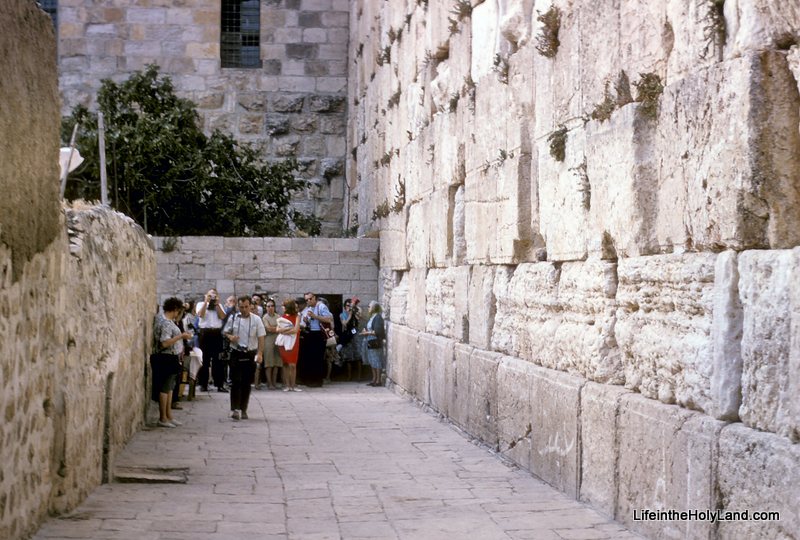
Pictures from the 1800s and photographs like the one below from the mid-1900s show that the old “Western Wall Plaza” wasn’t much of a plaza.  It was more like a hallway … or maybe just a closet. 

However, it was still revered by the Jewish people because it was the closest they could come to the place where the temple once stood, and the wall itself was part of the temple complex during the first century A.D.  (It was and still is part of a retaining wall that holds up part of the Temple Mount.)
During Israel’s War of Independence in 1948, the Jews lost control of the Old City of Jerusalem and with it lost access to their most revered place of worship: the Wailing Wall … or as they call it these days, the Western Wall. (When I was in college, one of my Jewish-born professors said that they didn’t call it the Wailing Wall anymore because they had done enough wailing.) So from 1948 until the Six Day War in 1967, the Jews were not allowed to worship at their most holy site.

All that changed in 1967 when Israeli soldiers defeated the Jordanian forces and captured the Old City. In his book, The Battle for Jerusalem, Lt. Gen. Mordechai Gur captures the emotions of that fateful day as he and his men visited the Western Wall for the first time in over 20 years:

We came to the narrow little gate, known as the Mograbi, and lowered our heads to duck through it to the top of the gloomy, crooked, steep, narrow stairs.  We heard the sounds of praying as we went down the steps.  The space in front of the wall was packed with people.  Soldiers were praying, some swaying devoutly as if in synagogue, although they were still wearing their stained battle dress.

To our right and above us was the wall: huge blocks, gray, bare, silent.  Only shrubs of hyssop in the cracks, like eyes, gave the stones life.  We saw that somebody had set up an Ark, brought from a military synagogue, and that in front of it stood Rabbi Goren praying in a hoarse voice.  he had been praying non-stop now for two hours. 

The site, the prayers, the great victory, the thoughts of the fallen seemed to release the paratroopers from their armor of iron and many of them wept unashamedly, like children. …

I drew near the crowd of soldiers praying, and when they noticed me they indicated I should go to the front.  I thanked them but stayed at the back. 

Despite the great congregation, I had to undergo my own private experience.  I did not listen to the prayers, but raised my eyes to the stones and looked at the paratroopers praying, some with helmets on their heads and some with skullcaps.  I scanned the buildings closing in on us from three directions, which gave the square a very intimate character.

I remembered our family visits at the wall.  Twenty-five years ago, as a child, I had walked through the narrow alleys and markets.  The impression made on me by the praying at the wall never left me.  My memories blended in with the pictures that I had seen at a later age of Jews, with long white beards, wearing frock coats and black hats.  They and the wall were one.

Shortly after this, the modern, spacious Western Wall plaza was created.

Excerpt from Mordechai Gur, The Battle for Jerusalem, trans. by Philip Gillon (New York: Popular Library, 1978), pp. 376, 378.

This picture and over 400 others are included in a collection called Photographs of Charles Lee Feinberg, and can be purchased here for $20 (with free shipping).  Additional images of the Western Wall throughout the last two centuries can be found here, here, and here.

Share:

Wayne Stiles wonders why the largest ancient site in Israel has been largely forgotten today.

Leen Ritmeyer provides context to the recent excavations of the “gate of hell” in Hierapolis.

On April 1, Luke Chandler revealed a stunning new translation of the Khirbet Qeiyafa Ostracon.

Few tourists are visiting Egypt these days and it’s hurting many who work in the industry.

Travel Weekly recommends how to spend a day visiting the harbor city of Jaffa (biblical Joppa).

A review of the new excavations of Azekah is available in a professionally-made 12-minute video.

HT: Charles Savelle, Jack Sasson

Azekah from northeast, tb030407700
Azekah from the northeast
Photo from the Pictorial Library of Bible Lands
Share:

The Israel Prize for the Land of Israel, Geography, and Archaeology “will not be given because the prize committee attempted to award it to two candidates, in violation of ministry rules which state that each prize may be given to only one winner.”

The Garden Tomb is now suggesting a $5 donation.

The Bible Lands Museum Jerusalem is recommended for children, according to this article in Haaretz.

A couple of Russian tourists climbed to the top of the Great Pyramid and took some photos.

Ted Weis (Living the Biblios) has written a Garden of Gethsemane Devotional and illustrated it with a number of helpful photos.

New excavations at Ur in southern Iraq have revealed a palace or temple.

David Amit, deputy director of the Excavations and Surveys Department of the Israel Antiquities
Authority, died last week.

The Vatican has asked Israel’s Chief of Police to protect Christians in Israel after criminals halted restoration work of the chapel in Nain.

Jerome Murphy-O’Connor’s new book, Keys to Jerusalem: Collected Essays, is reviewed by Joshua Schwartz in the Review of Biblical Literature.

The commercial heart of the ancient city of Thessalonica is in the way of a new subway station and
that’s a big problem.

Give SourceFlix two minutes and they’ll give you “Passion Week Archaeology.”

HT: Jack Sasson, Explorator

Garden Tomb at night, tb123005430
The Garden Tomb in Jerusalem
Photo from the Pictorial Library of Bible Lands
Share:

Joseph Aviram, 97, has lived through many exciting years of biblical archaeology in the land of Israel. Nir Hasson looks at the history through his eyes in an article in the Weekend magazine.

Yigael Yadin features prominently in the story, as do other well-known figures. Here is an excerpt about Moshe Dayan, Yohanan Aharoni, and Yadin:

Aviram also vividly recalls the more dubious legacy of another chief of staff who dabbled in archaeology. “Moshe Dayan helped us a great deal,” he says, “but very regrettably he engaged in robbery digs. He always wanted us to come to his house in Zahala to show us vessels. We knew about the stealing. Everyone knew. He was even caught a few times.”
Aviram declines to say more. Nor is he eager to talk about the “wars of the archaeologists,” which began in the 1970s. The most heated dispute of all continues to simmer today, at one level or another: It was between Yadin, as the representative of the biblical approach − those who find evidence for the Bible narrative in excavations − and the critical approach, which finds mainly contradictions between archaeological finds and the Scriptures.
“As long as there were no archaeologists, there were no arguments,” Aviram adds. “But suddenly there is a young generation. Well, arguments started. After the great success came the great arguments. Did Joshua capture Hatzor or not? Scientific disputes are fine, but it became personal and opposing camps sprang up. I always reassured Yadin. When he read something that [Tel Aviv University Institute of Archaeology head] Yohanan Aharoni wrote against him, it would drive him crazy, and he would fire off an angry letter. But his wife, who typed up the letters, told me she didn’t send them. There was a file of angry letters in the house that were never sent.”

The full story is worth reading. (Haaretz provides 10 articles per month with free registration.)

HT: Charles Savelle

Yigael Yadin lecturing at Megiddo, db6703260103
Yigael Yadin lecturing at Megiddo excavations, 1967
Photo from Views That Have Vanished
Share:

(Post by Seth M. Rodriquez)

Last week we provided a brief history of the American Colony and G. Eric Matson.  Before we move to the next collection in the Historic Views of the Holy Land series, there is one other story about the American Colony that I have to share.

Due to their reputation for organizing charitable work, their connections with the local authorities, and their location within the city of Jerusalem, the American Colony was able to play a role in some of the major historical events of their day.  Last week I mentioned that they were involved in the visit of Kaiser Wilhelm.  Another example is the following story about the day that the mayor of Jerusalem surrendered to the British in 1917:

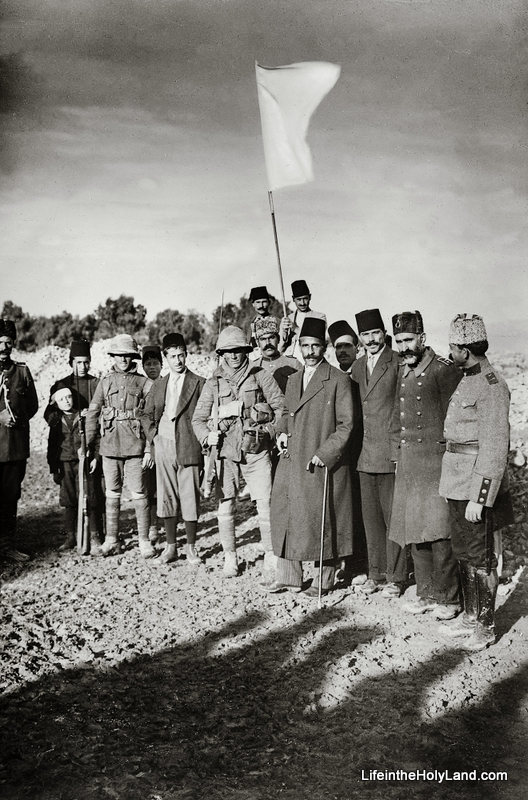
The final approach of the British forces to Jerusalem, in December 1917, and the subsequent surrender of the city, involved American Colony personnel in a number of curious and fascinating ways. For one, it gave rise to perhaps the most memorable of all American Colony photographs, that of the “first” surrender—by some counts there were as many as five!—of the city of Jerusalem in World War I. By the morning of December 9th Turkish army units had completely withdrawn from Jerusalem and the Turkish governor, Izzat Pasha, fleeing shortly before dawn (in a horse-drawn carriage borrowed from the Colony!), left in the hands of the mayor a letter of formal surrender, including an order that not a shot was to be fired in the city‘s defense. Thus, that Sunday morning the city‘s Arab mayor, Hassain Effendi al-Husseini, armed with the Pasha‘s letter of capitulation, set out to turn the city over to the British. On his way he first stopped to inform his close neighbors at the American Colony, where he had once been a student and was still a frequent visitor. Stopping first at the Big House he encountered Lewis and Edith Larsson, then proceeded to the nearby Vester house where his good friend Anna Spafford was then in residence. In the meantime, Larsson grabbed his camera, his three-year-old son, and a young assistant and hurried to join the mayor‘s growing group in Jaffa Road. In the process, someone from the American Colony—accounts differ as to who—fashioned the requisite white flag of surrender: a bed-sheet from one of the Colony-run hospitals nailed to a broomstick.

Near the village of Lifta on the western fringes of Jerusalem, the party encountered the British forward units, and the mayor tried to “surrender” to two sergeants on sentry duty. While they were waiting for higher-ranking officers to arrive, Larsson immortalized the moment with his camera, a scene showing the mayor, his entourage of municipal officers and Turkish policemen, Sergeants Hurcomb and Sedgewick of the Londoners, and the white bed-sheet flag—the famous image of the “first” surrender of Jerusalem. In the ensuing few hours, al-Husseini also “surrendered” to two artillery officers; to their commander, a Lieutenant Colonel Bailey; and then to Brigadier General C. F. Watson. Some of the local leaders asked Watson, as the ranking officer on the scene, to show himself to the populace in order to help quell some looting that had already broken out. Thus it was that Watson appeared with the mayor at Jaffa Gate and there (according to at least one version) accepted the mayor’s surrender document …. On this occasion, Larsson managed to take more photos, including an “official” shot of Watson opening the letter of surrender, with Mayor Husseini and others standing beside him. This all occurred by about 10 a.m….  

Larsson also managed to save the makeshift truce flag, which eventually found its way to the Imperial War Museum in London.

Quotation from Tom Powers, “Jerusalem’s American Colony and Its Photographic Legacy,” (essay included in The American Colony and Eric Matson Collection, 2009), pp. 35-36, 38. This photo and over 400 others are included in Volume 7 of The American Colony and Eric Matson Collection, and can be purchased here with free shipping.  For more information on the surrender of Jerusalem, see my previous post here.

Share:

Today is Passover and SourceFlix has released a new video short entitled “The Locusts.”

Recently, I sat down in the early morning to enjoy a cup of coffee and my newspaper. The headline of the Jerusalem Post read “Swarm of Locusts Crosses Sinai Border into Israel”. I leaped out of my chair, grabbed my camera gear, jumped in my car and raced towards the Egyptian border. Within three hours locusts were bouncing off my windshield! The estimated swarm of 120 million had been devastating Egypt for several days, but Israel was ready for them with pesticide-loaded planes and helicopters. So, while I didn’t get to see them in their full force, it was yet another experience in Israel that brought the pages of the Bible to life! I will never forget seeing these locusts carried in on the wind, eating everything in their path.

Click here to watch the 2-minute video.

Share: