(Post by Seth M. Rodriquez)

If you have been to Israel today then chances are that you flew there and your first glimpse of the country was from the air.  But what was it like to visit the Holy Land before the luxuries of modern travel?

Our picture of the week comes from a book written in the 1880s by a scholar and traveler named J. L. Porter.  The book is called Jerusalem, Bethany and Bethlehem and chronicles Porter’s travels and reflections in the Holy Land. It has been reproduced electronically and is available through LifeInTheHolyLand.com.
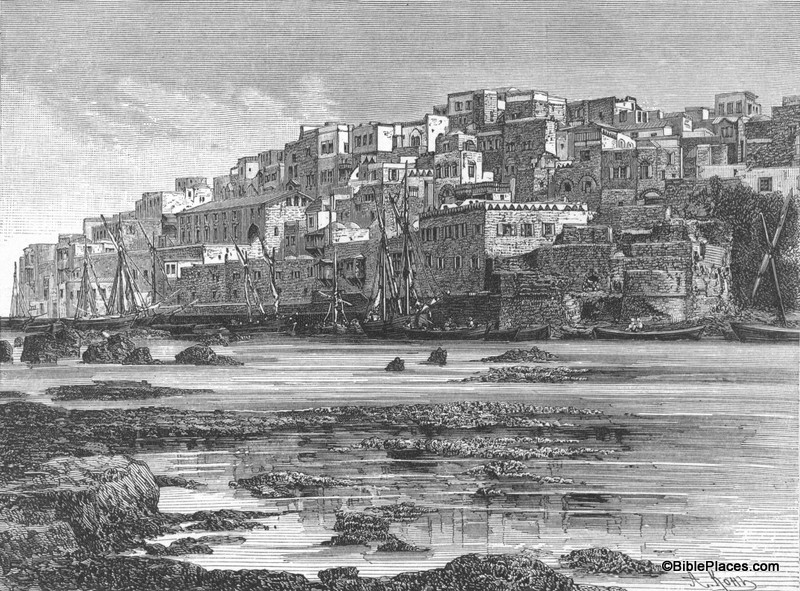
Joppa from the Southwest

In the introduction, Porter describes the port city of Joppa.  Today Joppa is engulfed by the modern city of Tel Aviv, but in Porter’s day it stood alone and was one of the most common places for travelers to enter the Promised Land.  In the picture you can see the shallow waters of the Mediterranean and the city rising above the boats in the harbor.  The following excerpt gives you a taste of Porter’s writing style as he describes his experience in this city:

     Joppa is one of the oldest cities in the world. Pliny says it was founded before the Flood; and Josephus attributes its origin to the Phoenicians in the earliest stage of their commercial enterprise. Strabo has another story, making it the scene of Andromeda’s exposure to the sea-monster.
     But Joppa has a far higher claim upon our attention than could be given by heathen fables, or by even the most extravagant ascription of mythical antiquity and commercial greatness. It was the port of Jerusalem three thousand years ago, when the mariners of Hiram brought down timber from Lebanon for the building of the Temple. It is the port of Jerusalem to this day [in 1886]. Most Western travellers there first touch the sacred soil of Palestine, and thence go forward on their pilgrimage journey to the Holy City. …
     When one reaches the shore, through barriers of rocks,—rather a difficult and even dangerous task if the wind happens to blow from the west,—he is charmed at once with the quaintness of the streets and houses, the picturesque beauty of the fountains, gates, and Crusaders’ walls, and the crowd of people dressed in the costumes of nearly every country of Europe and Asia. … The views obtained from the terraced roofs of the higher houses of the town, and from some of the old towers along the walls, are singularly rich. The eye roams over a vast sea of verdure, many-tinted and varied in outline, with the palm, the pomegranate, the spreading terebinth, the golden orange and lemon, and the stately cypress. Beyond the orchards appear wide reaches of the green meadows and corn-fields of the Plain of Sharon; while on the eastern horizon, miles away, is the long range of the Judean hills, delicately coloured with light-gray summits, russet sides, and deep purple glens. It is a grand panorama, and, as it seemed to me, it is a fitting introduction to the traditional and historic glories of the Promised Land. 

Quote taken from J. L. Porter, Jerusalem, Bethany and Bethlehem (London: Thomas Nelson and Sons, 1887), pp. i-ii, which can be purchased here.  The entire work contains over 90 images and almost 200 pages of text.  Additional images of Joppa can be seen here (1800s) and here (modern day).

Share:

The rain in Israel has turned to snow. Jerusalem is all but closed. A meter of snow fell on Mount Hermon overnight. The Sea of Galilee is up 6 inches. Haaretz is calling this the biggest storm in a decade with Israel’s main highway closed for 9 hours. Wind gusts in Haifa reached up to 75 miles per hour.

BBC reports that Gaza’s archaeological treasures are at risk from war and neglect.

Ferrell Jenkins explains the significance of Gaza.

Artifax and The Book & The Spade Radio program have posted their Top Ten 2012 Discoveries.

They are similar to our (unnumbered) list. Leen Ritmeyer picks his top two.

The conclusion from the 2012 excavations south of the Temple Mount (aka “Ophel”) is posted in an 11-minute video, concluding with a tour by archaeologist Eilat Mazar.

Thirty Days in the Land with Jesus: A Holy Land Devotional, by Charles H. Dyer, is for sale on Kindle for $1.99 this week. The 248-page book was released in 2012.

HT: Charles Savelle

Ophel Walls Iron Age tower, tb010112136

Iron Age tower in Ophel Excavations
Photo from Pictorial Library of Bible Lands
Share:

From the Daily Herald (Provo, UT):

Calvary Chapel of Salt Lake will be hosting a weeklong presentation by Biblical archaeologist Bryant G. Wood next [this] week. Wood will present a “college level” overview of Biblical archaeology at three different workshops; Wood’s “Biblical Archaeology Seminar” is free and open to the public.

The first session will be from 7 to 9 p.m. Wednesday, followed by a session from 7 to 9 p.m. Friday.

The concluding session will be held Jan. 12 from 8 a.m. to noon, and will be preceded by a complimentary breakfast.

Wood, a specialist in Canaanite pottery, has pursued Biblical archaeology since 1973. He received international media attention in the 1990s for his study of the ancient city of Jericho. Wood disputed earlier findings that suggested the city was not inhabited at the time of the Old Testament account of its destruction and capture by the ancient Israelites.

See the article for contact information. Bryant Wood is director of Associates for Biblical Research and excavator of Khirbet el-Maqatir, a possible location of biblical Ai.

Jericho fallen mudbrick with Bryant Wood, tbs94229709
Bryant Wood examining ancient walls of Jericho
Share:

Arutz-7 is reporting today on the excavation of biblical Shiloh.

A new archeological find at ancient Shilo fits in with the Biblical narrative regarding the war at Even Ha’ezer [Ebenezer], and could confirm scholars’ conjectures as to how Shilo was destroyed.
The First Book of Samuel does not say when and how Shilo, which served as the Israelite capital for 369 years, was destroyed. The latest archeological find at the Shilo site – a broken vase and remains of ashes from a fire – indicate large scale destruction. The remains are from the same period in which the War of Even Ha’ezer [Ebenezer] against the Philistines was waged.
Israel suffered a crushing defeat in that war, which is believed to have been waged near present-day Afek. The two sons of Eli the High Priest were killed, and Eli himself died upon hearing the news. Worst of all, the Holy Ark, which the Israelites had brought to the battleground, was taken by the Philistines.
Archeologists and scholars now have more evidence to back the assumption that after defeating the Israelites at Even Ha’ezer [Ebenezer], the Philistines advanced upon Shilo and sacked it.
Other Biblical passages, in Psalms and Jeremiah, confirm that Shilo was destroyed by Phlistines [sic].

Shiloh aerial from east, bb00120068-labeled
Shiloh from east. Screenshot from the new Pictorial Library of Bible Lands. Photo by Barry Beitzel.

A few comments:

1. The minimalistic reporting makes it impossible to evaluate the claim. The discovery of a broken vase and remains of ashes could indicate nothing more than the presence of a family hearth. Perhaps the archaeologists did find a destruction layer, but you have to believe that the journalist has evidence he was unwilling to share.

2. A destruction layer from the time of Samuel was already identified in Israel Finkelstein’s excavations in the 1980s. “This complex of buildings [in Area C] was destroyed by a violent conflagration whose traces were visible everywhere: charred floors and heaps of fallen bricks, sometimes more than one meter deep….As suggested by Albright following the Danish expedition’s excavations, this may be attributable to the Philistine destruction of the site (mid-eleventh century BCE)” (NEAEH 4: 1368).

3. The theory that the Philistines destroyed Shiloh in the aftermath of their capture of the ark at Aphek seems to be supported by the absence of Shiloh in the biblical narrative in the years of Samuel, Saul, and David. Its destruction by Philistines is suggested by its mention in two passages.

Psalm 78:60 — “He abandoned the tabernacle of Shiloh, the tent he had set up among men.”
Jeremiah 7:12–14 — “‘Go now to the place in Shiloh where I first made a dwelling for my Name, and see what I did to it because of the wickedness of my people Israel. While you were doing all these things, declares the Lord, I spoke to you again and again, but you did not listen; I called you, but you did not answer. Therefore, what I did to Shiloh I will now do to the house that bears my Name, the temple you trust in, the place I gave to you and your fathers.”

The Arutz-7 story, with a photo of a jar, is here.

Share:

One archaeologist is calling the 900-seat arts center built by Hadrian the most important Roman discovery since the discovery of the Forum in the 1920s. There is a photo of the dig site here.

The Temple Mount Sifting Project blog has a series of posts on the recent debris removal from the
Temple Mount. Nadav Shragai provides a summary in Israel Hayom. Leen Ritmeyer provides a brief commentary.

A baptistery has been discovered in the Byzantine monastery of Khirbet el-Maqatir.

Ferrell Jenkins has wrapped up his series of photo illustrations for the book of Acts.

The BBC has a month-by-month review of archaeological stories in 2012.

Our Archaeological Surveys Bibliography has been significantly expanded.

HT: Jack Sasson, Joseph Lauer, Ted Weis

Share: