“Scattered throughout Israel are dozens of archeological exhibits, indoor and outdoor, that anyone can visit at no charge.” Aviva and Shmuel Bar-Am recommend three of those sites to visit.
Iraqi authorities captured two smugglers in possession of rare statues and coins.

The Dallas Museum of Art is sending one of its 2nd century mosaics to Turkey after determining that it was probably stolen years ago from the area of Edessa.

The Jewish philanthropist who funded the excavation of the bust of Nefertiti was expunged from the records by the Nazis but is now being honored for his contributions.

Shmuel Browns has opened a new online store for products with his photographs and artwork.

El Al is offering reduced rates on winter flights to Israel.

Charles Savelle on the new Pictorial Library of Bible Lands: If you teach the Bible, plan to go to the
Bible lands, or have been there before, I would suggest you check this resource out.

HT: Jack Sasson, Joseph Lauer

Amarna, limestone, gypsum and rock crystal bust of Nefertiti, 18th dynasty, adr070511363
Bust of Nefertiti.
Photo by A.D. Riddle.
Share:

Accordance Bible Software has just announced an End of Year Sale which includes $40 off the American Colony Collection. This is one of the “staff favorites,” and Martha Holladay writes,

My favorite module is the BP American Colony.  The ability to view photos which illustrate the way the land looked in Biblical times helps bring Bible study alive.  Also, the historical views of Israel before modern technology and the founding of the nation are fascinating.  This module is an excellent resource for teaching illustrations as well.

I agree! The Accordance edition of this collection has a number of improvements over the original edition, and this is a great deal for a limited time.

88866-m

Recreation of feast in fields of Bethlehem, such as described in the book of Ruth
Share:

From the Christian News Network:

Archaeologists have uncovered what they believe is a road that was traveled by Jesus and the disciples in the ancient town of Bethsaida.
In conducting a dig near the Northeastern shore of the Sea of Galilee in Israel, which was originally meant to serve as a mission to find artifacts from the Roman period, archaeologists came across a distinctive discovery.
“We uncovered a paved street from the time of Jesus’s disciples, which runs westward through the residential area from the corner of the Fisherman’s House down toward the Jordan valley,” Nicolae Roddy of Creighton University in Omaha, Nebraska, one of the leaders of the dig, told the publication Popular Archaeology. “I tell people that Andrew, Peter and Phillip almost certainly walked on it because they would have had to have gone out of their way to avoid it!”

The article does not include a photo, and I don’t see any other reports on this besides this brief one.

HT: Joseph Lauer

Bethsaida house of fisherman, tb060105684

Newly discovered road ran from the “house of the fisherman” shown above toward the Jordan River. Photo from the Pictorial Library of Bible Lands.
Share:

Archaeologists working at Acco have discovered harbor remains and four shipwrecks from the early 19th century.

Deane Galbraith summarizes a new article in which Yigal Levin rejects the identification of Khirbet Qeiyafa as Shaaraim and proposes instead that it is the Israelite encampment.

Bible History Daily has a short story on a new exhibit about Famous Americans Who Made Holy Land Tours. Featured tourists include Mark Twain, Herman Melville, and Theodore Roosevelt.

The Muriel and Jeremy Josse Collection of Holy Land Maps includes more than 250 maps of late 19th- and early 20th-century Palestine and the African continent.

Harvard University is returning to archaeology in Iraq after nearly a century, but they’re doing so without touching the ground.

National Geographic has word (and photos) of the Oldest Pharaoh Rock Art Rediscovered in Egypt.

Bible History Daily posts more than a dozen high-res images of “King David’s Tomb.” You need a subscription to read Jeffrey Zorn’s related article, but the images are available to all. And if you ever teach about the subject, you should grab the nicely colored drawings from Weill’s excavations while they’re available (below the photos).

The city of Jerusalem has approved plans for rebuilding the second of two domed synagogues in the Old City. Both were destroyed in the 48 war, and the Hurvah Synagogue was rebuilt several years ago. A donation of $12 million is launching the rebuilding of the Tiferet Israel Synagogue.

For a look at what’s going on in the broader world of biblical studies in the past month, head over to the Carnival.

HT: David Coppedge

Tiferet Israel Synagogue, tb010312424
Tiferet Israel Synagogue in Jerusalem
Photo from the Pictorial Library of Bible Lands
Share:

From Art Daily:

The British Museum today announces that one of its most iconic objects, the Cyrus Cylinder, will tour to five major museum venues in the United States in 2013. This will be the first time this object has been seen in the US and the tour is supported by the Iran Heritage Foundation.

You have to skip to the end of the article to see where and when the object will be on display:

  • Smithsonian’s Arthur M. Sackler Gallery and Freer Gallery of Art, Washington D.C., 9th March – 28th April 2013
  • Museum of Fine Arts, Houston, 3rd May – 14th June 2013
  • The Metropolitan Museum of Art, New York, 20th June – 4th August 2013
  • Asian Art Museum, San Francisco, 9th August – 22nd September 2013
  • J. Paul Getty Museum at the Getty Villa, Los Angeles, 2nd October – 2nd December 2013

What is the Cyrus Cylinder?

The Cylinder was inscribed in Babylonian cuneiform (cuneiform is the earliest form of writing) on the orders of the Persian King Cyrus the Great (559-530BC) after he captured Babylon in 539BC. It is often referred to as the first bill of human rights as it appears to encourage freedom of worship throughout the Persian Empire and to allow deported people to return to their homelands. It was found in Babylon in modern Iraq in 1879 during a British Museum excavation and has been on display ever since.

Neil MacGregor, Director of the British Museum, gave an interesting 20-minute talk on the Cyrus Cylinder at TED last year. The museum has posted a full translation of the inscription.

One caveat: visiting this exhibit does not excuse you from visiting the British Museum! (And before you go, you should purchase this excellent guide.)

HT: Jack Sasson

Cyrus Cylinder, tb112004173
The Cyrus Cylinder in the British Museum
Share:
(Post by Seth M. Rodriquez)
Question: How much dirt does an archaeologist have to move? 
Answer: None. The volunteers do all the hard work.  😉
Actually, the answer to this question depends on the site.  Sometimes an archaeologist only has to scratch the surface and the Early Bronze Age or some other ancient period is revealed.  At other times, there is a massive amount of earth that has to be moved before the archaeologist gets down to the period he or she wants to study.  Here is a good example.
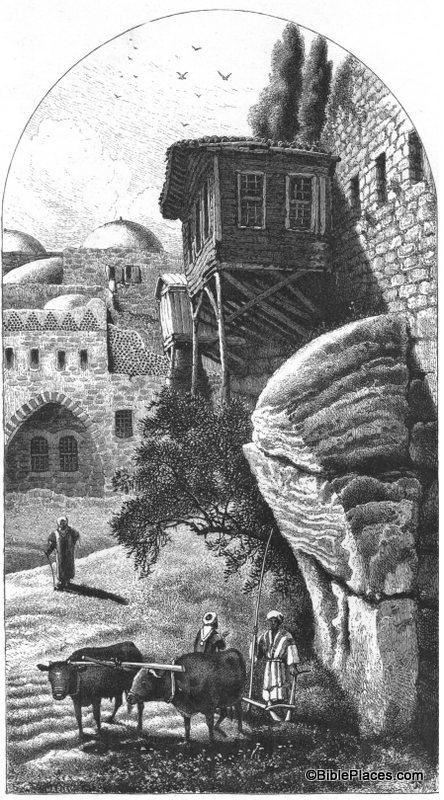
Our picture of the week, “Robinson’s Arch,” comes from a resource available through LifeInTheHolyLand.com, the sister site of BiblePlaces.com.  The resource is called Picturesque Palestine, Volume I: Jerusalem, Judah, and Ephraim.  It is part of the “Historic Views of the Holy Land” collection.  This was originally a book that was published in 1881 and edited by none other than Charles Wilson, one of the most prominent explorers of the Holy Land in the nineteenth century.  The book is a fascinating read as it discusses the landscape, holy sites, archaeological sites, and local culture as they appeared at that time.


Robinson’s “Arch” is really just the lowest section of what was originally an arch.  It is called Robinson’s Arch because it was discovered by Edward Robinson in the 1830s.  You can see the remains of the arch on the right half of this drawing, towering above the two men and the oxen.  The arch originally spanned across the Tyropean Valley in Jerusalem and formed the upper section of a long stairway that provided access to the Temple Mount during the time of Christ.  (A reconstruction of this stairway can be seen here.)  The Tyropean Valley was filled in over the years, beginning with the destruction of the Temple by the Romans in A.D. 70.  Over the centuries the area was built up and torn down over and over again, accumulating debris until it looked like this in the nineteenth century.

Returning to our question (“How much dirt does an archaeologist have to move?”), archaeologists in the 1960s–1990s had to move several meters of debris during their excavation of this area.  The picture above is what the area looked like in the 1870s.  Compare that with what it looks like today:

This picture (taken from the Jerusalem volume of the PLBL) is looking at Robinson’s Arch from the opposite direction as the drawing in Picturesque Palestine.  The arch is at the top of the photograph and circled in red in this photo.  You can see that it now towers over the remains of the 1st-century street below.  If you look carefully, there is a person standing on the street looking up at the arch.  That gives you an idea of the massive amount of dirt and stone that had to be moved by the excavation teams in recent decades.

This is just one example of the value of a work such as Picturesque Palestine.  It allows us to roll back the clock and see how the land appeared to the nineteenth century explorers before the excavations of the last 100 years.

This and other pictures of nineteenth-century Jerusalem are available in Picturesque Palestine, Volume I: Jerusalem, Judah, and Ephraim and can be purchased here.  Additional historic images of the Temple Mount can be seen here and here on the LifeInTheHolyLand.com website.  Several websites related to this topic can be found on the BiblePlaces website here.

Share: